
Hanwha C8012 vs Hanwha XNV-8020R: Specification Comparison
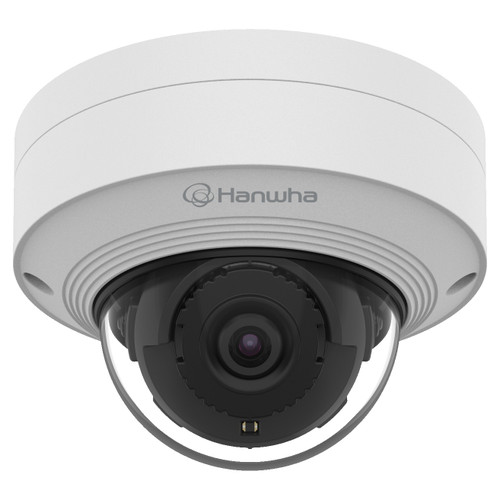
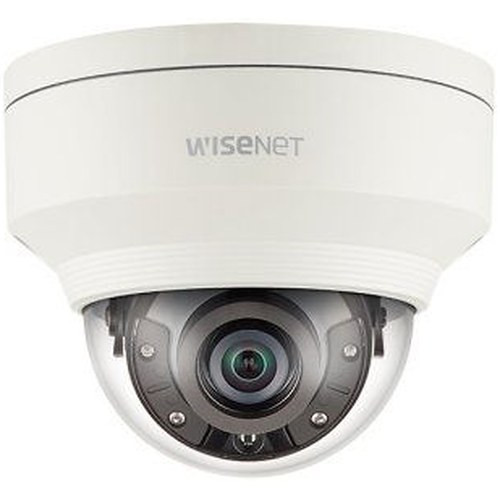
Both the Hanwha QNV-C8012 and the XNV-8020R are 5MP fixed-lens outdoor dome cameras powered by PoE, occupying the same general resolution class and form factor. Installers and IT buyers evaluating either model are typically weighing AI-driven analytics depth against conventional analytics breadth, newer-generation security hardening against established connectivity flexibility, and sensor size differences that directly affect low-light performance. This comparison draws exclusively from the provided specifications for each model.
In This Guide
How do the imaging specs compare?
The QNV-C8012 uses a 1/2.8" CMOS sensor at 2592×1944 resolution with a 2.4mm fixed lens at F2.0, delivering a 123° horizontal field of view and minimum illumination of 0.05 Lux color / 0.005 Lux B/W. The XNV-8020R uses a larger 1/1.8" CMOS sensor at 2560×1920 with a 3.7mm fixed lens at F1.6, yielding a narrower 97.5° horizontal field of view and minimum illumination of 0.16 Lux color / 0 Lux in IR mode. The XNV-8020R's larger sensor and wider aperture (F1.6 vs F2.0) generally support better passive light gathering, but the C8012 achieves a lower B/W floor (0.005 Lux vs 0.016 Lux per the IR_Lowlight field on the XNV-8020R) with its IR support.
Both cameras deliver 120dB WDR and 30fps at full resolution. The XNV-8020R specifies a 30m IR viewable length, while the C8012's IR distance field lists 0.5m—consistent with a minimum object distance rather than an IR throw specification; the C8012 datasheet does not provide an explicit IR range in meters in the supplied specs. The XNV-8020R additionally includes built-in digital image stabilization via a gyro sensor and a built-in optical defog filter, neither of which is listed for the C8012. The C8012 employs WiseNR II (AI-based noise reduction) vs the XNV-8020R's SSNRV, and the C8012 adds SSDR to its BLC/WDR backlight compensation stack versus BLC/HLC/WDR on the XNV-8020R.
What about installation and environment?
Both cameras carry IP66 and IK10 ratings and share a 3-year warranty. The QNV-C8012 adds NEMA 4X certification and a lower minimum operating temperature of -40°C vs -30°C for the XNV-8020R, making it more suitable for extreme cold environments. The C8012 is PoE-only (IEEE 802.3af, Class 3, max 7W / typical 4.9W), while the XNV-8020R accepts both PoE (IEEE 802.3af, Class 3, max 9W) and 12VDC (max 8W), offering an alternative power path where PoE infrastructure is unavailable.
Physically, the C8012 is smaller (Ø110×77mm, 522g / 1.15 lb) than the XNV-8020R (Ø120×97.5mm, 615g / 1.36 lb). The C8012 lists pan/tilt/rotate ranges of 0°–350° / -35°–70° / 0°–355°, while the XNV-8020R offers 0°–354° / 0°–67° / 0°–355°; the C8012's tilt range extends into negative values (-35°) which can assist with downward-angle ceiling mounting. The XNV-8020R also specifies IP67 rating (full immersion) in addition to IP66, which the C8012 does not list. The C8012 supports conduit accessories (SBD-110GP1) and a hanging mount (SBP-120HMW); specific accessory compatibility for the XNV-8020R is not provided in the supplied specs.
Which fits your VMS and analytics better?
The QNV-C8012 supports ONVIF Profile S/G/T/M versus the XNV-8020R's Profile S/G (and T per the Application field), giving the C8012 broader ONVIF metadata and media profile coverage. The C8012's analytics suite is AI-engine-based and includes classified object detection (person/vehicle with vehicle sub-type: car/bus/truck/motorcycle/bicycle), virtual line crossing with direction, virtual area events, people/vehicle counting, queue management, and heatmap—all driven by an on-device AI engine with WiseStream III and WiseNR II. The XNV-8020R analytics include loitering, directional detection, fog detection, digital auto-tracking, sound classification, heatmap, people counting, queue management, and tampering, but these are not described as AI-engine-based in the provided specs. The XNV-8020R also supports Wisenet open platform.
The XNV-8020R includes built-in audio in and out (selectable mic/line in with 2.5VDC supply; line out at 1Vrms) and audio compression (G.711 / G.726), plus one alarm input and one alarm output. The C8012 specifies no audio input/output and no dry-contact alarm I/O in the provided specs. For on-board storage, the C8012 offers a single Micro SD slot up to 256GB; the XNV-8020R provides two Micro SD slots for up to 512GB total. The C8012 carries advanced cybersecurity features including secure boot, signed firmware, firmware encryption, 802.1X with EAP-TLS/LEAP/PEAP-MSCHAPv2, SRTP, SD card partition encryption, device certificate, and a private root CA. The XNV-8020R lists HTTPS, digest authentication, IP filtering, user access log, and 802.1X (EAP-TLS, EAP-LEAP), but does not list secure boot, signed firmware, or SD encryption in the provided specs.
Which should you choose: the C8012 or the XNV-8020R?
Our take: The QNV-C8012 is the stronger choice when AI-based object classification, advanced cybersecurity hardening, and extreme cold tolerance (-40°C) are primary requirements. Key spec deltas: the C8012 provides AI-classified vehicle sub-type detection and WiseStream III that the XNV-8020R does not list; the C8012 operates to -40°C versus -30°C for the XNV-8020R; and the C8012's security stack adds secure boot, signed firmware, SD card encryption, and a device certificate absent from the XNV-8020R's listed specs. Conversely, the XNV-8020R is the stronger choice when audio I/O, dry-contact alarm integration, dual SD card redundancy (512GB), 12VDC power fallback, built-in image stabilization, defog, and IP67 immersion rating are needed. Buyers on Hanwha's Wisenet VMS with open-platform requirements may favor the XNV-8020R; those running ONVIF Profile M metadata pipelines or requiring NEMA 4X certification should select the C8012.
Side-by-Side Comparison
Spec-for-spec, from manufacturer data.
| Specification | Hanwha C8012 | Hanwha XNV-8020R |
|---|---|---|
| Resolution | 2592×1944 (5MP) | 2560×1920 (5MP) |
| Image Sensor | 1/2.8" CMOS | 1/1.8" CMOS |
| Lens / Focal Length | 2.4mm fixed, F2.0 | 3.7mm fixed, F1.6 |
| Horizontal FOV | 123° | 97.5° |
| Min. Illumination (Color / B/W) | 0.05 Lux / 0.005 Lux | 0.16 Lux / 0.016 Lux (IR mode) |
| IR Range | Not specified in provided specs | 30m (98.43ft) |
| Wide Dynamic Range | 120dB | 120dB |
| Max Frame Rate | 30fps @ 5MP | 30fps |
| Video Compression | H.265 / H.264 (Main/High) / MJPEG | H.265 / H.264 (Main/Baseline/High) / MJPEG |
| IP Rating | IP66, NEMA 4X | IP66 / IP67 |
| IK / Impact Rating | IK10 | IK10 |
| Operating Temperature | -40°C ~ +55°C | -30°C ~ +55°C |
| Power Input / PoE Class | PoE 802.3af Class 3 (max 7W); no 12VDC | PoE 802.3af Class 3 (max 9W); 12VDC |
| Edge Storage | 1× Micro SD up to 256GB | 2× Micro SD up to 512GB |
| Audio I/O | — | Audio in (mic/line) + audio out (line) |
| Alarm I/O | — | 1 input / 1 output |
| ONVIF Profiles | S / G / T / M | S / G (T per Application field) |
| AI Analytics | AI-engine: person/vehicle classification, sub-type detection, virtual line/area | Loitering, directional, fog detect, auto-tracking, sound classification (AI engine not specified) |
| Image Stabilization | — | Built-in gyro sensor (DIS) |
| Defog | — | Built-in optical filter |
| Dimensions | Ø110×77mm (Ø4.33×3.03") | Ø120×97.5mm (Ø4.72×3.84") |
| Weight | 522g (1.15 lb) | 615g (1.36 lb) |
| Warranty | 3 years | 3 years |
Frequently Asked Questions
Which should you choose: the C8012 or the XNV-8020R?
The QNV-C8012 is the stronger choice when AI-based object classification, advanced cybersecurity hardening, and extreme cold tolerance (-40°C) are primary requirements. Key spec deltas: the C8012 provides AI-classified vehicle sub-type detection and WiseStream III that the XNV-8020R does not list; the C8012 operates to -40°C versus -30°C for the XNV-8020R; and the C8012's security stack adds secure boot, signed firmware, SD card encryption, and a device certificate absent from the XNV-8020R's listed specs. Conversely, the XNV-8020R is the stronger choice when audio I/O, dry-contact alarm integration, dual SD card redundancy (512GB), 12VDC power fallback, built-in image stabilization, defog, and IP67 immersion rating are needed. Buyers on Hanwha's Wisenet VMS with open-platform requirements may favor the XNV-8020R; those running ONVIF Profile M metadata pipelines or requiring NEMA 4X certification should select the C8012.
Is the QNV-C8012 or XNV-8020R better for low-light performance?
Based on the provided specs, the QNV-C8012 lists a lower B/W minimum illumination (0.005 Lux) compared to the XNV-8020R's 0.016 Lux B/W (IR mode). However, the XNV-8020R has a larger 1/1.8" sensor (vs 1/2.8") and a wider aperture at F1.6 (vs F2.0), which benefits passive light collection. The XNV-8020R also specifies a 30m IR viewable length; the C8012's supplied specs do not state an IR throw distance in meters.
Does either camera support audio recording?
Yes—the XNV-8020R includes a built-in audio input (selectable mic/line in) and audio output (line out), plus G.711/G.726 audio compression, enabling two-way or recorded audio. The QNV-C8012's provided specifications do not list any audio input or output capability.
Which camera has better analytics for retail business intelligence?
Both cameras list people counting, queue management, and heatmap under Business Intelligence. The QNV-C8012 adds AI-engine-driven vehicle sub-type classification (car/bus/truck/motorcycle/bicycle) and virtual line/area event analytics described as based on an AI engine, and uses WiseStream III. The XNV-8020R includes loitering detection, digital auto-tracking, and sound classification not listed for the C8012, but its analytics are not described as AI-engine-based in the provided specs. For pure retail people-flow intelligence, both cover the core use case; the C8012 offers deeper AI classification.
Get a Second Opinion on Your Camera Choice
Share your site layout, coverage goals, and budget. Our team will validate the camera selection, flag anything we would change, and recommend products that match the use case.