
Hanwha XNV-8020R vs i-PRO X25500-V3LN: Specification Comparison
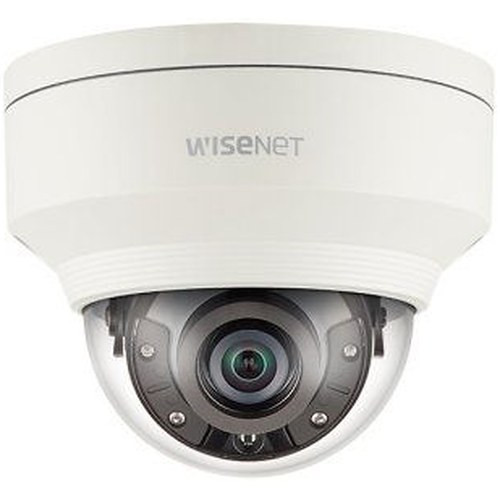
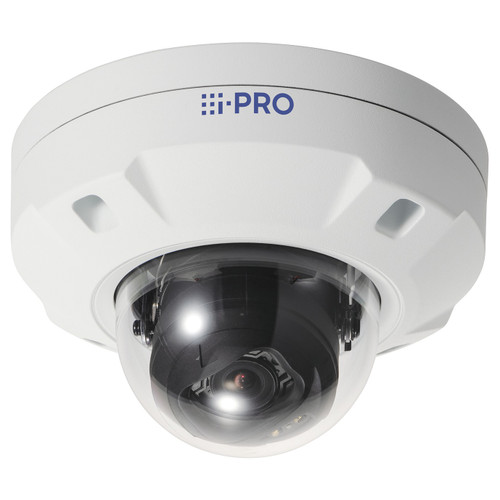
Both the Hanwha XNV-8020R and the i-PRO WV-X25500-V3LN are 5MP outdoor IP dome cameras designed for perimeter and area surveillance. They share a fixed-dome form factor, IK10 vandal resistance, IP66/IP67 weatherproofing, H.265/H.264/MJPEG compression, ONVIF compatibility, built-in IR illumination, and microSD edge storage. Despite sharing resolution class and form factor, they diverge meaningfully on lens type, IR range, dynamic range, PoE class, AI analytics depth, and warranty—making this a genuine cross-shop comparison for integrators specifying outdoor fixed-dome systems.
In This Guide
How do the imaging specs compare?
The XNV-8020R uses a 1/1.8-inch 6MP CMOS sensor outputting 5MP (2560×1920) at 30fps with a fixed 3.7mm lens at F1.6, delivering a 97.5° horizontal field of view. Its IR illuminator reaches 30m, minimum illumination is 0.16 lux in color and 0 lux with IR active, and its Wide Dynamic Range is rated at 120dB. The X25500-V3LN uses a smaller 1/2.8-inch CMOS sensor with a 3.1x motorized varifocal lens spanning 2.9–9mm (F1.3 wide to F2.5 tele), giving a horizontal FoV of 33–103°. Its IR illuminator reaches 70m—more than double the Hanwha—and minimum illumination is 0.02 lux in B&W with IR, while its Super Dynamic WDR reaches a specified 132dB at maximum setting.
The larger sensor in the XNV-8020R gives it a physical light-gathering advantage in color mode, and its wider fixed angle suits broad-area coverage without adjustment. The i-PRO unit's motorized varifocal lens enables field-adjustable zoom from wide-area to narrow corridor coverage without repositioning the camera, and its longer IR throw of 70m makes it better suited to deep perimeter lanes or parking structures. The Ambarella CV52 SoC in the X25500-V3LN also underpins its AI analytics pipeline. The XNV-8020R includes a built-in gyro-based digital image stabilizer and an optical defog filter; the X25500-V3LN offers a software image stabilizer (available in 30fps mode only) and software fog compensation.
What about installation and environment?
Both cameras carry IP66/IP67 and IK10 ratings, qualifying them for outdoor exposure and vandal-resistant installations. The XNV-8020R is powered by PoE IEEE 802.3af (Class 3, max 9.0W) or 12VDC (max 8.0W) and operates from -30°C to +55°C (-22°F to +131°F). The X25500-V3LN requires PoE+ IEEE 802.3at (max 14.2W)—driven by its motorized zoom and longer IR array—and its operating range is -40°C to +55°C (-40°F to +131°F), with a power-on floor of -30°C. The i-PRO unit additionally carries NEMA 4X and Type 4X (UL50E) certifications and a wind-resistance rating of up to 40m/s (~89mph), which the Hanwha spec does not list.
The XNV-8020R has a smaller footprint (Ø120×97.5mm, 615g / 1.36 lb) versus the X25500-V3LN (Ø154×105mm, 1.1kg / 2.43 lb). The Hanwha provides CVBS analog video output and a Micro USB port for on-site installation alignment; the i-PRO spec does not list analog or USB alignment outputs. The XNV-8020R supports dual microSD card slots up to 512GB total; the X25500-V3LN supports a single microSDXC slot up to 512GB. Both cameras feature pan/tilt/rotate adjustment for dome orientation.
Which fits your VMS and analytics better?
The XNV-8020R supports ONVIF Profile S and G, and the spec also references Profile T and Wisenet open platform (SUNAPI/HTTP API). Its on-board analytics include loitering, directional detection, fog detection, digital auto-tracking, sound classification, heatmap, people counting, queue management, and tampering detection. Privacy masking supports up to 32 polygonal zones with color options. Audio I/O is provided via selectable mic/line input and a line output. Edge storage uses two microSD slots supporting up to 512GB combined. The X25500-V3LN supports ONVIF Profile G/S/T/M—adding Profile M for metadata—and its Ambarella CV52-based AI pipeline covers 8 detection types including face detection, people/vehicle counting, AI sound classification (gunshot, yell, vehicle horn, glass break), and scene change detection. Privacy masking supports up to 8 zones. Audio I/O is via 3.5mm stereo mini jacks (input and output) with half/full duplex modes and AAC-LC compression in addition to G.711/G.726. The X25500-V3LN also lists SFTP, LLDP, MQTT, SRTP, and signed firmware/secure boot—protocols not listed in the XNV-8020R spec—and carries UL 62368-1 safety certification. Simultaneous user connections are 20 unicast on the Hanwha versus up to 14 on the i-PRO.
Which should you choose: the XNV-8020R or the X25500-V3LN?
Our take: The XNV-8020R is the stronger choice when wide fixed-angle coverage, standard PoE (802.3af) infrastructure, and a lower unit weight are the primary constraints. Its 1/1.8-inch sensor is physically larger than the X25500-V3LN's 1/2.8-inch sensor, it delivers a 97.5° fixed wide-angle view from a single 3.7mm lens, and it draws a maximum of 9W on PoE Class 3—meaning no PoE+ switches are required. The X25500-V3LN is the stronger choice for perimeter depth, lens flexibility, and certified AI analytics: its 70m IR reach versus 30m, motorized 3.1x varifocal lens (2.9–9mm) for field-adjustable coverage, 132dB WDR versus 120dB, NEMA 4X enclosure rating, wind-resistance spec, -40°C cold-start capability versus -30°C, signed firmware with secure boot, ONVIF Profile M, and a 5-year warranty versus 3-year tip the balance for higher-security or outdoor-extreme deployments—provided PoE+ infrastructure is available.
Side-by-Side Comparison
Spec-for-spec, from manufacturer data.
| Specification | Hanwha XNV-8020R | i-PRO X25500-V3LN |
|---|---|---|
| Resolution | 5MP (2560×1920) | 5MP (3072×2304 max in 4:3) |
| Image Sensor | 1/1.8" 6MP CMOS | Approx. 1/2.8" CMOS |
| Lens / Focal Length | 3.7mm fixed, F1.6 | 2.9–9mm motorized varifocal, F1.3–F2.5 |
| Horizontal FoV | 97.5° (fixed) | 33–103° (adjustable) |
| Min. Illumination | 0.16 lux (color) / 0 lux (IR) | 0.02 lux (B&W, IR) |
| IR Range | 30m (98ft) | 70m (230ft) |
| Wide Dynamic Range | 120dB | 132dB (Super Dynamic On, Level 31) |
| Max Frame Rate | 30fps (H.265/H.264) | 30fps |
| Video Compression | H.265, H.264, MJPEG | H.265, H.264, MJPEG |
| IP Rating | IP66 / IP67 | IP66 / IP67 / NEMA 4X / Type 4X |
| Vandal / Impact Rating | IK10 | IK10 (50J per IEC 60068-2-75) |
| Operating Temperature | -30°C to +55°C (-22°F to +131°F) | -40°C to +55°C (-40°F to +131°F); power-on from -30°C |
| Power Input / PoE Class | PoE 802.3af Class 3 (max 9.0W) or 12VDC | PoE+ 802.3at (max 14.2W) |
| Edge Storage | 2× microSD/SDHC/SDXC, up to 512GB | 1× microSDXC, up to 512GB |
| ONVIF Profiles | S, G (spec; T referenced separately) | G, S, T, M |
| Audio I/O | Mic/line in (selectable), line out | 3.5mm stereo in / 3.5mm stereo out, half/full duplex, AAC-LC |
| Alarm I/O | 1× input / 1× output | 3× alarm IN / 1× alarm OUT / 1× AUX OUT |
| Dimensions | Ø120.0×97.5mm (Ø4.72×3.84") | Ø154×105mm (Ø6-1/16×4-1/8") |
| Weight | 615g (1.36 lb) | 1.1kg (2.43 lb) |
| Warranty | 3 years | 5 years |
Frequently Asked Questions
Which should you choose: the XNV-8020R or the X25500-V3LN?
The XNV-8020R is the stronger choice when wide fixed-angle coverage, standard PoE (802.3af) infrastructure, and a lower unit weight are the primary constraints. Its 1/1.8-inch sensor is physically larger than the X25500-V3LN's 1/2.8-inch sensor, it delivers a 97.5° fixed wide-angle view from a single 3.7mm lens, and it draws a maximum of 9W on PoE Class 3—meaning no PoE+ switches are required. The X25500-V3LN is the stronger choice for perimeter depth, lens flexibility, and certified AI analytics: its 70m IR reach versus 30m, motorized 3.1x varifocal lens (2.9–9mm) for field-adjustable coverage, 132dB WDR versus 120dB, NEMA 4X enclosure rating, wind-resistance spec, -40°C cold-start capability versus -30°C, signed firmware with secure boot, ONVIF Profile M, and a 5-year warranty versus 3-year tip the balance for higher-security or outdoor-extreme deployments—provided PoE+ infrastructure is available.
Is the XNV-8020R or X25500-V3LN better for low-light performance?
Based on the provided specs, the X25500-V3LN has a lower minimum illumination figure—0.02 lux in B&W with IR active—compared to the XNV-8020R's 0.16 lux in color and 0 lux with IR active. In practice, the Hanwha spec lists 0 lux with IR on, which is the functional floor for active IR cameras; however, the i-PRO's 70m IR range versus the Hanwha's 30m means it illuminates subjects at significantly greater distances, which matters more for deep perimeter lanes.
Can I power the XNV-8020R and X25500-V3LN from the same PoE switch?
Not necessarily. The XNV-8020R is rated for PoE IEEE 802.3af (Class 3, max 9.0W), which any standard PoE switch can supply. The X25500-V3LN requires PoE+ IEEE 802.3at (max 14.2W), which demands a PoE+ capable switch port. If your existing switch only supports 802.3af, it will not reliably power the X25500-V3LN.
Which camera has a longer warranty?
The i-PRO WV-X25500-V3LN is specified with a 5-year warranty. The Hanwha XNV-8020R is specified with a 3-year warranty.
Get a Second Opinion on Your Camera Choice
Share your site layout, coverage goals, and budget. Our team will validate the camera selection, flag anything we would change, and recommend products that match the use case.