
Hanwha C8011R vs i-PRO X25500-V3LN: Specification Comparison
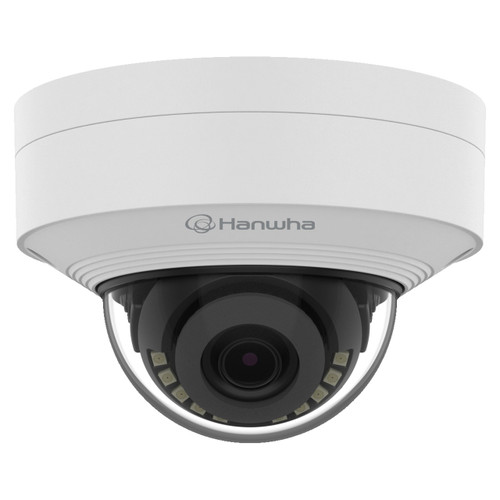
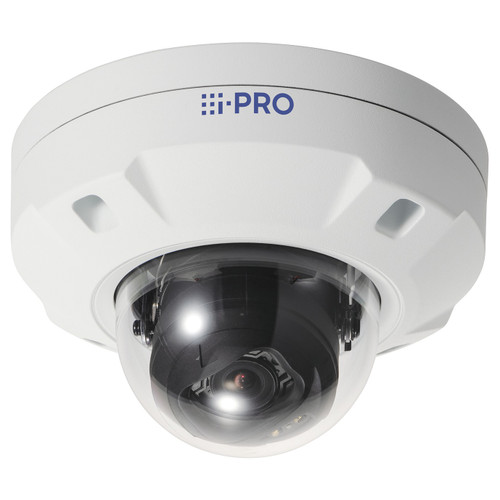
Both the Hanwha QNV-C8011R and i-PRO WV-X25500-V3LN are 5MP outdoor IP dome cameras aimed at commercial perimeter and area-coverage deployments. They share the same resolution class, sensor size, dome form factor, ONVIF compatibility, and outdoor-rated enclosures, making them genuine cross-shop candidates. Key differentiators are the fixed versus motorized-varifocal lens, IR illumination range, WDR performance, PoE class requirement, audio capability, and the depth of their respective on-camera AI analytics packages.
In This Guide
How do the imaging specs compare?
Both cameras use an approximately 1/2.8-inch CMOS sensor and deliver 5MP at 30 fps. The C8011R outputs a native 4:3 frame at 2592×1944, while the X25500-V3LN supports both 4:3 (up to 3072×2304) and 16:9 (up to 3072×1728) aspect ratios, giving the i-PRO a slight pixel-count edge at maximum resolution. The C8011R carries a fixed 3.0 mm F1.6 lens with a 100° horizontal field of view, while the X25500-V3LN offers a 3.1× motorized varifocal lens spanning 2.9–9 mm (F1.3 wide to F2.5 tele) and a 33–103° horizontal field of view, providing remote focus and zoom adjustment after installation without physically repositioning the camera.
In low light, the X25500-V3LN specifies a minimum illumination of 0.02 lux (B/W, IR LED) versus the C8011R's 0.03 lux color / 0 lux IR. IR illumination range differs significantly: the X25500-V3LN reaches 70 m, more than three times the C8011R's 20 m. WDR performance also diverges—the i-PRO claims 132 dB (Super Dynamic on, level 31) compared to 120 dB on the Hanwha. The i-PRO additionally lists fog compensation and an image stabilizer (available in 30 fps mode), neither of which is specified for the C8011R. DORI detection range at 25 ppm is 48.9 m (wide) / 207.4 m (tele) for the i-PRO versus 43.5 m for the fixed-lens Hanwha.
What about installation and environment?
Both cameras carry IP66 and IK10 ratings and are rated for –40 °C to +55 °C operation. The i-PRO adds IP67 and NEMA 4X / UL Type 4X certifications and specifies a 50 J shock resistance per IEC 60068-2-75, plus wind resistance up to 40 m/s (~89 mph)—none of these additional environmental ratings are listed for the C8011R. The C8011R is NEMA 4X rated as well. The C8011R is powered by PoE IEEE 802.3af (Class 3, max 8.5 W), while the X25500-V3LN requires PoE+ IEEE 802.3at (Class 4, max 14.2 W); existing switches must support 802.3at to power the i-PRO without an injector upgrade.
Physical size and weight differ: the C8011R measures ø110×77 mm and weighs 522 g (1.15 lb), while the X25500-V3LN is considerably larger at ø154×105 mm and 1.1 kg (2.43 lb). Both use an RJ-45 10/100BASE-T Ethernet interface. The C8011R includes a Micro USB Type B port for 1280×720 installation video output; no equivalent is listed for the X25500-V3LN. The C8011R's pan/tilt/rotate adjustment range is 0°–350° / –35°–70° / 0°–355°; the X25500-V3LN specifies pan ±180°, tilt –30° to +85°, yaw ±100°.
Which fits your VMS and analytics better?
Both cameras support ONVIF Profiles G, S, T, and M, and both encode in H.265, H.264, and MJPEG with CBR/VBR bitrate control. The C8011R supports up to 5 simultaneous stream profiles for up to 20 unicast users, while the X25500-V3LN supports up to 14 simultaneous users. Edge storage differs: the C8011R supports microSD/SDHC/SDXC up to 256 GB, while the X25500-V3LN supports up to 512 GB microSDXC. The i-PRO additionally specifies SFTP and MQTT protocol support, which are not listed for the C8011R. The C8011R lists SUNAPI (Hanwha HTTP API) as an additional interface.
On analytics, the C8011R's AI engine covers person/vehicle object detection, virtual line crossing with direction, virtual area, people and vehicle counting, queue management, and heatmap—all Hanwha WiseStream III codec optimization is AI-assisted. The X25500-V3LN lists eight AI video detection types and adds AI sound classification (gunshot, yell, vehicle horn, glass break), scene change detection, audio detection, and built-in audio I/O (3.5 mm input and output jacks with G.726/G.711/AAC-LC compression and half/full-duplex modes). The C8011R has no audio input or output specified. The i-PRO also lists an Ambarella CV52 SoC. For Panasonic/i-PRO-native VMS environments or deployments requiring on-camera audio, the X25500-V3LN integrates more natively; the C8011R is the natural fit for Wisenet VMS ecosystems.
Which should you choose: the C8011R or the X25500-V3LN?
Our take: The X25500-V3LN is the stronger choice when long-range IR coverage, remote lens adjustment, or on-camera audio analytics are required. Its 70 m IR range is 3.5× the C8011R's 20 m, its 3.1× motorized varifocal lens (2.9–9 mm) eliminates re-mounting when coverage angles change after installation, and its 132 dB WDR outperforms the C8011R's 120 dB in extreme contrast scenes. It also offers 512 GB edge storage versus 256 GB, adds IP67 and shock/wind ratings the C8011R does not list, and includes full-duplex audio I/O with AI sound classification absent from the Hanwha. However, the X25500-V3LN demands PoE+ (802.3at, 14.2 W max) versus the C8011R's standard PoE 802.3af (8.5 W max), is nearly twice the weight, and carries a 5-year warranty against the C8011R's 3-year. Choose the C8011R where 802.3af infrastructure is fixed, a compact/lightweight dome is preferred, Wisenet VMS integration is the platform, or business-intelligence heatmap and queue analytics are the primary requirement.
Side-by-Side Comparison
Spec-for-spec, from manufacturer data.
| Specification | Hanwha C8011R | i-PRO X25500-V3LN |
|---|---|---|
| Resolution | 2592×1944 (5MP, 4:3) | 3072×2304 (5MP, 4:3) / 3072×1728 (16:9) |
| Image Sensor | 1/2.8" CMOS | Approx. 1/2.8" CMOS |
| Lens / Focal Length | 3.0 mm fixed, F1.6 | 2.9–9 mm motorized varifocal, F1.3 (W)–F2.5 (T) |
| Optical Zoom | — | 3.1× motorized (up to 12.4× extra zoom at 640×360) |
| Horizontal Field of View | 100° | 33–103° (varifocal) |
| Min. Illumination | 0.03 lux color / 0 lux IR | 0.02 lux (B/W, IR LED) |
| IR Range | 20 m (850 nm) | 70 m |
| Wide Dynamic Range | 120 dB | 132 dB (Super Dynamic on, level 31) |
| Max Frame Rate | 30 fps @ 5MP | 30 fps |
| Video Compression | H.265, H.264, MJPEG | H.265, H.264, MJPEG |
| IP Rating | IP66, NEMA 4X | IP66, IP67, NEMA 4X, UL Type 4X |
| IK / Impact Rating | IK10 | IK10 (50 J per IEC 60068-2-75) |
| Operating Temperature | –40 °C to +55 °C | –40 °C to +55 °C (power-on: –30 °C to +55 °C) |
| Power Input / PoE Class | PoE 802.3af, Class 3, max 8.5 W | PoE+ 802.3at, Class 4, max 14.2 W |
| Edge Storage | microSD/SDHC/SDXC, max 256 GB | microSDXC, max 512 GB |
| Audio | — | 3.5 mm in/out, G.726/G.711/AAC-LC, half/full duplex |
| On-camera AI Analytics | People/vehicle counting, heatmap, queue mgmt, virtual line/area | 8 AI detection types, AI sound classification (gunshot, yell, horn, glass break) |
| ONVIF Profiles | G / S / T / M | G / S / T / M |
| Dimensions | ø110 × 77 mm | ø154 × 105 mm |
| Weight | 522 g (1.15 lb) | 1.1 kg (2.43 lb) |
| Warranty | 3 years | 5 years |
Frequently Asked Questions
Which should you choose: the C8011R or the X25500-V3LN?
The X25500-V3LN is the stronger choice when long-range IR coverage, remote lens adjustment, or on-camera audio analytics are required. Its 70 m IR range is 3.5× the C8011R's 20 m, its 3.1× motorized varifocal lens (2.9–9 mm) eliminates re-mounting when coverage angles change after installation, and its 132 dB WDR outperforms the C8011R's 120 dB in extreme contrast scenes. It also offers 512 GB edge storage versus 256 GB, adds IP67 and shock/wind ratings the C8011R does not list, and includes full-duplex audio I/O with AI sound classification absent from the Hanwha. However, the X25500-V3LN demands PoE+ (802.3at, 14.2 W max) versus the C8011R's standard PoE 802.3af (8.5 W max), is nearly twice the weight, and carries a 5-year warranty against the C8011R's 3-year. Choose the C8011R where 802.3af infrastructure is fixed, a compact/lightweight dome is preferred, Wisenet VMS integration is the platform, or business-intelligence heatmap and queue analytics are the primary requirement.
Is the C8011R or X25500-V3LN better for low-light and long-distance IR coverage?
The X25500-V3LN is better for both. It specifies a minimum illumination of 0.02 lux versus 0.03 lux for the C8011R, and its IR illumination reaches 70 m compared to 20 m on the C8011R. If the scene extends beyond roughly 20 m at night, the X25500-V3LN is the required choice based on published specs.
Can I power either camera from a standard 802.3af PoE switch?
Only the C8011R. It is rated for PoE IEEE 802.3af (Class 3, max 8.5 W). The X25500-V3LN requires PoE+ IEEE 802.3at (Class 4, max 14.2 W); a switch or midspan injector that supports 802.3at is mandatory for the i-PRO.
Which camera supports on-camera audio recording and detection?
The X25500-V3LN. It includes a 3.5 mm audio input and output, supports G.726, G.711, and AAC-LC compression, half- and full-duplex audio transmission, audio detection, and AI sound classification (gunshot, yell, vehicle horn, glass break). The C8011R has no audio input or output listed in its specifications.
Get a Second Opinion on Your Camera Choice
Share your site layout, coverage goals, and budget. Our team will validate the camera selection, flag anything we would change, and recommend products that match the use case.