
Hanwha XNV-8020R vs i-PRO S22500-V3LG: Specification Comparison
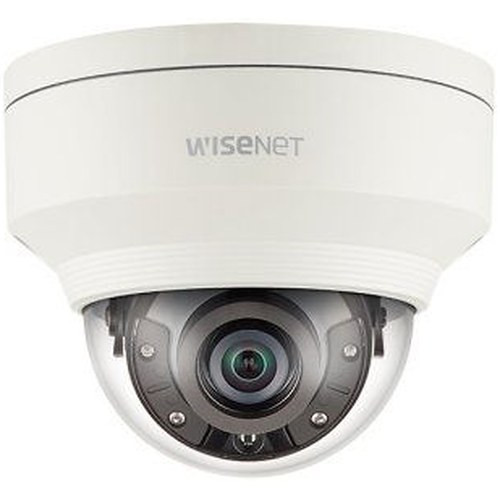
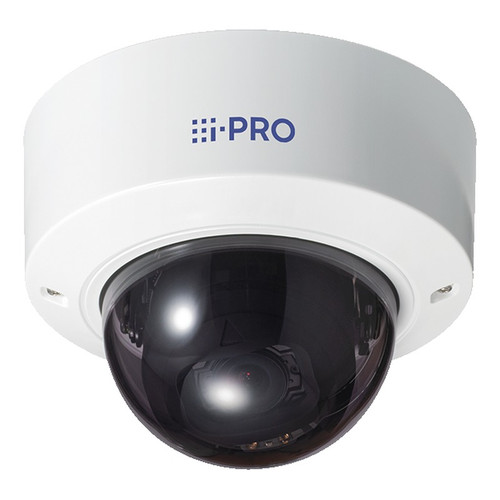
Both the Hanwha XNV-8020R and the i-PRO WV-S22500-V3LG are 5MP fixed-lens (or motorized-zoom) vandal-resistant IP dome cameras positioned for professional surveillance installations. The XNV-8020R is rated for outdoor deployment with a wide fixed lens and full weather-sealing, while the S22500-V3LG is an indoor vandal dome featuring motorized zoom and advanced AI analytics. Both deliver 5MP at 30 fps over PoE, making them realistic cross-shop candidates for buyers evaluating indoor lobby, retail, or covered-outdoor fixed-dome applications.
In This Guide
How do the imaging specs compare?
The XNV-8020R uses a 1/1.8" 6MP CMOS sensor (outputting 5MP at 2560×1920) with a fixed 3.7mm F1.6 lens delivering a 97.5° horizontal field of view. Its minimum illumination is 0.16 lux in color mode and 0 lux with IR active, backed by a built-in IR illuminator rated to 30m (98ft). WDR is specified at 120dB. The S22500-V3LG uses an approx. 1/2.8" CMOS sensor with a motorized 3.1× zoom lens spanning 2.9–9mm (f/1.3 wide to f/2.5 tele), producing a variable field of view from 105° to 33°. Its maximum resolution in 4:3 mode is 3072×2304. Minimum illumination is rated at 0.15 lux color and 0.12 lux in B&W, with IR range of 25m (82ft). Dynamic range is specified at up to 132dB with Super Dynamic enabled at maximum level.
On sensor size the XNV-8020R holds an advantage with its larger 1/1.8" chip versus the S22500-V3LG's approximately 1/2.8" sensor, which generally benefits low-light and dynamic range performance at the hardware level. However, the S22500-V3LG counters with a higher peak WDR figure (132dB vs 120dB) and a motorized zoom lens that a fixed-lens camera cannot match for post-installation framing adjustments. The XNV-8020R's 0 lux IR floor gives it a clear edge in complete-darkness scenarios, while the S22500-V3LG's DORI data (Detect: 47.1m wide / 207.4m tele; Identify: 4.7m wide / 20.7m tele) provides installers with concrete coverage planning figures absent from the XNV-8020R spec sheet.
What about installation and environment?
The XNV-8020R is rated IP66/IP67 and IK10, purpose-built for outdoor use with an operating temperature range of -30°C to +55°C (-22°F to +131°F). It supports PoE IEEE 802.3af (Class 3, max 9W) or 12VDC, has a micro USB port for local installation preview, and CVBS video output. Physical dimensions are Ø120×97.5mm at 615g (1.36 lb), with a chassis of aluminum construction in ivory. It ships with a waterproof connector kit and supports pan/tilt/rotate adjustment of 0–354°/0–67°/0–355°.
The S22500-V3LG is rated IK10 but carries no IP ingress rating in the provided specifications, and its environment rating is explicitly listed as Indoor. Its operating temperature range is -10°C to +50°C (power-on: 0°C to +50°C), significantly narrower than the XNV-8020R. Power input is DC12V or PoE IEEE 802.3af and power consumption is listed at 12W (PoE Class 0). Dimensions are Ø129.5×102.5mm at approximately 800g (1.77 lb). It provides a 3.5mm stereo mini-jack audio input and 3.5mm audio output, plus three Alarm IN/OUT terminals and one AUX OUT, versus the XNV-8020R's single alarm in/out pair. The S22500-V3LG holds UL, c-UL, CE, and IEC62368-1 safety certifications; the XNV-8020R specifies IP66/IP67 and IK10 certifications in the provided data.
Which fits your VMS and analytics better?
Both cameras declare ONVIF compliance: the XNV-8020R lists ONVIF Profile S/G and references Profile T in supplemental fields; the S22500-V3LG explicitly certifies ONVIF Profile G/M/S/T. The S22500-V3LG also supports SFTP, MQTT, LLDP, SRTP, and IPv6 on a broader protocol stack. The XNV-8020R supports Wisenet SUNAPI and the Wisenet open platform, tying it natively to Hanwha VMS ecosystems. The S22500-V3LG does not list a proprietary VMS SDK in the provided specifications.
On analytics, the XNV-8020R offers loitering, directional detection, fog detection, digital auto-tracking, sound classification, heatmap, people counting, queue management, and tampering detection — all listed as on-camera analytics. The S22500-V3LG provides AI Motion, Face Detection, Vehicle Detection, and AI Sound Classification (gunshot, yell, vehicle horn, glass break) and references Facial Recognition in its spec fields. The S22500-V3LG uniquely carries FIPS 140-2 Level 3 certification and an NXP EdgeLock SE050F hardware security element, a meaningful differentiator for government or high-security installations. Both support dual-slot or single-slot microSD up to 512GB (XNV-8020R: 2 slots, 512GB total; S22500-V3LG: single slot, up to 512GB). Both support audio in/out. The XNV-8020R provides digital image stabilization via a built-in gyro sensor; no equivalent is listed for the S22500-V3LG.
Which should you choose: the XNV-8020R or the S22500-V3LG?
Our take: The XNV-8020R is the stronger choice when outdoor weatherproof deployment, extreme temperature tolerance, or Hanwha/Wisenet VMS integration is required. Its IP66/IP67 rating and -30°C to +55°C operating range far exceed the S22500-V3LG's indoor-only rating and -10°C to +50°C envelope. Its larger 1/1.8" sensor and 0 lux IR floor provide a hardware advantage in complete-darkness scenes, and its dual microSD slots offer redundant edge storage. Conversely, the S22500-V3LG is the stronger choice for indoor, access-controlled environments where post-installation lens adjustment matters: its 3.1× motorized zoom (2.9–9mm) eliminates lens-swap service calls, its 132dB Super Dynamic rating edges out the XNV-8020R's 120dB WDR, and its FIPS 140-2 Level 3 hardware security module is a hard requirement for certain government and financial deployments. Choose the XNV-8020R for outdoor or harsh-environment fixed-angle coverage on Hanwha VMS; choose the S22500-V3LG for indoor, security-sensitive sites where zoom flexibility and hardware-attested firmware integrity are priorities.
Side-by-Side Comparison
Spec-for-spec, from manufacturer data.
| Specification | Hanwha XNV-8020R | i-PRO S22500-V3LG |
|---|---|---|
| Resolution | 5MP (2560×1920) | 5MP (3072×2304 in 4:3 mode) |
| Image Sensor | 1/1.8" CMOS (6MP chip) | Approx. 1/2.8" CMOS |
| Lens / Focal Length | 3.7mm fixed, F1.6 | 2.9–9mm motorized zoom (3.1×), f/1.3–f/2.5 |
| Horizontal Field of View | 97.5° | 33°–105° (motorized) |
| Min. Illumination (Color) | 0.16 lux | 0.15 lux (30IRE) |
| Min. Illumination (B&W / IR off) | Not specified | 0.12 lux |
| Min. Illumination (IR on) | 0 lux | Not specified |
| IR Range | 30m (98ft) | 25m (82ft) |
| Wide Dynamic Range | 120dB | Up to 132dB (Super Dynamic level 31) |
| Max Frame Rate | 30fps (H.265/H.264) | 30fps |
| Video Compression | H.265, H.264, MJPEG | H.265, H.264, MJPEG |
| IP Rating | IP66 / IP67 | Not specified (Indoor rated) |
| IK / Impact Rating | IK10 | IK10 |
| Operating Temperature | -30°C to +55°C | -10°C to +50°C (power-on: 0°C to +50°C) |
| Power Input / PoE Class | PoE IEEE 802.3af Class 3 / 12VDC (max 9W PoE) | PoE IEEE 802.3af Class 0 / DC12V (12W) |
| Edge Storage | Dual microSD/SDHC/SDXC, up to 512GB total | Single microSDXC, up to 512GB |
| Alarm I/O | 1 input / 1 output | 3 inputs / 1 output + 1 AUX OUT |
| Audio | Mic/line in (2.5VDC supply); line out (1Vrms max) | 3.5mm stereo mic in; 3.5mm stereo line out (600Ω, -20dBV) |
| ONVIF Profiles | S, G (T in supplemental fields) | G, M, S, T (explicit certification) |
| On-Camera Analytics | Loitering, directional, fog, auto-tracking, heatmap, people counting, queue mgmt, sound classification, tampering | AI Motion, Face Detection, Vehicle Detection, AI Sound Classification (4 classes) |
| Cybersecurity Certifications | HTTPS, 802.1X EAP-TLS/EAP-LEAP, IP filtering, digest auth | FIPS 140-2 Level 3, NXP EdgeLock SE050F hardware security element |
| Dimensions | Ø120.0 × 97.5mm | Ø129.5 × 102.5mm |
| Weight | 615g (1.36 lb) | Approx. 800g (1.77 lb) |
| Warranty | 3-year | 5-year |
Frequently Asked Questions
Which should you choose: the XNV-8020R or the S22500-V3LG?
The XNV-8020R is the stronger choice when outdoor weatherproof deployment, extreme temperature tolerance, or Hanwha/Wisenet VMS integration is required. Its IP66/IP67 rating and -30°C to +55°C operating range far exceed the S22500-V3LG's indoor-only rating and -10°C to +50°C envelope. Its larger 1/1.8" sensor and 0 lux IR floor provide a hardware advantage in complete-darkness scenes, and its dual microSD slots offer redundant edge storage. Conversely, the S22500-V3LG is the stronger choice for indoor, access-controlled environments where post-installation lens adjustment matters: its 3.1× motorized zoom (2.9–9mm) eliminates lens-swap service calls, its 132dB Super Dynamic rating edges out the XNV-8020R's 120dB WDR, and its FIPS 140-2 Level 3 hardware security module is a hard requirement for certain government and financial deployments. Choose the XNV-8020R for outdoor or harsh-environment fixed-angle coverage on Hanwha VMS; choose the S22500-V3LG for indoor, security-sensitive sites where zoom flexibility and hardware-attested firmware integrity are priorities.
Is the XNV-8020R or the S22500-V3LG better for low-light performance?
The XNV-8020R reaches 0 lux in IR mode (versus 0.12 lux B&W for the S22500-V3LG) and uses a larger 1/1.8" sensor compared to the S22500-V3LG's approximately 1/2.8" sensor, giving it an edge in complete darkness. The S22500-V3LG's color minimum illumination (0.15 lux) is marginally lower than the XNV-8020R's (0.16 lux), but both cameras rely on IR illuminators rated at 25–30m range.
Can either camera be installed outdoors?
Only the XNV-8020R is rated for outdoor installation: it carries IP66/IP67 weatherproof certification, includes a waterproof connector kit, and operates down to -30°C. The S22500-V3LG is listed as an indoor camera with no IP ingress rating in the provided specifications and an operating floor of -10°C (power-on 0°C), making it unsuitable for direct outdoor or exposed installations.
Which camera has better cybersecurity credentials for a government or high-security site?
The S22500-V3LG holds a clear advantage: it is certified to FIPS 140-2 Level 3 and integrates an NXP EdgeLock SE050F hardware security element for hardware-attested secure boot and encrypted data storage. The XNV-8020R lists HTTPS/SSL, 802.1X (EAP-TLS, EAP-LEAP), digest authentication, and IP filtering, but no equivalent hardware security certification is stated in its specifications.
Get a Second Opinion on Your Camera Choice
Share your site layout, coverage goals, and budget. Our team will validate the camera selection, flag anything we would change, and recommend products that match the use case.