
Hanwha XNV-8020R vs i-PRO S22500-F3L: Specification Comparison
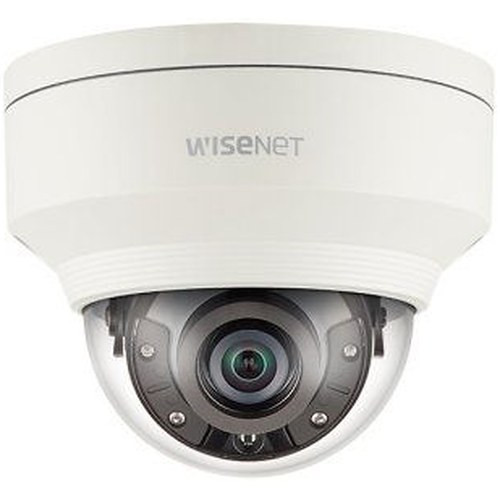
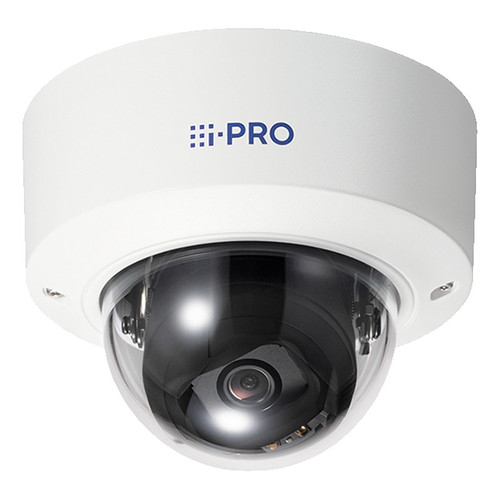
Both the Hanwha XNV-8020R and the i-PRO WV-S22500-F3L are 5MP fixed-lens vandal-resistant dome IP cameras operating at 30 fps, placing them in the same resolution class and form factor. The XNV-8020R is rated for outdoor deployment with IP66/IP67 and IK10, while the S22500-F3L is specified for indoor use with IK10. This comparison examines imaging performance, installation and environmental suitability, and VMS/analytics integration to help installers and IT buyers determine which unit better fits a given deployment scenario.
In This Guide
How do the imaging specs compare?
The XNV-8020R uses a 1/1.8" 6MP CMOS sensor delivering a 5MP (2560×1920) output at 30 fps, with a fixed 3.7 mm f/1.6 lens providing a 97.5° horizontal field of view and a minimum object distance of 0.4 m. Its IR illuminators reach 30 m (98.4 ft), with a minimum illumination of 0.16 lux in color and 0 lux in IR mode. Wide dynamic range is specified at 120 dB. The S22500-F3L pairs a smaller 1/2.8" CMOS sensor with a 3.2 mm f/2.0 fixed lens that supports auto-focus and up to 3× digital extra zoom, producing a 5MP output at up to 3072×2304 (4:3) or 3072×1728 (16:9) at 30 fps, with a 95° horizontal field of view. Its IR illuminators reach 25 m (82 ft), with minimum illumination of 0.12 lux in color and 0.1 lux in B&W (0 lux with IR).
On WDR, the i-PRO's Super Dynamic system is rated up to 132 dB at maximum level (31), compared to 120 dB for the XNV-8020R, a measurable advantage in high-contrast scenes. The XNV-8020R's larger 1/1.8" sensor and wider f/1.6 aperture offer a theoretical advantage in light-gathering over the S22500-F3L's 1/2.8" sensor and f/2.0 aperture, though the i-PRO's color minimum illumination is marginally lower (0.12 lux vs. 0.16 lux). The XNV-8020R has a 5 m longer IR throw. Both cameras include digital noise reduction, BLC/HLC, and ICR-based day/night switching. Built-in gyro-based digital image stabilization is noted for the XNV-8020R; no equivalent spec is listed for the S22500-F3L.
What about installation and environment?
The XNV-8020R carries IP66, IP67, and IK10 ratings, making it suitable for outdoor installations exposed to weather, dust, and vandalism. Its operating temperature range is -30°C to +55°C (-22°F to +131°F), supporting cold-climate deployments. It accepts PoE (IEEE 802.3af, Class 3) or 12 VDC, drawing a maximum of 9.0 W via PoE. Physical dimensions are Ø120.0×97.5 mm and it weighs 615 g (1.36 lb), with an aluminum housing. Pan/tilt/rotate adjustment ranges are 0°–354° / 0°–67° / 0°–355°.
The S22500-F3L is rated IK10 but is specified as an indoor camera with no IP ingress-protection rating listed in the provided specs. Its operating temperature range is -10°C to +50°C (14°F to 122°F), narrower on both ends. It accepts PoE (IEEE 802.3af, PoE Class 0) or DC 12 V at 880 mA. Dimensions are Ø129.5×102.5 mm and weight is approximately 800 g (1.77 lb). The i-PRO includes three alarm input terminals and one alarm output plus one AUX output; the XNV-8020R provides one alarm input and one alarm output. For outdoor or extreme-temperature installations, only the XNV-8020R is rated and specified to meet those conditions.
Which fits your VMS and analytics better?
Both cameras support ONVIF: the XNV-8020R covers ONVIF Profile S, G, and T; the S22500-F3L covers ONVIF Profile G, M, S, and T, adding Profile M which includes metadata for AI analytics. The XNV-8020R also exposes Hanwha's SUNAPI (HTTP API) and Wisenet open platform. The S22500-F3L includes the Ambarella CV22 SoC and ships with AI analytics covering AI Video Motion Detection, Face Detection, and Vehicle Detection, plus AI Sound Classification (gunshot, yell, vehicle horn, glass break). The XNV-8020R lists analytics including loitering, directional detection, fog detection, digital auto-tracking, sound classification, heatmap, people counting, queue management, and tampering.
Both cameras provide two-way audio capability, though connector formats differ: the XNV-8020R uses selectable mic/line input with a 2.5 VDC supply and line output, while the S22500-F3L uses a 3.5 mm stereo mini jack input and 3.5 mm stereo output. Both support a microSD/SDXC card up to 512 GB for edge recording. The S22500-F3L supports SFTP and MQTT protocols not listed for the XNV-8020R. Security posture differs materially: the S22500-F3L is FIPS 140-2 Level 3 certified with an NXP SE050F secure element and supports signed firmware; no equivalent hardware-security or FIPS certification is listed for the XNV-8020R. The S22500-F3L also lists a longer warranty period at 5 years versus 3 years for the XNV-8020R.
Which should you choose: the XNV-8020R or the S22500-F3L?
Our take: The XNV-8020R is the stronger choice when the deployment is outdoor or in harsh environments: it carries IP66/IP67 weatherproofing alongside IK10 and operates down to -30°C, whereas the S22500-F3L lacks a listed IP ingress rating and is limited to -10°C. The XNV-8020R also delivers a longer IR throw (30 m vs. 25 m) and uses a larger 1/1.8" sensor with an f/1.6 aperture. Conversely, the S22500-F3L is the better fit for high-security indoor installations: its Super Dynamic WDR reaches 132 dB versus 120 dB, it is FIPS 140-2 Level 3 certified with a hardware secure element, supports ONVIF Profile M for AI metadata, includes face and vehicle detection on-board, and carries a 5-year warranty versus 3 years. Choose the XNV-8020R for outdoor/extreme-temp sites; choose the S22500-F3L for regulated or cybersecurity-sensitive indoor environments.
Side-by-Side Comparison
Spec-for-spec, from manufacturer data.
| Specification | Hanwha XNV-8020R | i-PRO S22500-F3L |
|---|---|---|
| Resolution | 5MP (2560×1920) | 5MP (3072×2304 max 4:3 / 3072×1728 16:9) |
| Image Sensor | 1/1.8" 6MP CMOS | Approx. 1/2.8" CMOS |
| Lens / Focal Length | 3.7 mm fixed, f/1.6 | 3.2 mm fixed, f/2.0, auto-focus |
| Horizontal FOV | 97.5° | 95° |
| Min. Illumination (Color) | 0.16 lux | 0.12 lux |
| Min. Illumination (B&W / IR) | 0 lux (IR) | 0.1 lux (B&W) / 0 lux (IR) |
| Wide Dynamic Range | 120 dB | Up to 132 dB (Super Dynamic Level 31) |
| IR Range | 30 m (98.4 ft) | 25 m (82 ft, 30IRE) |
| Max Frame Rate | 30 fps (H.265/H.264) | 30 fps (H.265/H.264/MJPEG) |
| Video Compression | H.265, H.264, MJPEG | H.265, H.264, MJPEG |
| IP Rating | IP66 / IP67 | Not listed (indoor rated) |
| IK / Impact Rating | IK10 | IK10 |
| Operating Temperature | -30°C to +55°C | -10°C to +50°C |
| Power Input / PoE Class | PoE 802.3af Class 3 / 12 VDC; max 9.0 W | PoE 802.3af Class 0 / DC 12 V 880 mA |
| Edge Storage | microSD/SDHC/SDXC up to 512 GB (2 slots) | microSDXC up to 512 GB (1 slot) |
| Alarm I/O | 1 input / 1 output | 3 inputs / 1 output / 1 AUX output |
| ONVIF Profiles | S, G, T | G, M, S, T |
| AI / Edge Analytics | Loitering, directional, people counting, heatmap, queue mgmt, sound classification, tampering | AI VMD, face detection, vehicle detection, AI sound classification (gunshot, yell, horn, glass break) |
| Cybersecurity Certification | — | FIPS 140-2 Level 3, NXP SE050F secure element, signed firmware |
| Audio | Selectable mic/line in; line out | 3.5 mm stereo mic/line in; 3.5 mm stereo out |
| Dimensions | Ø120.0 × 97.5 mm | Ø129.5 × 102.5 mm |
| Weight | 615 g (1.36 lb) | ~800 g (1.77 lb) |
| Housing Material | Aluminum | Aluminum die cast, polycarbonate dome |
| Warranty | 3 years | 5 years |
Frequently Asked Questions
Which should you choose: the XNV-8020R or the S22500-F3L?
The XNV-8020R is the stronger choice when the deployment is outdoor or in harsh environments: it carries IP66/IP67 weatherproofing alongside IK10 and operates down to -30°C, whereas the S22500-F3L lacks a listed IP ingress rating and is limited to -10°C. The XNV-8020R also delivers a longer IR throw (30 m vs. 25 m) and uses a larger 1/1.8" sensor with an f/1.6 aperture. Conversely, the S22500-F3L is the better fit for high-security indoor installations: its Super Dynamic WDR reaches 132 dB versus 120 dB, it is FIPS 140-2 Level 3 certified with a hardware secure element, supports ONVIF Profile M for AI metadata, includes face and vehicle detection on-board, and carries a 5-year warranty versus 3 years. Choose the XNV-8020R for outdoor/extreme-temp sites; choose the S22500-F3L for regulated or cybersecurity-sensitive indoor environments.
Is the XNV-8020R or S22500-F3L better for low-light performance?
Both include IR illuminators and ICR day/night switching with 0-lux capability in IR mode. The XNV-8020R has a longer IR range (30 m vs. 25 m) and a larger 1/1.8" sensor with a wider f/1.6 aperture, which provides a theoretical advantage in passive light gathering. The S22500-F3L's specified color minimum illumination is marginally lower (0.12 lux vs. 0.16 lux), and its WDR is rated higher at up to 132 dB versus 120 dB for the XNV-8020R. Neither model's spec conclusively dominates across all low-light conditions; the XNV-8020R has the IR distance edge, while the i-PRO has the WDR edge.
Can the XNV-8020R be used outdoors while the S22500-F3L cannot?
Based on the provided specifications, yes. The XNV-8020R carries IP66 and IP67 ratings (dust-tight and protected against water immersion) and an operating temperature range of -30°C to +55°C, making it rated for outdoor use. The S22500-F3L's specifications do not list an IP ingress-protection rating and its operating temperature range is -10°C to +50°C; it is listed as an indoor-rated camera. Deploying the S22500-F3L outdoors would be outside its specified environmental parameters.
Which camera is better suited for a cybersecurity-sensitive or government installation?
The i-PRO S22500-F3L has a documented advantage here: it is FIPS 140-2 Level 3 certified, incorporates an NXP SE050F hardware secure element, supports signed firmware, and lists SFTP and MQTT alongside HTTPS, 802.1X, and SRTP. The XNV-8020R supports HTTPS, 802.1X (EAP-TLS, EAP-LEAP), and SNMPv3, but no FIPS certification or hardware secure element is listed in its specifications. For deployments requiring FIPS 140-2 compliance, the S22500-F3L is the only one of the two with that credential documented.
Get a Second Opinion on Your Camera Choice
Share your site layout, coverage goals, and budget. Our team will validate the camera selection, flag anything we would change, and recommend products that match the use case.