
Honeywell 3320G-5USBX-0 vs Honeywell 1202G-1USB-5-N: Specification Comparison
Both the Honeywell Vuquest 3320G-5USBX-0 and the Honeywell 1202G-1USB-5-N are corded/wireless 1D/2D barcode scanners sharing the same core imaging technology and barcode format support. However, they differ significantly in form factor, connectivity, durability, and intended deployment environment. This comparison evaluates the three most decision-relevant dimensions for B2B scanner procurement: scan performance and working range, durability and environmental protection, and connectivity and deployment flexibility.
In This Guide
- Which scanner delivers better scan range and imaging performance for your workflow?
- Which scanner is better protected against drops, dust, and liquids in demanding environments?
- Which scanner fits your cabling, mobility, and integration requirements?
- Which should you choose: the 3320G-5USBX-0 or the 1202G-1USB-5-N?
- Side-by-Side Specs
- FAQ
Which scanner delivers better scan range and imaging performance for your workflow?
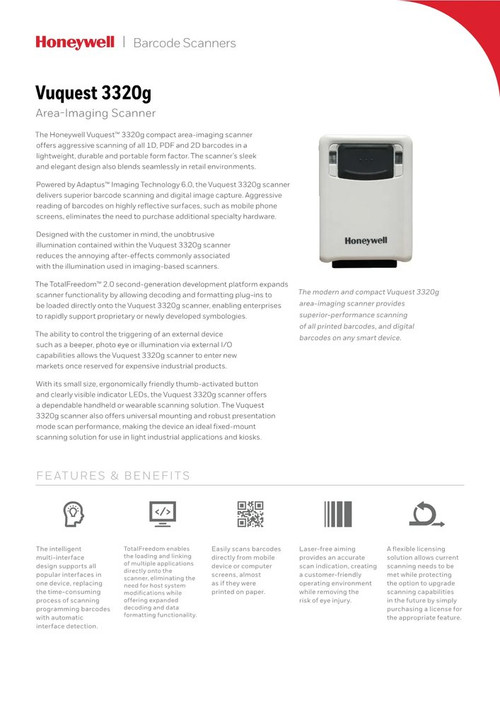
The 3320G-5USBX-0 (Vuquest 3320g) uses an 838 × 640 pixel area imager and operates across a working range of 15–120 cm (6–48 in), making it suited to presentation-style checkout where items are passed at varying distances from the scanner. Its scan engine handles 1D symbologies (Code 128, Code 39, EAN, UPC) as well as 2D formats (QR Code, Data Matrix, PDF417).
The 1202G-1USB-5-N (Xenon XP 1952g) specifies a working range of 2.5–50.8 cm (1–20 in) and its scan pattern is listed as a single scan line, which is a narrower depth-of-field window than the 3320g. Supported formats include EAN, UPC, Code 128, QR Code, and Data Matrix; PDF417 support is not confirmed in the provided specs.
For applications where items arrive at inconsistent distances — such as a busy retail lane — the 3320g's 120 cm maximum range provides a meaningful advantage. For close-range, handheld scanning tasks the 1952g's range is adequate, though its shallower maximum reach limits versatility at distance.
Which scanner is better protected against drops, dust, and liquids in demanding environments?
The 3320G-5USBX-0 carries an IP53 rating (spec sheet field) alongside an IP42 rating noted in the enriched data — there is a conflict between these two values in the provided specs; both are cited here without resolution. Drop specification is stated at 1.8 m (6 ft) to concrete.
The 1202G-1USB-5-N is rated IP65, which provides full dust-tight protection and resistance to water jets — a higher ingress protection standard than either IP42 or IP53. Its drop rating is 2.0 m, also exceeding the 3320g's 1.8 m specification.
For warehouse, manufacturing, or outdoor-adjacent environments where exposure to dust, moisture, and frequent drops is expected, the 1952g's IP65 / 2.0 m credentials offer a stronger certified protection profile. The 3320g's IP rating conflict in the provided data means buyers should verify against Honeywell's published datasheet before specifying it in a protection-critical application.
Which scanner fits your cabling, mobility, and integration requirements?
The 3320G-5USBX-0 is a corded USB device powered directly from the host port at 5 VDC ± 0.25 V. It is a presentation scanner — designed to sit fixed at a checkout or kiosk point — and does not offer wireless capability. Battery is listed as not applicable.
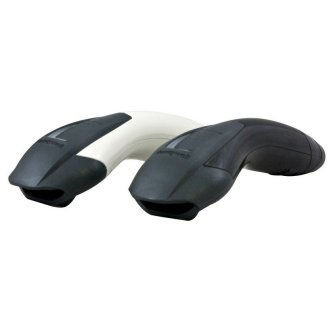
The 1202G-1USB-5-N adds Bluetooth 4.2 wireless connectivity on top of a USB corded option, enabling untethered handheld operation alongside a base station. Its mount type is listed as recessed, suggesting compatibility with embedded or countertop-mount installations as well as handheld use. Input voltage is 5 V ± 5%.
Deployments requiring operator mobility — warehouse receiving, floor-level inventory, or retail environments where staff move between stations — benefit directly from the 1952g's Bluetooth 4.2 capability. Fixed-point POS checkout lanes where a tethered, always-powered scanner is preferable are better served by the 3320g's simpler USB corded setup and lower 77 g weight versus the 1952g's 125 g.
Which should you choose: the 3320G-5USBX-0 or the 1202G-1USB-5-N?
Our take: The 3320G-5USBX-0 is the stronger choice when a fixed-point, high-throughput retail POS lane is the deployment target and scan range is the primary criterion; the 1202G-1USB-5-N is the stronger choice when operator mobility, higher environmental protection, and tougher drop resilience are required. On range, the 3320g reaches 120 cm versus the 1952g's 50.8 cm — a 2.4× advantage for presentation-mode scanning. On durability, the 1952g holds IP65 and a 2.0 m drop rating against the 3320g's conflicted IP rating (IP42/IP53 discrepancy in provided specs) and 1.8 m drop spec. On connectivity, only the 1952g offers Bluetooth 4.2 for wireless operation; the 3320g is USB-only. Buyers equipping fixed checkout counters with reliable USB POS integration should favor the 3320g; buyers outfitting mobile warehouse or multi-surface retail staff should favor the 1952g.
Side-by-Side Comparison
Spec-for-spec, from manufacturer data.
| Specification | Honeywell 3320G-5USBX-0 | Honeywell 1202G-1USB-5-N |
|---|---|---|
| Series / Family | Vuquest 3320g | Xenon XP 1952g |
| Part Number | 3320G-5USBX-0 | 1202G-1USB-5-N |
| Form Factor | Presentation Scanner | Handheld / Recessed Mount |
| Scan Engine | 1D/2D Area Imager (838×640 px) | 1D/2D Area Imager (single scan line) |
| Working Range | 15–120 cm (6–48 in) | 2.5–50.8 cm (1–20 in) |
| Connectivity | Corded USB | Bluetooth 4.2 + USB |
| IP Rating | IP53 (IP42 also noted — conflict in specs) | IP65 |
| Drop Specification | 1.8 m (6 ft) to concrete | 2.0 m |
| 1D Symbologies | Code 128, Code 39, EAN, UPC | EAN, UPC, Code 128 |
| 2D Symbologies | QR Code, Data Matrix, PDF417 | QR Code, Data Matrix (PDF417 not confirmed) |
| Operating Temperature | 0°C to 40°C (spec sheet); -20° to 50°C (field data — conflict) | 0°C to 50°C |
| Storage Temperature | — | -20°C to 60°C |
| Weight | 77 g (2.7 oz) | 125 g (4.4 oz) |
| Input Voltage | 5 VDC ± 0.25 V | 5 V ± 5% |
| Battery | Not applicable (USB powered) | — |
| Warranty | 3-year | 3-year |
Frequently Asked Questions
Which should you choose: the 3320G-5USBX-0 or the 1202G-1USB-5-N?
The 3320G-5USBX-0 is the stronger choice when a fixed-point, high-throughput retail POS lane is the deployment target and scan range is the primary criterion; the 1202G-1USB-5-N is the stronger choice when operator mobility, higher environmental protection, and tougher drop resilience are required. On range, the 3320g reaches 120 cm versus the 1952g's 50.8 cm — a 2.4× advantage for presentation-mode scanning. On durability, the 1952g holds IP65 and a 2.0 m drop rating against the 3320g's conflicted IP rating (IP42/IP53 discrepancy in provided specs) and 1.8 m drop spec. On connectivity, only the 1952g offers Bluetooth 4.2 for wireless operation; the 3320g is USB-only. Buyers equipping fixed checkout counters with reliable USB POS integration should favor the 3320g; buyers outfitting mobile warehouse or multi-surface retail staff should favor the 1952g.
Is the 3320G-5USBX-0 or 1202G-1USB-5-N better for warehouse receiving and inventory tasks?
Based on the provided specs, the 1202G-1USB-5-N is better suited to warehouse tasks. It offers Bluetooth 4.2 for untethered mobility, an IP65 dust-and-water-jet rating, and a 2.0 m drop specification — all relevant to warehouse environments where operators move between dock, floor, and shelving locations. The 3320G-5USBX-0 is a corded presentation scanner without wireless capability and carries a lower drop and ingress rating.
Can either scanner read QR codes and 2D barcodes, or is one limited to 1D only?
Both scanners support 1D and 2D barcode formats. The 3320G-5USBX-0 explicitly lists QR Code, Data Matrix, and PDF417 alongside Code 128, Code 39, EAN, and UPC. The 1202G-1USB-5-N lists QR Code, Data Matrix, EAN, UPC, and Code 128; PDF417 support is not confirmed in the provided specs for that model.
Which scanner is lighter and easier to use at a fixed checkout counter?
The 3320G-5USBX-0 weighs 77 g (2.7 oz) and is designed as a presentation scanner for fixed retail POS use. The 1202G-1USB-5-N weighs 125 g (4.4 oz) and is a handheld-style device. For a fixed counter installation where the scanner remains stationary, the 3320g's lighter weight and purpose-built presentation form factor are the closer match, though the 1952g's recessed mount type does indicate it can be counter-installed as well.
More Barcode Scanner Comparisons
- Zebra DS8108 vs Datalogic GBT4600-HC-BTK1-HP
- Zebra DS8108 vs Datalogic GD4590-HCK10-HDR-B
- Zebra DS8108 vs Honeywell 1202G-2USB-5BF-N
- Zebra DS8108 vs Datalogic GBT4500-BK-BTK1DRA
- Zebra DS8108 vs Zebra DS3608
- Zebra DS8108 vs Zebra LI3608
Barcode Scanner Buying Guides
Get a Second Opinion on Your Camera Choice
Share your site layout, coverage goals, and budget. Our team will validate the camera selection, flag anything we would change, and recommend products that match the use case.