
Honeywell 1960HSR-5USB-N vs Honeywell 3320G-5USBX-0: Specification Comparison
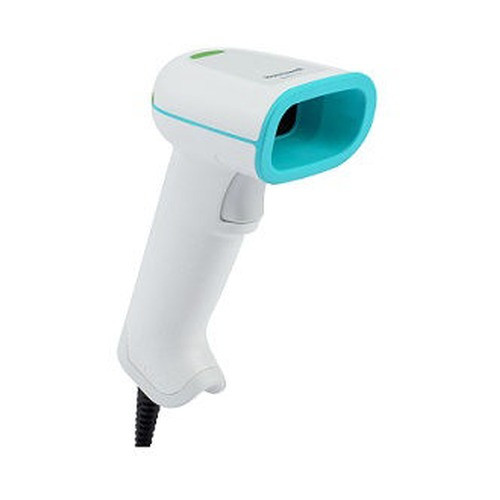
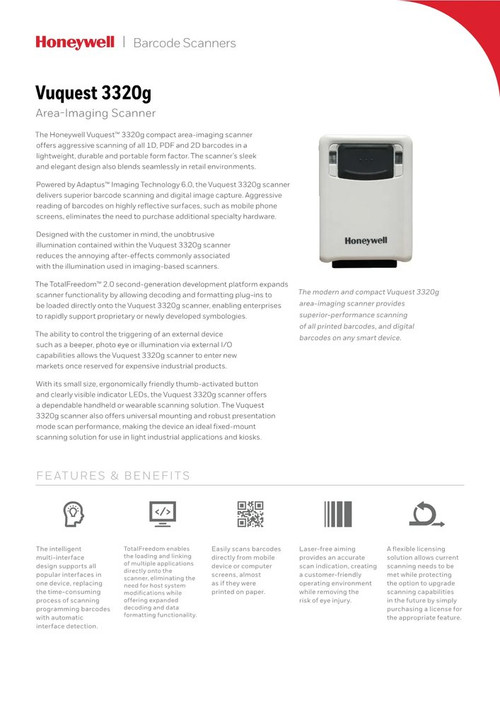
The Honeywell 1960HSR-5USB-N (Xenon XP 1952g series) and the Honeywell 3320G-5USBX-0 (Vuquest 3320g series) are both 1D/2D area-imager barcode scanners from the same manufacturer, targeting overlapping SKU-scanning use cases. The 1960HSR-5USB-N is a handheld wireless unit built for mobile, ruggedized environments such as warehouses, while the 3320G-5USBX-0 is a corded presentation scanner designed for fixed-point retail POS counters. Buyers cross-shopping these two are typically choosing between mobile flexibility and hands-free counter scanning.
In This Guide
- Which scanner better matches your working range and deployment style — handheld mobile or fixed presentation?
- Which unit offers stronger environmental protection and drop tolerance for your operating conditions?
- How do the connectivity options and power requirements affect integration into your existing infrastructure?
- Which should you choose: the 1960HSR-5USB-N or the 3320G-5USBX-0?
- Side-by-Side Specs
- FAQ
Which scanner better matches your working range and deployment style — handheld mobile or fixed presentation?
The 1960HSR-5USB-N is a handheld area imager with a working range of 2.5–50.8 cm (1–20 in), suited to close-range, point-and-shoot scanning tasks where the operator moves to the item. Its Bluetooth 4.2 plus USB connectivity means it can operate wirelessly and untethered from a fixed station, making it well-suited to warehouse picking, receiving, or any workflow where the scanner travels with the user.
The 3320G-5USBX-0 is a corded presentation scanner with a substantially wider working range of 15–120 cm (6–48 in), designed to sit on a counter and capture barcodes as items pass through the scan zone hands-free. Its USB-only corded connection ties it to a fixed POS terminal. The 838 × 640 pixel array scan engine is specified in the product data, enabling reliable omnidirectional reads at the counter. Buyers needing a free-standing, always-on scanner at checkout will find the 3320G-5USBX-0's form factor and range more appropriate; those needing a portable handheld will favor the 1960HSR-5USB-N.
Which unit offers stronger environmental protection and drop tolerance for your operating conditions?
The 1960HSR-5USB-N carries an IP65 ingress protection rating, meaning it is fully dust-tight and protected against low-pressure water jets from any direction. Its specified drop rating is 2.0 m (6.5 ft). The operating temperature range is 0°C to 50°C (32°–122°F). At 147.2 g (5.2 oz), it is a lightweight handheld built for repeated drops in industrial or warehouse environments.
The 3320G-5USBX-0 presents conflicting IP data across its spec fields: the structured product attribute lists IP53, while the datasheet-derived fields cite IP42. Both ratings indicate partial ingress protection — neither achieves the dust-tight standard of IP6x. The drop specification attributed to the 3320G-5USBX-0 is 1.8 m (6 ft) to concrete. Its operating temperature range is listed as -20°C to 50°C in one field and 0°C to 40°C in another, creating an unresolved discrepancy; buyers should verify against the manufacturer's official datasheet before specifying for cold-storage or outdoor use. At 77 g (2.7 oz), it is lighter, reflecting its counter-mount form factor.
How do the connectivity options and power requirements affect integration into your existing infrastructure?
The 1960HSR-5USB-N supports Bluetooth 4.2 as its primary wireless protocol and also accommodates USB, giving integrators the choice of wireless pairing to a host device or direct wired connection. This dual-mode capability is directly stated in the specifications. Input voltage is listed as 4.4V–5.5V DC. The AI Detection framework support noted in the specs suggests compatibility with analytics or host-software pipelines, though no further platform names are provided in the available data.
The 3320G-5USBX-0 is USB-only corded, powered at 5VDC ± 0.25V from the host port — no battery, no wireless pairing. This simplifies deployment at fixed POS stations where power and data travel on the same cable and no charging management is needed. Symbology support is explicitly specified: 1D (Code 128, Code 39, EAN, UPC) and 2D (QR Code, Data Matrix, PDF417). An optional accessory bundle item (52-52559-N-3-FR) is referenced in the product data; its nature is not described in the provided specs. No wireless option exists for this model.
Which should you choose: the 1960HSR-5USB-N or the 3320G-5USBX-0?
Our take: The 1960HSR-5USB-N is the stronger choice when operators need to move freely through a facility and require industrial-grade ruggedness, while the 3320G-5USBX-0 is the correct pick for a fixed, hands-free retail counter position. On durability, the 1960HSR-5USB-N's IP65 rating and 2.0 m drop spec measurably exceed the 3320G-5USBX-0's contested IP42/IP53 and 1.8 m drop figures. On working range, the 3320G-5USBX-0's 15–120 cm span gives it a clear advantage over the 1960HSR-5USB-N's 2.5–50.8 cm for presentation-style scanning. On connectivity, only the 1960HSR-5USB-N offers wireless Bluetooth 4.2, which is essential for untethered mobile workflows; the 3320G-5USBX-0 is USB-corded only. Platform qualifier: the 3320G-5USBX-0's IP rating inconsistency across its own spec fields warrants verification against the manufacturer datasheet before specifying for demanding environments.
Side-by-Side Comparison
Spec-for-spec, from manufacturer data.
| Specification | Honeywell 1960HSR-5USB-N | Honeywell 3320G-5USBX-0 |
|---|---|---|
| Series / Family | Xenon XP 1952g | Vuquest 3320g |
| Part Number | 1960HSR-5USB-N | 3320G-5USBX-0 |
| Form Factor | Handheld | Presentation (counter-mount) |
| Scan Type | Area Imager (1D/2D) | Area Imager (1D/2D) |
| Working Range | 2.5–50.8 cm (1–20 in) | 15–120 cm (6–48 in) |
| Connectivity | Bluetooth 4.2 + USB | USB corded only |
| IP Rating | IP65 | IP53 (attr) / IP42 (datasheet) — conflicting |
| Drop Rating | 2.0 m (6.5 ft) | 1.8 m (6 ft) |
| Operating Temperature | 0°C to 50°C | −20°C to 50°C (attr) / 0°C to 40°C (datasheet) — conflicting |
| Weight | 147.2 g (5.2 oz) | 77 g (2.7 oz) |
| Input Voltage | 4.4V–5.5V DC | 5VDC ± 0.25V |
| Battery | Not specified in provided data | Not applicable (USB powered) |
| Application | General purpose / mobile | Retail point-of-sale |
| Symbologies (2D) | QR, Data Matrix, Aztec | QR Code, Data Matrix, PDF417 |
| Warranty | 3-year | 3-year |
| Scan Engine Pixel Array | — | 838 × 640 pixels |
Frequently Asked Questions
Which should you choose: the 1960HSR-5USB-N or the 3320G-5USBX-0?
The 1960HSR-5USB-N is the stronger choice when operators need to move freely through a facility and require industrial-grade ruggedness, while the 3320G-5USBX-0 is the correct pick for a fixed, hands-free retail counter position. On durability, the 1960HSR-5USB-N's IP65 rating and 2.0 m drop spec measurably exceed the 3320G-5USBX-0's contested IP42/IP53 and 1.8 m drop figures. On working range, the 3320G-5USBX-0's 15–120 cm span gives it a clear advantage over the 1960HSR-5USB-N's 2.5–50.8 cm for presentation-style scanning. On connectivity, only the 1960HSR-5USB-N offers wireless Bluetooth 4.2, which is essential for untethered mobile workflows; the 3320G-5USBX-0 is USB-corded only. Platform qualifier: the 3320G-5USBX-0's IP rating inconsistency across its own spec fields warrants verification against the manufacturer datasheet before specifying for demanding environments.
Is the 1960HSR-5USB-N or 3320G-5USBX-0 better for a warehouse picking operation?
The 1960HSR-5USB-N is the more suitable option for warehouse picking. It is a handheld unit with Bluetooth 4.2 wireless connectivity, an IP65 seal, and a 2.0 m drop rating — all of which support a mobile operator working away from a fixed station. The 3320G-5USBX-0 is corded and designed for counter-mounted presentation use, which does not fit a roving warehouse workflow.
Can either scanner work in a cold-storage or freezer environment?
Based on the provided specifications, neither unit has a clearly verified low-temperature rating below 0°C for reliable operation. The 3320G-5USBX-0 lists -20°C in one spec field but 0°C in another — this discrepancy is unresolved in the available data, and the manufacturer's official datasheet should be consulted before deploying in sub-zero conditions. The 1960HSR-5USB-N specifies a lower operating limit of 0°C only. Neither unit's provided specs confirm a validated freezer-rated configuration.
Which scanner reads barcodes at greater distance — the 1960HSR-5USB-N or the 3320G-5USBX-0?
The 3320G-5USBX-0 reads at a significantly greater distance, with a working range of 15–120 cm (6–48 in) versus the 1960HSR-5USB-N's 2.5–50.8 cm (1–20 in). If your application requires scanning items held further from the scan window — such as large retail items passing across a counter — the 3320G-5USBX-0's extended range is the relevant advantage. The 1960HSR-5USB-N's shorter range is typical for a close-contact handheld scanner.
More Barcode Scanner Comparisons
- Zebra DS8108 vs Datalogic GBT4600-HC-BTK1-HP
- Zebra DS8108 vs Datalogic GD4590-HCK10-HDR-B
- Zebra DS8108 vs Honeywell 1202G-2USB-5BF-N
- Zebra DS8108 vs Datalogic GBT4500-BK-BTK1DRA
- Zebra DS8108 vs Zebra DS3608
- Zebra DS8108 vs Zebra LI3608
Barcode Scanner Buying Guides
Get a Second Opinion on Your Camera Choice
Share your site layout, coverage goals, and budget. Our team will validate the camera selection, flag anything we would change, and recommend products that match the use case.