
Honeywell 1400GSR-1-N vs Honeywell 3320G-5USBX-0: Specification Comparison
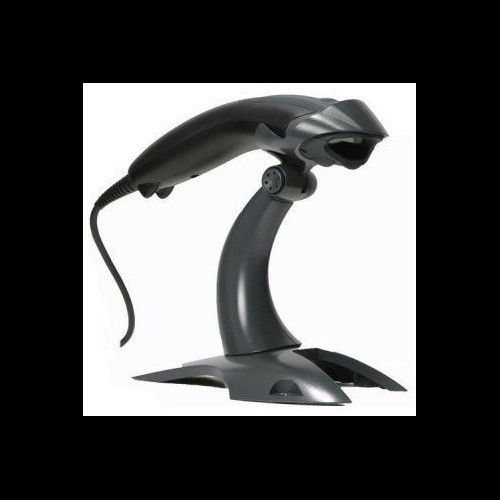
Both the Honeywell 1400GSR-1-N (Xenon XP 1952g) and the Honeywell 3320G-5USBX-0 (Vuquest 3320g) are 1D/2D area-imager barcode scanners from the same manufacturer, each targeting enterprise data-capture workflows. However, they diverge sharply in form factor and deployment intent: the 1400GSR-1-N is a hand-held wireless scanner built for mobile, rugged environments, while the 3320G-5USBX-0 is a fixed-position presentation scanner designed for stationary corded use at a retail POS or service counter. Buyers cross-shopping these models are typically deciding between mobility and hands-free convenience.
In This Guide
Which scanner fits your deployment: wireless handheld or corded presentation?
The 1400GSR-1-N uses Bluetooth 4.2 wireless connectivity, untethering the operator from a fixed terminal and enabling use across a warehouse floor, field service vehicle, or retail floor without cable management concerns. Its handheld form factor requires an active trigger pull by the user.
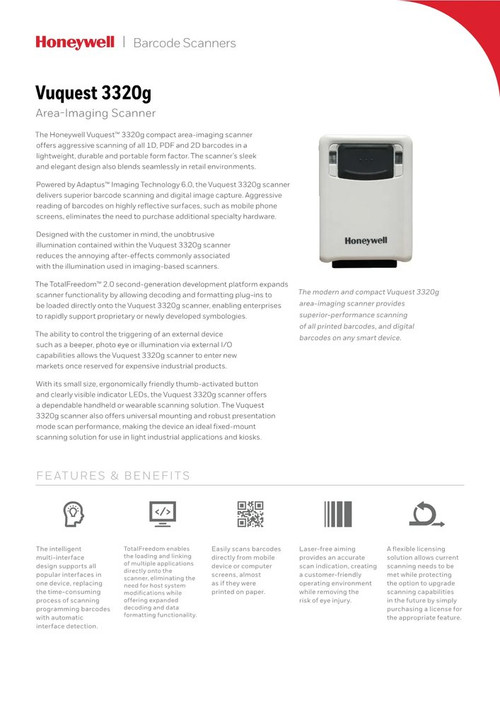
The 3320G-5USBX-0 connects via corded USB and operates as a presentation scanner — items are passed in front of the unit rather than the unit being aimed at items. This hands-free mode suits high-throughput checkout lanes or self-service kiosks where the operator's hands must remain free. Battery life is not applicable on the 3320G-5USBX-0 since it draws power directly from the USB host (5 VDC ± 0.25 V); the 1400GSR-1-N operates on 4.0–5.5 VDC but battery specifications are not provided in the supplied data.
Which scanner covers your read-distance and barcode-type requirements?
The 3320G-5USBX-0 offers a substantially wider working range of 15–120 cm (6–48 in), which allows it to read barcodes presented at varying distances from the window — useful when item sizes differ greatly at a checkout counter. Its scan array is 838 × 640 pixels and it explicitly lists 1D symbologies (Code 128, Code 39, EAN, UPC) and 2D symbologies (QR Code, Data Matrix, PDF417) in the provided specifications.
The 1400GSR-1-N has a narrower working range of 2.5–50.8 cm (1–20 in), which is suited to close-range scanning of labels on boxes, shelves, or documents. Its scan array is 640 × 480 pixels. Both units read 1D and 2D barcodes via area-imager engines, but the 3320G-5USBX-0's larger pixel array may support reading smaller or lower-contrast codes at distance. Specific decode performance figures (first-pass read rate, minimum bar width) are not provided in the supplied specs for either model.
Which scanner is better protected for your physical environment?
The 1400GSR-1-N carries an IP65 ingress protection rating — fully dust-tight and protected against water jets — and a 2.0 m (6.6 ft) drop rating. These ratings make it appropriate for warehouse loading docks, manufacturing floors, or outdoor field use where the device may be exposed to dust, spray, or accidental drops from waist or shoulder height.
The 3320G-5USBX-0 is rated IP53 per its primary specification field (note: a secondary tilde-prefixed field in the provided data states IP42 — the two figures conflict; buyers should verify against the official Honeywell datasheet before specifying). Its drop rating is 1.8 m (6 ft) to concrete per the provided specs. Both devices share an operating temperature range of 0°C to 40°C (32°F to 104°F) at the spec-sheet level. The 3320G-5USBX-0 lists a storage/operating low of -20°C, while the 1400GSR-1-N lists storage down to -40°C — an advantage in cold-chain or unheated storage environments.
Which should you choose: the 1400GSR-1-N or the 3320G-5USBX-0?
Our take: The 1400GSR-1-N is the stronger choice when mobility, ruggedness, and wire-free operation are the primary requirements. Its Bluetooth 4.2 wireless connectivity, IP65 rating versus the 3320G-5USBX-0's IP53 (or IP42 — conflicting specs in the provided data), and 2.0 m drop rating versus 1.8 m make it the more durable, portable unit. The 3320G-5USBX-0 wins on working range (15–120 cm versus 2.5–50.8 cm) and scan resolution (838 × 640 versus 640 × 480 pixels), and its hands-free presentation scanning mode is purpose-built for retail POS lanes where throughput and operator ergonomics matter more than mobility. Choose the 1400GSR-1-N for roving warehouse or field-service deployments requiring wireless freedom; choose the 3320G-5USBX-0 for fixed checkout counters or service desks where corded USB power and hands-free scanning drive efficiency.
Side-by-Side Comparison
Spec-for-spec, from manufacturer data.
| Specification | Honeywell 1400GSR-1-N | Honeywell 3320G-5USBX-0 |
|---|---|---|
| Series / Family | Xenon XP 1952g | Vuquest 3320g |
| Part Number | 1400GSR-1-N | 3320G-5USBX-0 |
| Form Factor | Handheld | Presentation Scanner |
| Scan Type | Area Imager (1D/2D) | Area Imager (1D/2D) |
| Connectivity | Bluetooth 4.2 (wireless) | Corded USB |
| Working Range | 2.5–50.8 cm (1–20 in) | 15–120 cm (6–48 in) |
| Scan Array | 640 × 480 pixels | 838 × 640 pixels |
| IP Rating | IP65 | IP53 (secondary source states IP42 — verify datasheet) |
| Drop Rating | 2.0 m (6.6 ft) | 1.8 m (6 ft) to concrete |
| Operating Temp | 0°C to 40°C (32°F to 104°F) | 0°C to 40°C (per spec field; -20°C listed in separate field — verify) |
| Storage Temp | -40°C to 60°C | — |
| Input Voltage | 4.0–5.5 VDC | 5 VDC ± 0.25 V |
| Battery | — | Not applicable (USB powered) |
| Weight | 119 g (4.2 oz) | 77 g (2.7 oz) |
| Dimensions (L×W×H) | 180 × 66 × 43 mm (7.1 × 2.6 × 1.7 in) | — |
| Warranty | 3-year | 3-year |
Frequently Asked Questions
Which should you choose: the 1400GSR-1-N or the 3320G-5USBX-0?
The 1400GSR-1-N is the stronger choice when mobility, ruggedness, and wire-free operation are the primary requirements. Its Bluetooth 4.2 wireless connectivity, IP65 rating versus the 3320G-5USBX-0's IP53 (or IP42 — conflicting specs in the provided data), and 2.0 m drop rating versus 1.8 m make it the more durable, portable unit. The 3320G-5USBX-0 wins on working range (15–120 cm versus 2.5–50.8 cm) and scan resolution (838 × 640 versus 640 × 480 pixels), and its hands-free presentation scanning mode is purpose-built for retail POS lanes where throughput and operator ergonomics matter more than mobility. Choose the 1400GSR-1-N for roving warehouse or field-service deployments requiring wireless freedom; choose the 3320G-5USBX-0 for fixed checkout counters or service desks where corded USB power and hands-free scanning drive efficiency.
Is the 1400GSR-1-N or the 3320G-5USBX-0 better for a warehouse picking operation?
The 1400GSR-1-N is better suited to warehouse picking. Its Bluetooth 4.2 wireless connection frees pickers from cable tethering, its IP65 rating handles dust and spray common in distribution environments, and its 2.0 m drop rating tolerates accidental drops from picking height. The 3320G-5USBX-0 is a corded presentation scanner optimized for stationary POS use, not mobile picking workflows.
Which scanner handles a wider range of barcode distances at a retail checkout?
The 3320G-5USBX-0 covers 15–120 cm (6–48 in), compared to 2.5–50.8 cm (1–20 in) for the 1400GSR-1-N. For a retail checkout where items of varying sizes are passed across the scanner window, the 3320G-5USBX-0's longer maximum read distance and higher-resolution 838 × 640 pixel array provide more flexibility. Both units read 1D and 2D symbologies including QR Code, Data Matrix, and PDF417.
Do both scanners carry the same warranty?
Yes — both the 1400GSR-1-N and the 3320G-5USBX-0 are covered by a 3-year warranty per the provided specifications. Warranty terms and service depot details should be confirmed with Honeywell directly, as the supplied specs do not detail coverage scope or regional conditions.
More Barcode Scanner Comparisons
- Zebra DS8108 vs Datalogic GBT4600-HC-BTK1-HP
- Zebra DS8108 vs Datalogic GD4590-HCK10-HDR-B
- Zebra DS8108 vs Honeywell 1202G-2USB-5BF-N
- Zebra DS8108 vs Datalogic GBT4500-BK-BTK1DRA
- Zebra DS8108 vs Zebra DS3608
- Zebra DS8108 vs Zebra LI3608
Barcode Scanner Buying Guides
Get a Second Opinion on Your Camera Choice
Share your site layout, coverage goals, and budget. Our team will validate the camera selection, flag anything we would change, and recommend products that match the use case.