
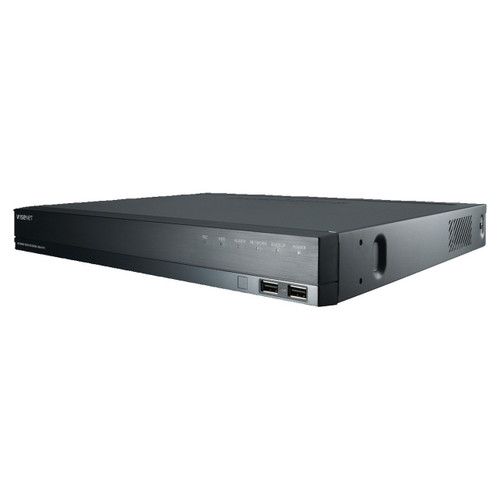
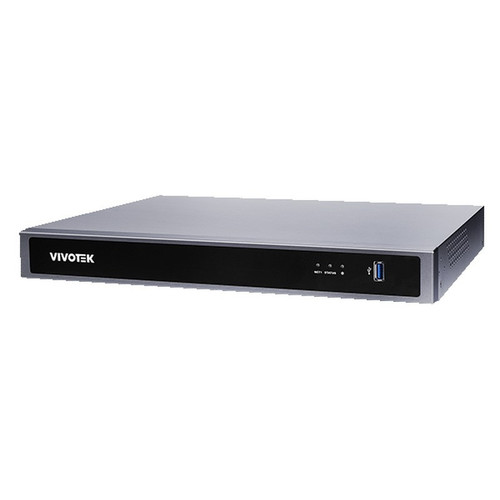
Hanwha XRN-820S vs Vivotek ND9326P: Specification Comparison
The Hanwha XRN-820S and Vivotek ND9326P are both 8-channel, 4K-capable PoE network video recorders occupying the same market tier: dual-bay SATA storage, ONVIF Profile S, hardware decoding, and onboard analytics. Both target mid-market installer deployments where a single appliance must handle recording, live display, and remote access. This comparison examines the three dimensions that most directly drive purchasing decisions—storage and throughput capacity, display and analytics depth, and connectivity and platform resilience—using only manufacturer-published specifications.
In This Guide
- Which NVR offers more recording bandwidth and storage flexibility?
- Which NVR provides stronger display capability, decoding headroom, and search analytics?
- Which NVR is better equipped for integration, remote access, and operational resilience?
- Which should you choose: the XRN-820S or the ND9326P?
- Side-by-Side Specs
- FAQ
Which NVR offers more recording bandwidth and storage flexibility?
The ND9326P records at a maximum of 192 Mbps, compared to 120 Mbps on the XRN-820S—a 60 percent throughput advantage that matters when deploying multiple high-bitrate 4K or multi-imager cameras simultaneously.
Total network input/output throughput on the ND9326P is rated at 224 Mbps versus 120 Mbps on the XRN-820S, confirming the delta is not limited to the recording pipe alone.
Both units provide two internal 3.5-inch SATA HDD bays. The XRN-820S specifies a maximum of 12 TB total (up to 6 TB per drive). The ND9326P does not publish a per-drive or aggregate maximum in the provided specifications, so direct storage-ceiling comparisons cannot be made.
The ND9326P supports RAID 0 and RAID 1, providing either mirrored redundancy or striped capacity across both drives. The XRN-820S does not list RAID support in the provided specifications; it instead offers ARB (Automatic Rate Backup) and N+1 Failover at the camera level rather than the disk level.
The ND9326P documents pre-record of up to 10 seconds and post-record of up to 300 seconds per event. The XRN-820S does not specify pre/post record durations in the provided data.
Which NVR provides stronger display capability, decoding headroom, and search analytics?
The ND9326P's decoded output resolution extends to 7680x2560, while the XRN-820S peaks at 3840x2160 (4K UHD) on its HDMI output. Both provide a single HDMI and single VGA output. The XRN-820S explicitly supports dual-monitor operation in Full HD mode (HDMI + VGA simultaneously); simultaneous dual-output on the ND9326P is not stated in the provided specifications.
Decoding throughput on the ND9326P is rated at 3840x2160 at 120 fps and 1920x1080 at 480 fps. The XRN-820S is rated at 1080p at 240 fps and 32 MP at 15 fps. These figures are not directly equivalent—the Vivotek spec is frame-rate at a resolution tier; the Hanwha spec combines a high-frame-rate 1080p figure with a low-frame-rate 32 MP ceiling.
The ND9326P includes an onboard DLPU (Deep Learning Processing Unit) and supports object-attribute analytics natively: people attributes (gender, age, clothing color, accessories) and vehicle attributes (type, color), plus line crossing, intrusion, loitering, VCA counting, and Smart Search II—all processed locally. The XRN-820S supports AI object-attribute search only when paired with a compatible Wisenet AI Camera; analytics are camera-side, not NVR-side.
Fisheye dewarping is handled locally on the ND9326P in six modes (1O, 1P, 1R, 1O3R, 1O8R, 1P3R). On the XRN-820S, fisheye dewarping is available only through the CMS software, not locally at the NVR.
The XRN-820S supports up to 32-channel simultaneous playback (8 local, 8 remote per user) and up to 16 display divisions. The ND9326P specifies 4-channel simultaneous playback and 8-channel live view per the provided specs.
The ND9326P includes Trend Micro IoT Security as an embedded cybersecurity layer. The XRN-820S relies on 802.1x, IP filtering, Hanwha Techwin Root CA device certificates, and signed firmware; no equivalent embedded third-party security engine is listed.
Which NVR is better equipped for integration, remote access, and operational resilience?
Both NVRs provide 8 PoE+ ports for camera connections plus 2 uplink RJ-45 ports. The XRN-820S specifies the uplink ports at 1 Gbps and PoE ports at 10/100 Mbps. The ND9326P lists the uplink ports as 10/100/1000 Mbps; per-PoE-port speed is not broken out in the provided specifications.
The XRN-820S publishes a 100 W PoE budget across its 8 ports (approximately 12.5 W average per camera). The ND9326P does not state a total PoE power budget in the provided specifications—a meaningful gap for installers sizing PoE-powered cameras.
The XRN-820S supports up to 10 live unicast and 20 multicast concurrent users, with a cap of 3 simultaneous search users. The ND9326P does not specify concurrent user limits in the provided data.
For camera-level resilience, the XRN-820S provides N+1 Failover and ARB (Automatic Rate Backup). The ND9326P does not list failover or automatic rate backup features in the provided specifications; it does include a hardware + software watchdog and automatic restart after power recovery, which the XRN-820S does not list.
The XRN-820S supports P2P QR-code configuration and Hanwha DDNS. The ND9326P does not specify P2P or quick-setup mechanisms in the provided data.
VMS ecosystem differs materially: the XRN-820S integrates with Hanwha WAVE and SSM (enterprise VMS platforms), Webviewer, Smart Viewer, and Wisenet Mobile. The ND9326P integrates with Vivotek Shepherd and VSS (VAST Security Station), plus iViewer, VIVOCloud, and VORTEX mobile apps. Browser support on the ND9326P is Chrome-only; the XRN-820S additionally supports Edge and Safari.
The XRN-820S operates from 0°C to 40°C; the ND9326P operates from -10°C to 55°C—a 10°C lower cold-side and 15°C higher warm-side tolerance relevant for unconditioned enclosures or outdoor cabinets.
The ND9326P carries published certifications: CE, FCC, VCCI, C-Tick, UL, CB, BSMI, and BIS, plus a stated 2-year warranty. The XRN-820S does not list certifications or warranty terms in the provided specifications.
Which should you choose: the XRN-820S or the ND9326P?
Our take: The ND9326P is the stronger choice when recording bandwidth, onboard AI analytics, and storage redundancy are the primary criteria; the XRN-820S is the stronger choice when VMS ecosystem depth, concurrent user capacity, and camera-level resilience are paramount. On throughput, the ND9326P leads at 192 Mbps versus the XRN-820S's 120 Mbps—a 60 percent advantage. On analytics, the ND9326P's onboard DLPU handles people- and vehicle-attribute search and VCA natively, while the XRN-820S delegates analytics to compatible Wisenet AI cameras. On concurrent access and resilience, the XRN-820S supports 32-channel simultaneous playback versus 4-channel on the ND9326P, documents N+1 failover, a published 100 W PoE budget, and 10 concurrent live unicast users—figures the ND9326P either does not match or does not publish. Installers building a Hanwha camera ecosystem or requiring WAVE/SSM VMS integration should favor the XRN-820S; those deploying mixed-brand cameras needing onboard deep-learning analytics, RAID 1 storage protection, and a wider operating temperature range (-10°C to 55°C) should favor the ND9326P.
Side-by-Side Comparison
Spec-for-spec, from manufacturer data.
| Specification | Hanwha XRN-820S | Vivotek ND9326P |
|---|---|---|
| Max camera inputs | 8 CH | 8 CH |
| Max input resolution per camera | 32 MP | 8 MP (per spec fields) |
| Max recording bandwidth | 120 Mbps | 192 Mbps |
| Total network throughput (in+out) | 120 Mbps | 224 Mbps |
| HDD bays | 2x SATA (max 12 TB; 6 TB per drive) | 2x internal 3.5" (max capacity not specified) |
| RAID support | — | RAID 0, 1 |
| PoE ports | 8x PoE+ (10/100 Mbps each) | 8x PoE+ |
| PoE power budget | 100 W | — |
| Uplink ports | 2x RJ-45 (1 Gbps) | 2x RJ-45 (10/100/1000 Mbps) |
| Display outputs | 1x HDMI (4K@30Hz) + 1x VGA (1080p@60Hz) | 1x HDMI + 1x VGA (up to 3840x2160) |
| Max simultaneous playback channels | 32 CH (8 local + 8 remote/user) | 4 CH |
| Onboard AI / deep learning | Via Wisenet AI Camera (camera-side) | DLPU onboard (people & vehicle attributes, VCA) |
| Fisheye dewarping | CMS only (not local) | Local: 6 modes; Web: 3 modes |
| N+1 failover / ARB | Yes (N+1 Failover + ARB) | — |
| Operating temperature | 0°C to +40°C | -10°C to +55°C |
| Third-party certifications | — | CE, FCC, UL, VCCI, C-Tick, CB, BSMI, BIS |
Frequently Asked Questions
Which should you choose: the XRN-820S or the ND9326P?
The ND9326P is the stronger choice when recording bandwidth, onboard AI analytics, and storage redundancy are the primary criteria; the XRN-820S is the stronger choice when VMS ecosystem depth, concurrent user capacity, and camera-level resilience are paramount. On throughput, the ND9326P leads at 192 Mbps versus the XRN-820S's 120 Mbps—a 60 percent advantage. On analytics, the ND9326P's onboard DLPU handles people- and vehicle-attribute search and VCA natively, while the XRN-820S delegates analytics to compatible Wisenet AI cameras. On concurrent access and resilience, the XRN-820S supports 32-channel simultaneous playback versus 4-channel on the ND9326P, documents N+1 failover, a published 100 W PoE budget, and 10 concurrent live unicast users—figures the ND9326P either does not match or does not publish. Installers building a Hanwha camera ecosystem or requiring WAVE/SSM VMS integration should favor the XRN-820S; those deploying mixed-brand cameras needing onboard deep-learning analytics, RAID 1 storage protection, and a wider operating temperature range (-10°C to 55°C) should favor the ND9326P.
Can I mix cameras from other brands on either NVR?
Both NVRs support ONVIF Profile S, which enables basic interoperability with cameras from other manufacturers. The XRN-820S also lists SUNAPI, Hanwha's proprietary protocol, which unlocks advanced features—including AI object-attribute search—only when used with compatible Wisenet AI cameras. The ND9326P's onboard DLPU-based analytics are applied to its own recording pipeline; the provided specifications do not clarify whether the same analytics depth applies to non-Vivotek ONVIF cameras.
Which NVR handles more cameras at high resolution without dropping frames?
Based on published specifications, the ND9326P has a higher recording bandwidth ceiling (192 Mbps vs. 120 Mbps) and a higher total network throughput (224 Mbps vs. 120 Mbps), providing more headroom per channel at high bitrates across an 8-camera deployment. The XRN-820S supports up to 32 MP input resolution per camera versus 8 MP per the ND9326P's spec fields, so the Hanwha unit may be appropriate if any camera exceeds 8 MP—provided aggregate bitrate stays within 120 Mbps.
Do either of these NVRs protect recordings if a hard drive fails?
The ND9326P supports RAID 1 (mirroring), which writes identical data to both drives and maintains recording access if one drive fails. The XRN-820S does not list RAID support in the provided specifications; its resilience features are camera-level (N+1 Failover and ARB) rather than disk-level. For sites where drive failure cannot interrupt footage retention, the ND9326P's RAID 1 capability is a meaningful differentiator.
Get a Second Opinion on Your Camera Choice
Share your site layout, coverage goals, and budget. Our team will validate the camera selection, flag anything we would change, and recommend products that match the use case.