
Vivotek ND9323P vs Hanwha QRN-830S: Specification Comparison
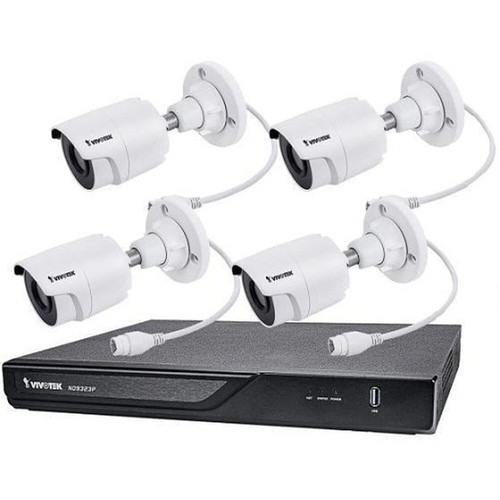
Both the Vivotek ND9323P and the Hanwha QRN-830S are 8-channel embedded-Linux network video recorders targeting small-to-midsize IP camera deployments. The ND9323P ships as a bundle including four 2MP IR turret cameras, a 2TB HDD, and a built-in PoE+ switch, making it a turnkey kit. The QRN-830S is a standalone recorder with an 8-port PoE switch, single HDD bay, and a broader codec and redundancy feature set. This comparison evaluates both units on recording capacity and throughput, power architecture and physical footprint, and integration, redundancy, and management capabilities.
In This Guide
- How do the two NVRs compare on recording capacity, throughput, and storage?
- How do the two units differ in power architecture, PoE budget, and physical footprint?
- Which NVR offers stronger integration, redundancy, and remote management capabilities?
- Which should you choose: the ND9323P or the QRN-830S?
- Side-by-Side Specs
- FAQ
How do the two NVRs compare on recording capacity, throughput, and storage?
The ND9323P supports a maximum recording throughput of 64 Mbps across its 8 channels and ships with a 2TB HDD pre-installed across two internal 3.5-inch SATA bays. It supports RAID 0 and RAID 1, providing either performance striping or mirror redundancy. Maximum single-channel decode reaches 4K (3840×2160) at 30 fps, with multi-channel decode rated at 1080p×4 channels at 120 fps and 720p×8 channels at 240 fps. The unit records a single stream per channel.
The QRN-830S specifies a maximum recording bandwidth of 80 Mbps, 25% higher than the ND9323P. It accommodates a single SATA HDD rated up to 6TB—no RAID is specified. Decode performance is stated as 8MP at 60 fps, 1080p at 240 fps, and 720p at 240 fps. The QRN-830S also supports Dual Stream recording mode alongside Normal, Schedule, Event, and Bookmark modes—the ND9323P lists Single stream only. Simultaneous playback reaches 32 channels (local 8, remote 8 per user up to 3 remote users) versus the ND9323P's 4-channel local playback display.
For raw throughput and single-drive capacity, the QRN-830S has the higher ceiling (80 Mbps, 6TB). The ND9323P counters with RAID support and a bundled 2TB drive, which is meaningful for installations that require disk redundancy without external NAS.
How do the two units differ in power architecture, PoE budget, and physical footprint?
The ND9323P draws up to 175 W maximum and is powered by 100–240 V AC. Its PoE+ switch feeds all 8 camera ports; however, the total PoE budget is not explicitly stated in the provided specifications. The unit measures 366 × 320.3 × 46 mm and weighs 2.5 kg without HDD. It offers one front USB 3.0 and one rear USB 2.0 port, plus one HDMI and one VGA video output.
The QRN-830S is powered by a 54 VDC / 1.55 A DC adapter and draws a maximum of 84 W with one HDD installed and PoE active—less than half the ND9323P's rated maximum. Its PoE budget is specified at 65 W across 8 ports rated at 10/100 Mbps each, with a separate 1 Gbps RJ-45 for LAN/WAN uplink. It measures 300 × 47.6 × 238.9 mm and weighs 1.32 kg. It provides two front USB 2.0 ports and HDMI output only—no VGA.
The QRN-830S is physically smaller and substantially more power-efficient. The ND9323P includes VGA output (useful where legacy monitors are present) and higher-speed USB 3.0 on the front panel. The ND9323P's total PoE budget is not disclosed in the spec sheet; the QRN-830S explicitly lists 65 W, which constrains camera power draw per port to an average of ~8 W if all 8 are in use simultaneously.
Which NVR offers stronger integration, redundancy, and remote management capabilities?
The ND9323P integrates with ONVIF Profile S cameras and supports Vivotek's own VCA (video content analytics) features including crowd control, people counting, and VCA event search. Management software includes Shepherd and VAST 2 on the desktop side, iViewer for Android and iOS, and VIVOCloud for cloud access. Security features include Trend Micro IoT Security and cybersecurity management. The unit supports two user levels (administrator and regular user) and logs system, recording, user, and error events. No failover or ARB redundancy is specified.
The QRN-830S supports both ONVIF Profile S and Hanwha's proprietary SUNAPI, enabling tighter integration with Hanwha cameras and third-party SUNAPI-compatible systems. It specifies N+1 failover redundancy and ARB (Automatic Recovery Backup) support—neither of which appears in the ND9323P specs. The log system stores up to 100,000 entries each for system and event logs. Remote access allows up to 10 live unicast users and 20 multicast users simultaneously. Security features include 802.1x port authentication, IP address filtering, device certificates (Hanwha Techwin Root CA), and signed firmware. P2P setup via QR code is supported. Web viewer is confirmed on Windows 10 and macOS 11 via Chrome, Edge, and Safari.
The QRN-830S carries a materially stronger redundancy and security posture: N+1 failover, ARB, 802.1x, signed firmware, and device certificates are all absent from the ND9323P spec sheet. The ND9323P's advantage lies in its bundled VCA analytics suite and Trend Micro IoT integration, which add value for sites already in the Vivotek ecosystem.
Which should you choose: the ND9323P or the QRN-830S?
Our take: The ND9323P is the stronger choice when the buyer needs a turnkey kit—cameras, HDD, and RAID-capable storage included—and values Vivotek's on-board VCA analytics and Trend Micro cybersecurity integration. The QRN-830S outperforms it on three concrete dimensions: recording bandwidth (80 Mbps vs 64 Mbps), maximum single-drive capacity (6TB vs 2TB pre-installed), and enterprise redundancy (N+1 failover plus ARB, both absent from the ND9323P spec sheet). Power draw also favors the QRN-830S significantly (84 W vs 175 W maximum), relevant for rack-density or UPS-sizing decisions. The ND9323P is best suited for a small, self-contained Vivotek camera deployment where RAID disk mirroring and an all-in-one kit reduce installation time. The QRN-830S is better aligned with integrators building or expanding Hanwha Wisenet ecosystems who need higher throughput headroom, enterprise failover, and stronger authenticated security controls.
Side-by-Side Comparison
Spec-for-spec, from manufacturer data.
| Specification | Vivotek ND9323P | Hanwha QRN-830S |
|---|---|---|
| Camera Channels | 8 | 8 |
| Max Recording Bandwidth | 64 Mbps | 80 Mbps |
| Video Compression | H.265, H.264, MJPEG | H.265, H.264, MJPEG |
| Max Decode Resolution | 3840×2160 (4K) | 3840×2160 (4K) |
| HDD Bays | 2 × internal 3.5" SATA | 1 × SATA |
| Max HDD Capacity | Not specified (see VIVOTEK HDD list) | 6TB |
| Bundled Storage | 2TB HDD included | No HDD included |
| RAID Support | RAID 0, 1 | — |
| PoE Ports | 8 (PoE+) | 8 × 10/100 (PoE) |
| PoE Budget | Not specified | 65W |
| Max Power Draw | 175W | 84W (with 1HDD, PoE on) |
| Video Outputs | HDMI × 1, VGA × 1 | HDMI × 1 |
| Failover / ARB | — | N+1 failover; ARB supported |
| Camera Protocol | ONVIF Profile S | ONVIF Profile S; SUNAPI |
| 802.1x / Signed Firmware | — | Supported |
| Operating Temperature | 0°C – 40°C | 0°C – 40°C |
Frequently Asked Questions
Which should you choose: the ND9323P or the QRN-830S?
The ND9323P is the stronger choice when the buyer needs a turnkey kit—cameras, HDD, and RAID-capable storage included—and values Vivotek's on-board VCA analytics and Trend Micro cybersecurity integration. The QRN-830S outperforms it on three concrete dimensions: recording bandwidth (80 Mbps vs 64 Mbps), maximum single-drive capacity (6TB vs 2TB pre-installed), and enterprise redundancy (N+1 failover plus ARB, both absent from the ND9323P spec sheet). Power draw also favors the QRN-830S significantly (84 W vs 175 W maximum), relevant for rack-density or UPS-sizing decisions. The ND9323P is best suited for a small, self-contained Vivotek camera deployment where RAID disk mirroring and an all-in-one kit reduce installation time. The QRN-830S is better aligned with integrators building or expanding Hanwha Wisenet ecosystems who need higher throughput headroom, enterprise failover, and stronger authenticated security controls.
Does the ND9323P or QRN-830S support higher recording throughput?
The QRN-830S specifies a maximum recording bandwidth of 80 Mbps versus 64 Mbps for the ND9323P, giving it a 25% throughput advantage. This matters in deployments using higher-bitrate 4K or multi-stream cameras.
Which NVR is better if I need disk redundancy or failover?
The ND9323P supports RAID 0 and RAID 1 across its two internal HDD bays, providing on-device disk redundancy. The QRN-830S does not list RAID (it has a single HDD bay) but does specify N+1 recorder failover and ARB (Automatic Recovery Backup)—a different form of redundancy at the system level rather than the disk level. Neither model offers both; the right choice depends on whether the priority is disk-level or recorder-level resilience.
Can I use the QRN-830S or ND9323P with cameras from other manufacturers?
Both units support ONVIF Profile S, enabling integration with third-party ONVIF-compliant cameras. The QRN-830S additionally supports SUNAPI, Hanwha's proprietary protocol, offering deeper integration with Hanwha Wisenet cameras. The ND9323P lists ONVIF Profile S only; no proprietary multi-vendor protocol is specified beyond that.
Get a Second Opinion on Your Camera Choice
Share your site layout, coverage goals, and budget. Our team will validate the camera selection, flag anything we would change, and recommend products that match the use case.