
Vivotek ND9323P vs Vivotek ND9323P: Specification Comparison
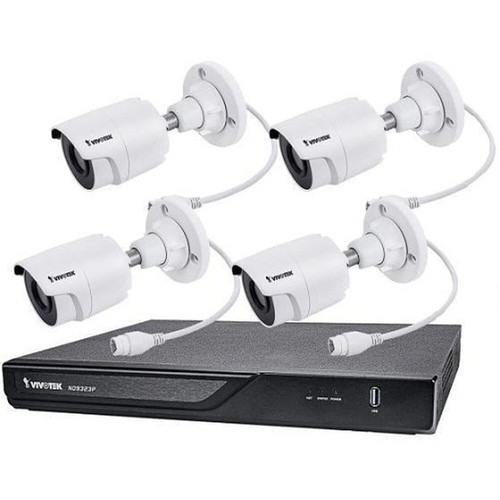
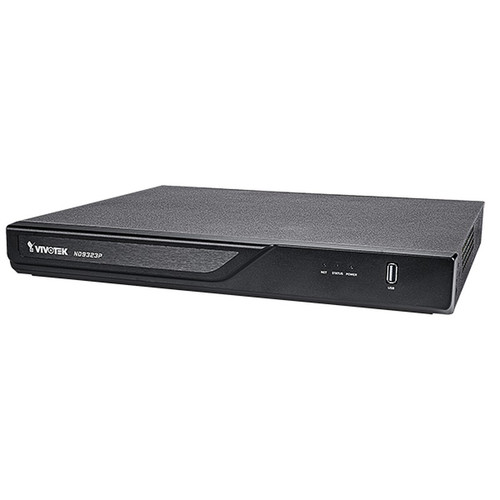
Both SKUs are built on the Vivotek ND9323P, an 8-channel embedded-Linux NVR with PoE+ camera ports, hardware H.265 decode to 4K, dual 3.5-inch SATA bays with RAID 0/1 support, and a 64 Mbps recording throughput ceiling. The comparison is between the standalone recorder (SKU: ND9323P) and a pre-configured bundle (SKU: ND9323P-2TB-4IB69) that adds a 2TB HDD and four 2MP IR turret cameras. A buyer choosing between them is weighing out-of-box readiness and camera compatibility against the flexibility of self-sourcing storage and cameras.
In This Guide
- What does each SKU include out of the box, and how does that affect day-one deployment?
- Are there any recording throughput, decoding, or power delivery differences between the two listings?
- How do both SKUs compare on camera integration, VMS compatibility, remote access, and cybersecurity features?
- Which should you choose: the ND9323P or the ND9323P?
- Side-by-Side Specs
- FAQ
What does each SKU include out of the box, and how does that affect day-one deployment?
The bundle SKU (ND9323P-2TB-4IB69) ships with a 2TB HDD pre-installed across the NVR's dual 3.5-inch SATA bays and includes four 2MP (1920×1080) IR turret cameras. The turret cameras are wired, wall- and ceiling-mountable, and connect via the NVR's integrated PoE+ ports — no separate power supplies or DVR-style coax required. The camera specs note IR illumination for low-light operation, though no specific IR range in meters is stated in the provided specs.
The standalone SKU (ND9323P) ships without any pre-installed HDD and without cameras. The buyer must separately source up to two 3.5-inch SATA drives (Vivotek's recommended HDD list applies) and compatible IP cameras. RAID 0 or RAID 1 can be configured once drives are installed; RAID 1 would mirror two drives for redundancy but would halve usable capacity. For installers who prefer to specify their own camera models — including higher-resolution units up to the NVR's 4K decode ceiling — the standalone unit provides that flexibility without paying for bundled cameras that may not fit the project.
Are there any recording throughput, decoding, or power delivery differences between the two listings?
Core recording and decoding specs are identical across both listings: 64 Mbps recording throughput, 88 Mbps total network throughput (input/output), hardware H.265/H.264/MJPEG decode, and a decoding capability of 4K@30fps on one channel, 1080p@120fps across four channels, or 720p@240fps across all eight channels. Pre-record buffer is 5 seconds (max 10) and post-record is 20 seconds (max 300). Both list a maximum power draw of 175W.
One spec field diverges and warrants attention: the 'Frame Rate' field reads 30fps for the bundle SKU and 60fps for the standalone SKU. Given that both share identical Decoding Capability entries (4K@30fps, 1080p@120fps, 720p@240fps), this appears to be a data-entry inconsistency between the two product listings rather than a hardware difference — buyers should confirm with Vivotek documentation or the datasheet before relying on that field.
Similarly, the 'PoE Power' field lists 802.3af for the bundle and 802.3at (PoE+) for the standalone, while both listings share the same 'Power Type: PoE+' body spec. 802.3af delivers up to 15.4W per port; 802.3at delivers up to 30W per port. If the bundled turret cameras are rated for 802.3af power, the lower figure in the bundle listing may simply reflect camera compatibility rather than NVR port capability. Buyers powering high-wattage cameras should verify NVR per-port power budget against Vivotek's published hardware spec.
How do both SKUs compare on camera integration, VMS compatibility, remote access, and cybersecurity features?
Both SKUs share identical integration and management specs. Camera integration is ONVIF Profile S on both, meaning any ONVIF Profile S-compliant IP camera can be added to the remaining four (or all eight, in the standalone) PoE+ ports beyond the bundled cameras. PTZ control lists differ slightly: the bundle SKU specifies Direction Control, Preset, Patrol, and PiP (picture-in-picture); the standalone SKU lists Direction Control, Home, Iris, Preset, and Patrol — adding Home and Iris control but not listing PiP. Both support Smart VCA events, crowd control analytics, VCA counting, and VCA event search.
Remote access and software ecosystem are identical: Shepherd and VAST 2 software, iViewer mobile app (Android and iOS), VIVOCloud remote access, and Trend Micro IoT Security integration. Cybersecurity management is listed as supported on both. User management supports administrator and regular-user levels. Supported protocols include IPv4/IPv6, HTTPS, RTSP/RTP/RTCP, SMTP, FTP, DHCP, NTP, DNS, DDNS, and IP Filter. Both carry the same safety certifications: CE, FCC, VCCI, C-Tick, UL, CB, BSMI, and BIS.
Which should you choose: the ND9323P or the ND9323P?
Our take: The ND9323P bundle (ND9323P-2TB-4IB69) is the stronger choice when a buyer needs a complete, immediately deployable 8-channel system at a defined spec point — specifically four 2MP IR turret cameras plus 2TB of pre-installed storage — while the standalone ND9323P suits integrators who will self-specify cameras and storage. Three concrete deltas from the specs: (1) the bundle includes 2TB HDD vs. no storage in the standalone, directly affecting day-one recording readiness; (2) the bundle adds four 2MP IR turret cameras vs. zero included cameras in the standalone; (3) the PoE power field shows 802.3af for the bundle vs. 802.3at for the standalone — a discrepancy that buyers powering higher-wattage cameras should verify against Vivotek's published hardware spec before procurement. Both units share identical NVR core hardware, ONVIF Profile S integration, VAST 2/VIVOCloud management, and Trend Micro IoT security. The standalone is the right choice for custom integrations requiring cameras above 2MP or specific third-party models.
Side-by-Side Comparison
Spec-for-spec, from manufacturer data.
| Specification | Vivotek ND9323P | Vivotek ND9323P |
|---|---|---|
| SKU | ND9323P-2TB-4IB69 | ND9323P |
| Bundle Includes | NVR + 2TB HDD + 4x 2MP IR turret cameras | NVR only (no HDD, no cameras) |
| Recording Channels | 8 | 8 |
| Pre-installed Storage | 2TB HDD (dual 3.5" SATA) | None (dual 3.5" SATA bays, HDD sold separately) |
| RAID Support | RAID 0, 1 | RAID 0, 1 |
| Recording Throughput | 64 Mbps | 64 Mbps |
| Network Throughput (Total) | 88 Mbps | 88 Mbps |
| Decoding Capability | 4K@30fps (1-CH); 1080p@120fps (4-CH); 720p@240fps (8-CH) | 4K@30fps (1-CH); 1080p@120fps (4-CH); 720p@240fps (8-CH) |
| Max Display Resolution | 3840x2160 | 3840x2160 |
| Video Formats | H.265, H.264, MJPEG | H.265, H.264, MJPEG |
| PoE Power Field (listing) | PoE 802.3af (see note) | PoE+ 802.3at (see note) |
| Frame Rate Field (listing) | 30fps (see note) | 60fps (see note) |
| PTZ Features | Direction Control, Preset, Patrol, PiP | Direction Control, Home, Iris, Preset, Patrol |
| Camera Integration | ONVIF Profile S | ONVIF Profile S |
| Max Power Draw | 175W | 175W |
| Safety Certifications | CE, FCC, VCCI, C-Tick, UL, CB, BSMI, BIS | CE, FCC, VCCI, C-Tick, UL, CB, BSMI, BIS |
| Warranty | 2 Year | 2 Year |
Frequently Asked Questions
Which should you choose: the ND9323P or the ND9323P?
The ND9323P bundle (ND9323P-2TB-4IB69) is the stronger choice when a buyer needs a complete, immediately deployable 8-channel system at a defined spec point — specifically four 2MP IR turret cameras plus 2TB of pre-installed storage — while the standalone ND9323P suits integrators who will self-specify cameras and storage. Three concrete deltas from the specs: (1) the bundle includes 2TB HDD vs. no storage in the standalone, directly affecting day-one recording readiness; (2) the bundle adds four 2MP IR turret cameras vs. zero included cameras in the standalone; (3) the PoE power field shows 802.3af for the bundle vs. 802.3at for the standalone — a discrepancy that buyers powering higher-wattage cameras should verify against Vivotek's published hardware spec before procurement. Both units share identical NVR core hardware, ONVIF Profile S integration, VAST 2/VIVOCloud management, and Trend Micro IoT security. The standalone is the right choice for custom integrations requiring cameras above 2MP or specific third-party models.
Do I need to buy cameras and a hard drive separately if I choose the standalone ND9323P?
Yes. The standalone SKU (ND9323P) ships without any pre-installed HDD or cameras. You will need to source up to two 3.5-inch SATA hard drives (consult Vivotek's recommended HDD list) and up to eight ONVIF Profile S-compatible IP cameras separately. The bundle SKU (ND9323P-2TB-4IB69) includes a 2TB HDD pre-installed and four 2MP IR turret cameras ready to connect via the NVR's PoE+ ports.
Can I add higher-resolution cameras — like 4K or 5MP — to either SKU?
Both SKUs share the same NVR hardware, which specifies a decoding capability of 4K (3840×2160) at 30fps on a single channel and a total recording throughput of 64 Mbps. You can connect higher-resolution cameras to available PoE+ ports on either unit, subject to that throughput ceiling and per-port power budget. The bundled turret cameras are 2MP; the four remaining open ports on the bundle SKU can accept cameras up to the NVR's decode ceiling, provided they are ONVIF Profile S-compliant.
Is there a real hardware difference between the bundle and standalone listings, or are they the same NVR?
The underlying NVR hardware in both SKUs is the same Vivotek ND9323P model, sharing identical processor, decode, throughput, port count, dimensions, weight, OS, and certification specs. The bundle (ND9323P-2TB-4IB69) adds pre-installed 2TB storage and four 2MP IR turret cameras. Two spec fields — Frame Rate (30fps vs. 60fps) and PoE Power level (802.3af vs. 802.3at) — differ between the two listings; based on the shared Decoding Capability entries, these appear to be listing-level data inconsistencies rather than hardware differences, and should be verified against Vivotek's official datasheet before purchase.
Get a Second Opinion on Your Camera Choice
Share your site layout, coverage goals, and budget. Our team will validate the camera selection, flag anything we would change, and recommend products that match the use case.