
Hanwha XRN-6420RB2 vs i-PRO NX400/3000T3: Specification Comparison
Both the Hanwha XRN-6420RB2-48TB and the i-PRO WJ-NX400/3000T3 are rack-mount, 64-channel NVRs designed for enterprise-scale IP camera deployments. The comparison covers recording capacity and bandwidth, storage architecture and redundancy, and integration and cybersecurity posture—three dimensions that determine fitness for large-site or multi-site security programs. Neither unit includes built-in PoE switching; both rely on external PoE infrastructure. The two units occupy the same channel tier but differ substantially in pre-installed storage, maximum resolution, bandwidth headroom, and cybersecurity certifications.
In This Guide
- Which NVR delivers more recording capacity and higher-resolution throughput?
- How do the two units compare on installed storage, maximum capacity, and data-protection options?
- Which unit offers stronger third-party integration and cybersecurity credentials?
- Which should you choose: the XRN-6420RB2 or the NX400/3000T3?
- Side-by-Side Specs
- FAQ
Which NVR delivers more recording capacity and higher-resolution throughput?
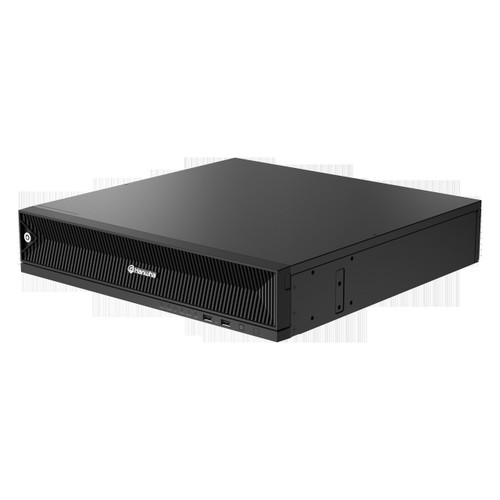
The XRN-6420RB2 supports a maximum per-camera resolution of 32 MP and a total recording bandwidth of 520 Mbps in distributed mode. It decodes 8.3 MP across 4 channels at 30 fps, 1080p across 16 channels at 30 fps, and CIF across all 64 channels at 30 fps. The 32 MP ceiling accommodates current 4K and emerging 8K camera generations without a hardware refresh.
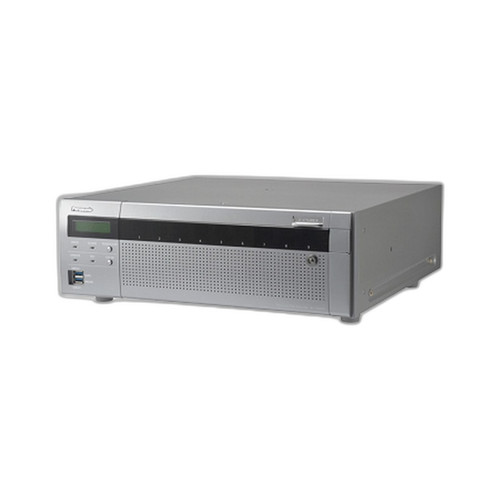
The WJ-NX400/3000T3 specifies a maximum resolution of 2 MP across its 64 channels. No aggregate recording bandwidth figure is provided in the supplied specifications. For deployments where camera resolution is expected to remain at 1080p or below, this ceiling may be sufficient, but the spec gap makes direct bandwidth comparison impossible.
How do the two units compare on installed storage, maximum capacity, and data-protection options?
The XRN-6420RB2 ships with 48 TB pre-configured across 8 SATA HDD bays and expands to a stated maximum of 80 TB. Data protection is limited to RAID 5 and RAID 6, plus an N+1 automatic failover mechanism. RAID 5 tolerates one drive failure; RAID 6 tolerates two. The Intel 12th-generation processor supports the computational overhead of these parity-based RAID modes at high resolution.
The WJ-NX400/3000T3 ships with a single 3 TB drive but supports a maximum capacity of 324 TB—more than four times the Hanwha ceiling—making it suited for very long retention or multi-server SAN/NAS expansion scenarios. It supports RAID 0, 1, 5, 6, and 10, offering a broader redundancy menu including RAID 10 (mirroring plus striping) and RAID 1 (pure mirroring). Local microSD storage is also specified, providing an edge-buffer option. No processor specification is provided in the supplied data.
Which unit offers stronger third-party integration and cybersecurity credentials?
The XRN-6420RB2 is ONVIF-compliant and also supports Hanwha's proprietary SUNAPI, Wisenet Viewer, and Wisenet mobile app. Cybersecurity features include TPM 2.0 hardware root-of-trust and signed firmware. The unit carries NDAA compliance certification. Analytics on-board include defocus detection, audio analytics, dynamic event, and user-defined events. Audio codec support spans G.711, G.726, and AAC at 16 kHz and 48 kHz.
The WJ-NX400/3000T3 is ONVIF Profile S compliant and is stated to be compatible with major VMS platforms and i-PRO IP cameras. No proprietary SDK, cybersecurity hardware features, NDAA compliance status, or on-board analytics are listed in the provided specifications. The absence of these data points does not confirm their absence in the product; buyers should request i-PRO documentation directly for those attributes.
Which should you choose: the XRN-6420RB2 or the NX400/3000T3?
Our take: The XRN-6420RB2 is the stronger choice when resolution headroom, bandwidth capacity, and certified cybersecurity posture are the primary decision criteria. It supports cameras up to 32 MP versus the NX400/3000T3's specified 2 MP ceiling—a 16× resolution advantage—and its 520 Mbps distributed-mode bandwidth is a concrete figure the i-PRO spec sheet does not match. It ships with 48 TB installed versus 3 TB, reducing day-one integration labor for large sites. TPM 2.0, signed firmware, and NDAA compliance are documented on the Hanwha; none of those attributes are confirmed in the i-PRO supplied specs. Conversely, the WJ-NX400/3000T3's 324 TB maximum capacity ceiling and five RAID modes—including RAID 10—make it preferable for very-long-retention or NAS-expansion architectures where the Hanwha's 80 TB hard ceiling becomes a constraint. Buyers already invested in the i-PRO camera ecosystem should verify native integration depth before selecting either unit.
Side-by-Side Comparison
Spec-for-spec, from manufacturer data.
| Specification | Hanwha XRN-6420RB2 | i-PRO NX400/3000T3 |
|---|---|---|
| Product Type | NVR | NVR |
| SKU | XRN-6420RB2-48TB | WJ-NX400/3000T3 |
| Recording Channels | 64 | 64 |
| Maximum Camera Resolution | 32 MP | 2 MP |
| Recording Bandwidth | 520 Mbps (distributed mode) | — |
| Video Compression | H.265, H.264, MJPEG | H.265, H.264, MJPEG |
| Pre-Installed Storage | 48 TB (8 × SATA HDD) | 3 TB (1 × HDD) |
| Maximum Storage Capacity | 80 TB | 324 TB |
| RAID Modes | RAID 5, RAID 6 + N+1 failover | RAID 0, 1, 5, 6, 10 |
| Local Edge Storage | — | microSD |
| ONVIF Compliance | Yes | Yes (Profile S) |
| Proprietary VMS / App | SUNAPI; Wisenet Viewer; Wisenet mobile | i-PRO cameras; major VMS platforms |
| On-Board Analytics | Defocus, Audio, Dynamic Event, User Event | — |
| Cybersecurity Features | TPM 2.0; Signed firmware | — |
| NDAA Compliance | Yes | — |
| Processor | Intel 12th generation | — |
| Network Interfaces | RJ-45 × 3 (LAN/WAN, 1 Gbps each) | — |
| Operating Temperature | 0°C to +40°C (32°F to 104°F) | — |
| Power Input | — | 12V DC |
| Form Factor | Rack-mount NVR | Box (Rack / Shelf) |
| Warranty | 5-Year | — |
| Weight (without HDD) | 8.8 kg (19.4 lb) | — |
| Two-Way Audio | Yes (G.711, G.726, AAC 16/48 kHz) | — |
| Operating System | Embedded Linux | — |
Frequently Asked Questions
Which should you choose: the XRN-6420RB2 or the NX400/3000T3?
The XRN-6420RB2 is the stronger choice when resolution headroom, bandwidth capacity, and certified cybersecurity posture are the primary decision criteria. It supports cameras up to 32 MP versus the NX400/3000T3's specified 2 MP ceiling—a 16× resolution advantage—and its 520 Mbps distributed-mode bandwidth is a concrete figure the i-PRO spec sheet does not match. It ships with 48 TB installed versus 3 TB, reducing day-one integration labor for large sites. TPM 2.0, signed firmware, and NDAA compliance are documented on the Hanwha; none of those attributes are confirmed in the i-PRO supplied specs. Conversely, the WJ-NX400/3000T3's 324 TB maximum capacity ceiling and five RAID modes—including RAID 10—make it preferable for very-long-retention or NAS-expansion architectures where the Hanwha's 80 TB hard ceiling becomes a constraint. Buyers already invested in the i-PRO camera ecosystem should verify native integration depth before selecting either unit.
Is the XRN-6420RB2 or WJ-NX400/3000T3 better for larger deployments with high-resolution cameras?
Based on the provided specifications, the XRN-6420RB2 is better suited for high-resolution deployments. It supports cameras up to 32 MP with a 520 Mbps recording bandwidth, while the WJ-NX400/3000T3 specifies a 2 MP maximum resolution and provides no aggregate bandwidth figure. If your camera rollout includes 4K or higher sensors, the Hanwha is the only unit of the two with documented support.
Which NVR gives me more flexibility for long-term video retention?
The WJ-NX400/3000T3 has the larger maximum storage ceiling at 324 TB, compared to 80 TB for the XRN-6420RB2. If your retention policy requires months of continuous recording at 64 channels, or if you plan to attach external NAS/SAN arrays, the i-PRO unit's higher capacity ceiling and RAID 10 option provide more architectural room. The Hanwha ships with far more pre-installed storage (48 TB vs. 3 TB) but hits its ceiling sooner.
Does either NVR meet federal procurement or cybersecurity requirements like NDAA compliance?
The XRN-6420RB2 is explicitly listed as NDAA-compliant in the provided specifications and includes TPM 2.0 and signed firmware as documented cybersecurity controls. The WJ-NX400/3000T3's supplied specifications do not include NDAA compliance status or cybersecurity hardware features. Buyers subject to federal or NDAA Section 889 procurement rules should request current compliance documentation from i-PRO before specifying the WJ-NX400/3000T3.
Get a Second Opinion on Your Camera Choice
Share your site layout, coverage goals, and budget. Our team will validate the camera selection, flag anything we would change, and recommend products that match the use case.