
Vivotek NR9682-V3 vs Hanwha XRN-6420DB4: Specification Comparison
Both the Vivotek NR9682-V3 and the Hanwha XRN-6420DB4 are rackmount, 64-channel network video recorders built for large-scale IP surveillance deployments. Each ships with 16 hot-swappable SATA drive bays, dual-stream support, RAID redundancy, H.265 compression, and ONVIF compatibility. Buyers evaluating either unit are typically outfitting enterprise or multi-site installations requiring high channel density, significant local storage, and resilient recording. The comparison examines recording throughput and display capability, storage and power architecture, and integration and management ecosystems.
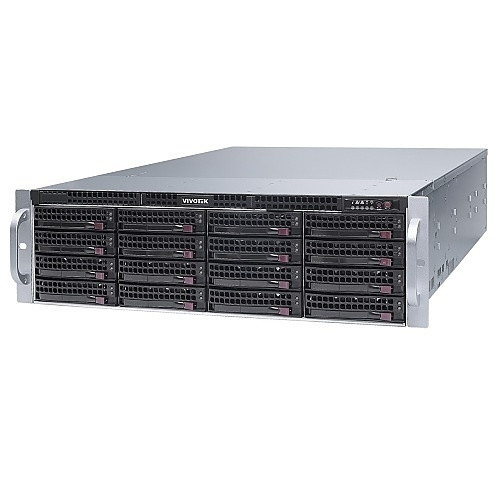
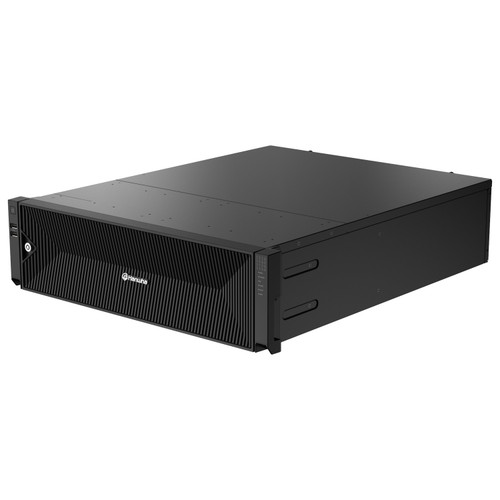
In This Guide
- Which NVR delivers higher recording throughput and better display flexibility?
- How do the two units compare on storage architecture, RAID capability, and power design?
- Which unit offers broader integration, platform compatibility, and management capabilities?
- Which should you choose: the NR9682-V3 or the XRN-6420DB4?
- Side-by-Side Specs
- FAQ
Which NVR delivers higher recording throughput and better display flexibility?
The NR9682-V3 specifies a recording throughput of 512 Mbps and a separate remote-client video throughput of 650 Mbps. Its decoding engine handles resolutions up to 7680x2560 at H.264 1920x1080@360 fps or H.265 1920x1080@180 fps. Display outputs are notably broad: HDMI at 4096x2160 (4K), DisplayPort at 7680x4320 (8K), plus DVI and VGA, with dual-monitor support confirmed.
The XRN-6420DB4 specifies a recording bandwidth of up to 520 Mbps and a playback bandwidth of up to 200 Mbps across 64 channels simultaneously. Its local display is limited to dual HDMI outputs: one at 4K@30Hz and one at 1080p@60Hz. No DisplayPort, DVI, or VGA outputs are listed in the provided specifications. Multi-screen display supports up to 64 divisions.
On raw recording bandwidth the XRN-6420DB4 has a marginal edge (520 Mbps vs. 512 Mbps). The NR9682-V3 holds a decisive advantage in display output variety—four output types versus two HDMI-only—and its DisplayPort output reaches 8K (7680x4320), a resolution not claimed by the Hanwha unit.
How do the two units compare on storage architecture, RAID capability, and power design?
Both recorders provide 16 hot-swappable SATA bays. The XRN-6420DB4 specifies a maximum raw capacity of 160 TB (10 TB per drive) and supports iSCSI external expansion. Its RAID implementation covers RAID 5 and 6, structured as 8-HDD arrays with up to two arrays. Dual SMPS (redundant power supplies) are built in; maximum rated power draw is 265 W with 16 HDDs installed.
The NR9682-V3 does not specify a per-drive capacity ceiling or a total raw TB figure in the provided specs; it directs buyers to a supported HDD list on the Vivotek website. Its RAID support is significantly broader: RAID 0, 1, 5, 6, 10, 50, and 60. iSCSI is listed as a supported protocol. The unit operates on redundant 100–240 V AC input and is 80 Plus Platinum certified; maximum rated power draw is 920 W—substantially higher than the Hanwha unit.
The XRN-6420DB4 offers a clear maximum storage figure (160 TB) and a lower power envelope (265 W vs. 920 W). The NR9682-V3 counters with a wider RAID menu (seven levels vs. two) and an 80 Plus Platinum efficiency rating, though its higher wattage ceiling reflects a heavier compute load and redundant PSU design rather than inefficiency per se.
Which unit offers broader integration, platform compatibility, and management capabilities?
The NR9682-V3 runs Embedded Windows 10 and supports ONVIF Profile S. Its integration ecosystem is extensive: ADAM-6000, CYT-133SC, and ioLogik E1210/E1211/E1212 I/O boxes; POS integration via ARCH; UPS integration; hardware and software watchdog; and failover. User management scales to 4,096 accounts with Windows Active Directory support. VCA counting, LPR, Smart Search I and II, Deep Search, and cybersecurity management are all listed. The companion software is Shepherd and VSS Pro; mobile support is via iViewer on iOS and Android. Channel capacity can be licensed up to 192 channels.
The XRN-6420DB4 runs Embedded Linux and supports both SUNAPI and ONVIF protocols. It is explicitly noted as compatible with Hanwha AI cameras for object-attribute analytics. User accounts are limited to a maximum of 4 (1 local, 3 remote). It supports N+1 failover and ARB (Automatic Recovery Backup). Remote access is supported via Windows 10 or higher and macOS 13.5.2 or higher through Chrome, Edge, or Safari. The log capacity is up to 100,000 entries per log type. No third-party I/O box, POS, or AD integration is listed in the provided specifications.
The NR9682-V3 offers a substantially richer integration surface: AD-based user management at 4,096 accounts versus 4, named third-party I/O hardware support, POS integration, and a licensable channel ceiling of 192. The XRN-6420DB4's tight coupling with Hanwha AI cameras is an advantage in a pure Hanwha camera ecosystem, but its integration breadth beyond that ecosystem is not detailed in the available specifications.
Which should you choose: the NR9682-V3 or the XRN-6420DB4?
Our take: The NR9682-V3 is the stronger choice when the deployment demands maximum integration flexibility, broader RAID options, and high display output diversity. Key spec deltas: the Vivotek supports seven RAID levels (0, 1, 5, 6, 10, 50, 60) versus the Hanwha's two (5 and 6); it scales to 4,096 user accounts with Active Directory versus a hard ceiling of 4 on the XRN-6420DB4; and it adds DisplayPort at 8K plus DVI and VGA outputs that the Hanwha does not list. The XRN-6420DB4 holds a marginal recording-bandwidth edge (520 Mbps vs. 512 Mbps), a lower maximum power draw (265 W vs. 920 W), and a confirmed 160 TB raw storage ceiling—and it is purpose-optimized for Hanwha AI camera analytics. Integrators standardized on the Hanwha camera ecosystem who prioritize lower power consumption and a simpler user model will find the XRN-6420DB4 well-matched; those requiring multi-vendor camera support, AD integration, POS connectivity, or licensed channel expansion to 192 should specify the NR9682-V3.
Side-by-Side Comparison
Spec-for-spec, from manufacturer data.
| Specification | Vivotek NR9682-V3 | Hanwha XRN-6420DB4 |
|---|---|---|
| Product Type | NVR | NVR |
| Max Camera Channels (native) | 64 | 64 |
| Max Camera Channels (licensed) | 192 | Not specified |
| Operating System | Embedded Windows 10 | Embedded Linux |
| Recording Bandwidth | 512 Mbps | 520 Mbps |
| Playback Bandwidth | Not specified separately | 200 Mbps (64CH simultaneous) |
| Drive Bays | 16 hot-swappable | 16 hot-swappable SATA |
| Max Raw Storage | Not specified (see HDD support list) | 160 TB (10TB x 16) |
| RAID Levels Supported | 0, 1, 5, 6, 10, 50, 60 | 5, 6 (8-HDD arrays x2) |
| iSCSI Support | Yes (protocol listed) | Yes |
| Video Outputs | HDMI (4K), DisplayPort (8K), DVI, VGA | Dual HDMI: 4K@30Hz + 1080p@60Hz |
| Dual Monitor | Supported | Supported (dual HDMI) |
| Max Decoding Resolution | 7680x2560 | Not specified |
| Network Ports | 2x 2.5 Gigabit LAN | 3x RJ-45 1 Gbps (LAN/WAN) |
| Max User Accounts | 4,096 (with Windows AD) | 4 (1 local, 3 remote) |
| Redundant Power Supply | Yes (80 Plus Platinum) | Yes (Dual SMPS) |
| Max Power Draw | 920 W | 265 W (with 16 HDDs) |
| Failover | Supported | N+1 |
| ONVIF | Profile S | Yes (also SUNAPI) |
| Operating Temperature | 5°C to 35°C | 0°C to 40°C |
| Weight (without HDD) | 33 kg | 15.1 kg |
| Warranty | 3 years | Not specified in provided specs |
Frequently Asked Questions
Which should you choose: the NR9682-V3 or the XRN-6420DB4?
The NR9682-V3 is the stronger choice when the deployment demands maximum integration flexibility, broader RAID options, and high display output diversity. Key spec deltas: the Vivotek supports seven RAID levels (0, 1, 5, 6, 10, 50, 60) versus the Hanwha's two (5 and 6); it scales to 4,096 user accounts with Active Directory versus a hard ceiling of 4 on the XRN-6420DB4; and it adds DisplayPort at 8K plus DVI and VGA outputs that the Hanwha does not list. The XRN-6420DB4 holds a marginal recording-bandwidth edge (520 Mbps vs. 512 Mbps), a lower maximum power draw (265 W vs. 920 W), and a confirmed 160 TB raw storage ceiling—and it is purpose-optimized for Hanwha AI camera analytics. Integrators standardized on the Hanwha camera ecosystem who prioritize lower power consumption and a simpler user model will find the XRN-6420DB4 well-matched; those requiring multi-vendor camera support, AD integration, POS connectivity, or licensed channel expansion to 192 should specify the NR9682-V3.
Is the NR9682-V3 or XRN-6420DB4 better for larger deployments that may need more than 64 cameras?
The NR9682-V3 explicitly supports channel-count expansion via licensing, up to 192 channels for both live view and playback. The XRN-6420DB4 specifications provided state a maximum of 64 channels with no mention of a licensed expansion path. If future scalability beyond 64 channels on a single unit is a requirement, the NR9682-V3 is the only unit of the two with a documented upgrade path.
Which unit is more suitable for a mixed-brand camera environment?
The NR9682-V3 declares ONVIF Profile S compatibility and lists no brand-specific camera dependency. The XRN-6420DB4 supports both ONVIF and Hanwha's proprietary SUNAPI protocol, and its AI object-attribute analytics are noted as compatible with Hanwha AI cameras specifically. For a genuinely mixed-brand environment, the NR9682-V3 presents fewer ecosystem constraints based on the available specifications.
Which NVR has the lower power and thermal footprint for data-center or rack-dense installations?
The XRN-6420DB4 is rated at a maximum of 265 W (904.2 BTU with 16 HDDs). The NR9682-V3 is rated at a maximum of 920 W. The Hanwha unit draws significantly less power and generates less heat, which is a material consideration in rack-dense or cooling-constrained environments. Note that the NR9682-V3's higher wattage reflects its redundant PSU configuration and broader compute capability, but the raw power ceiling is substantially higher.
Get a Second Opinion on Your Camera Choice
Share your site layout, coverage goals, and budget. Our team will validate the camera selection, flag anything we would change, and recommend products that match the use case.