
Vivotek NR9682-V3 vs Hanwha PRN-6400DB4: Specification Comparison
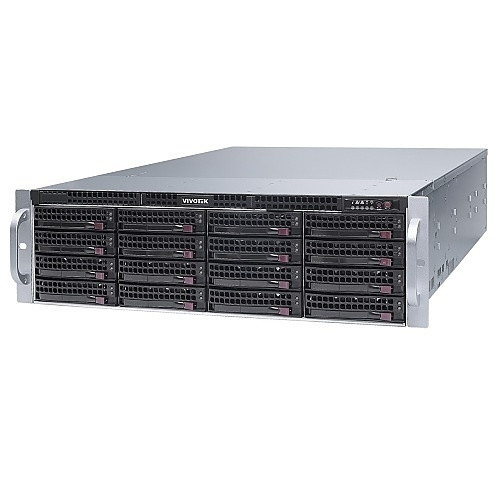
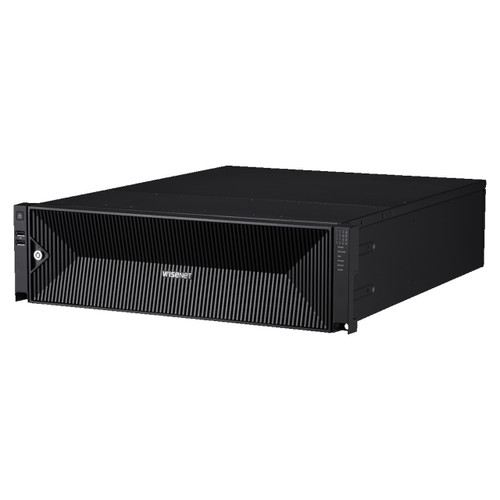
Both the Vivotek NR9682-V3 and the Hanwha PRN-6400DB4 are enterprise-class 64-channel NVRs in a 16-bay rackmount form factor, directly competing in the same tier of large-site surveillance infrastructure. This comparison examines recording throughput and decoding capability, storage architecture and redundancy, and ecosystem integration plus management features — the three axes that most determine fit in a multi-site or campus-scale deployment where both units are plausible candidates.
In This Guide
- Which NVR delivers higher recording throughput and decoding capability?
- How do storage capacity, RAID options, and physical redundancy compare?
- Which NVR integrates more broadly with cameras, analytics, and management platforms?
- Which should you choose: the NR9682-V3 or the PRN-6400DB4?
- Side-by-Side Specs
- FAQ
Which NVR delivers higher recording throughput and decoding capability?
The Vivotek NR9682-V3 specifies a recording throughput of 512 Mbps and a remote-client video throughput of 650 Mbps. Its software decoder handles resolutions up to 7680x2560, with documented H.264 decoding at 1920x1080 @360 fps and H.265 at 1920x1080 @180 fps. Display outputs span HDMI (4096x2160), DisplayPort (7680x4320), DVI, and VGA, enabling dual-monitor configurations and 8K-class display on the DP port.
The Hanwha PRN-6400DB4 specifies a maximum recording bandwidth of 400 Mbps and a maximum simultaneous playback bandwidth of 64 Mbps across 64 channels. Its dual-HDMI local display outputs are rated 4K@30Hz and 1080p@60Hz. It supports up to 32MP camera resolution per channel (H.265) and simultaneous 64-division multiscreen. The PRN-6400DB4 does not specify a DisplayPort or VGA output.
On raw throughput, the NR9682-V3 holds a 28% advantage (512 vs 400 Mbps). For display flexibility, the NR9682-V3 provides four distinct output types including an 8K-capable DisplayPort, while the PRN-6400DB4 offers two HDMI ports. The PRN-6400DB4's per-channel maximum resolution (32MP) exceeds the NR9682-V3's documented maximum camera resolution (12MP per the product spec field), which is a meaningful differentiator for very-high-resolution camera deployments.
How do storage capacity, RAID options, and physical redundancy compare?
Both units provide 16 hot-swappable SATA bays. The Hanwha PRN-6400DB4 specifies a maximum per-HDD capacity of 10TB and a total maximum of 160TB, with RAID support limited to RAID-5 and RAID-6 (configured as two 8-HDD arrays). It also supports iSCSI external storage expansion. The NR9682-V3 does not specify a per-HDD maximum or a total raw capacity ceiling in the provided specs; the datasheet refers buyers to VIVOTEK's HDD compatibility list.
The NR9682-V3 supports RAID 0, 1, 5, 6, 10, 50, and 60 — a broader array of RAID levels than the PRN-6400DB4, which is limited to RAID-5/6. The NR9682-V3 also supports iSCSI, SMB/CIFS NAS for both manual and scheduled backup, and USB backup (FAT format). The PRN-6400DB4 supports iSCSI and file backup in BU/Exe/AVI and JPG/AVI formats.
Power redundancy is supported on both units; the NR9682-V3 specifies a maximum power draw of 920W (80 Plus Platinum certified) versus 285W for the PRN-6400DB4 — a significant difference relevant to rack power budgeting and cooling. The PRN-6400DB4's N+1 failover and Automatic Recovery Backup (ARB) are explicitly documented; the NR9682-V3 also lists failover support. The PRN-6400DB4's lower power envelope and confirmed 160TB ceiling are operational planning advantages; the NR9682-V3's wider RAID portfolio offers more storage architecture flexibility.
Which NVR integrates more broadly with cameras, analytics, and management platforms?
The Vivotek NR9682-V3 declares ONVIF Profile S compatibility and integrates with VIVOTEK's Shepherd and VSS Pro software platforms. It supports E-Map, VCA counting, LPR, Smart VCA event search, Deep Search, and metadata display for VCA and Data Magnet. I/O box integration covers ADAM-6000, CYT-133SC, and ioLogik E1210/E1211/E1212. User management supports up to 4,096 users with Windows Active Directory. The OS is embedded Windows 10. Mobile access is provided via iViewer (iOS/Android). POS integration is listed via ARCH.
The Hanwha PRN-6400DB4 supports both Wisenet-native (SUNAPI) and ONVIF Profile-S cameras. Its OS is embedded Linux. AI search capabilities include person, face (requires Wisenet AI camera), vehicle, and license plate detection — object-attribute AI natively embedded in the NVR. PTZ preset capacity is documented at 300 presets. Remote user limits are explicitly stated: 3 search, 10 live unicast, 20 multicast. Security features include 802.1x, IP filtering, signed firmware, and device certificates from Hanwha Techwin Root CA. Wisenet mobile, Smart Viewer, and CGI/SUNAPI client software are included. P2P QR-code setup is supported.
The NR9682-V3's Windows 10 base and 4,096-user AD integration are strong enterprise IT arguments. The PRN-6400DB4's embedded Linux, signed firmware, 802.1x, and Hanwha CA certificate chain represent a more hardened security posture as documented. Native AI object detection on the PRN-6400DB4 does not require a separate analytics server, whereas the NR9682-V3's AI capabilities are tied to camera-side VCA metadata ingestion. Both support 2-way audio. Alarm I/O is documented at 8 inputs/4 outputs on the PRN-6400DB4; the NR9682-V3 lists I/O only via external I/O boxes.
Which should you choose: the NR9682-V3 or the PRN-6400DB4?
Our take: The NR9682-V3 is the stronger choice when the deployment demands maximum recording throughput, broad RAID flexibility, or deep Windows AD user management. Its 512 Mbps recording bandwidth exceeds the PRN-6400DB4's 400 Mbps by 28%, it supports RAID 0/1/5/6/10/50/60 versus the PRN-6400DB4's RAID-5/6 only, and its 4,096-user Active Directory integration scales to large enterprise IT environments. However, the PRN-6400DB4 counters with a higher per-channel camera resolution ceiling (32MP vs 12MP), native AI object detection without an ancillary analytics server, a significantly lower power draw (285W vs 920W), and a more documented security stack (signed firmware, 802.1x, CA-issued device certificates). Choose the NR9682-V3 for VIVOTEK-centric or mixed-ONVIF sites prioritizing throughput and storage architecture options; choose the PRN-6400DB4 for Wisenet-camera ecosystems where AI search, power efficiency, and firmware-level security are primary requirements.
Side-by-Side Comparison
Spec-for-spec, from manufacturer data.
| Specification | Vivotek NR9682-V3 | Hanwha PRN-6400DB4 |
|---|---|---|
| Channel Capacity (native) | 64CH (expandable to 192 with license) | 64CH |
| Max Camera Resolution | 12MP | 32MP |
| Recording Bandwidth | 512 Mbps | 400 Mbps |
| Decoding Resolution | Up to 7680x2560 | 32MP @ 15fps (H.265) |
| Video Compression | H.265, H.264, MPEG4, MJPEG | H.265, H.264, MJPEG, WiseStream |
| HDD Bays | 16 hot-swappable | 16 hot-swappable (SATA) |
| Max Raw Storage | Not specified (see compatibility list) | 160TB (up to 10TB per HDD) |
| RAID Levels | 0, 1, 5, 6, 10, 50, 60 | 5, 6 (8 HDD x 2 arrays) |
| Video Outputs | HDMI, DisplayPort, DVI, VGA | Dual HDMI (4K@30Hz + 1080p@60Hz) |
| Network Ports | 2x 2.5 Gigabit LAN | 3x RJ-45 1 Gbps (LAN/WAN) |
| Operating System | Embedded Windows 10 | Embedded Linux |
| Max Power Draw | 920W | 285W |
| Alarm I/O (onboard) | Via external I/O box only | 8 inputs / 4 outputs |
| AI Analytics | VCA / LPR via camera metadata | Person, face, vehicle, LPR (on-NVR) |
| User Capacity | 4,096 users (Windows AD supported) | Not specified in provided specs |
| Operating Temperature | 5°C to 35°C | 0°C to 40°C |
| Weight (no HDD) | 33 kg | 14.3 kg |
| Failover / Redundancy | Failover supported; redundant PSU | N+1 failover, ARB, dual SMPS |
Frequently Asked Questions
Which should you choose: the NR9682-V3 or the PRN-6400DB4?
The NR9682-V3 is the stronger choice when the deployment demands maximum recording throughput, broad RAID flexibility, or deep Windows AD user management. Its 512 Mbps recording bandwidth exceeds the PRN-6400DB4's 400 Mbps by 28%, it supports RAID 0/1/5/6/10/50/60 versus the PRN-6400DB4's RAID-5/6 only, and its 4,096-user Active Directory integration scales to large enterprise IT environments. However, the PRN-6400DB4 counters with a higher per-channel camera resolution ceiling (32MP vs 12MP), native AI object detection without an ancillary analytics server, a significantly lower power draw (285W vs 920W), and a more documented security stack (signed firmware, 802.1x, CA-issued device certificates). Choose the NR9682-V3 for VIVOTEK-centric or mixed-ONVIF sites prioritizing throughput and storage architecture options; choose the PRN-6400DB4 for Wisenet-camera ecosystems where AI search, power efficiency, and firmware-level security are primary requirements.
Is the NR9682-V3 or PRN-6400DB4 better for very-high-resolution camera deployments?
Based on the provided specs, the PRN-6400DB4 supports up to 32MP per channel in H.265, while the NR9682-V3's spec sheet lists a maximum camera resolution of 12MP. If your camera inventory includes 4K+ or higher-resolution sensors, the PRN-6400DB4 has a documented resolution advantage. Verify individual camera compatibility with each NVR's published compatibility list before purchasing.
Which unit is more power-efficient for a dense rack installation?
The PRN-6400DB4 specifies a maximum power draw of 285W (with 16 HDDs installed), versus 920W maximum for the NR9682-V3. In a multi-unit rack, that difference has a direct impact on UPS sizing, rack PDU circuit loading, and data-center cooling costs. The NR9682-V3 carries an 80 Plus Platinum certification, which speaks to efficiency at load, but its absolute wattage ceiling is still more than three times higher than the PRN-6400DB4's.
Does either NVR include built-in AI analytics, or does that require a separate server?
The Hanwha PRN-6400DB4 includes on-board AI search for person, face, vehicle, and license plate — face detection requires a compatible Wisenet AI camera, but the compute runs on the NVR itself. The Vivotek NR9682-V3 supports VCA counting, LPR, Smart VCA, and Deep Search, but these capabilities rely on metadata generated by cameras or external VCA systems rather than a documented on-NVR AI inference engine. Buyers who want AI object search without a separate analytics appliance should note this architectural difference.
Get a Second Opinion on Your Camera Choice
Share your site layout, coverage goals, and budget. Our team will validate the camera selection, flag anything we would change, and recommend products that match the use case.