
Hanwha PRN-6400DB4 vs i-PRO NX400/3000T3: Specification Comparison
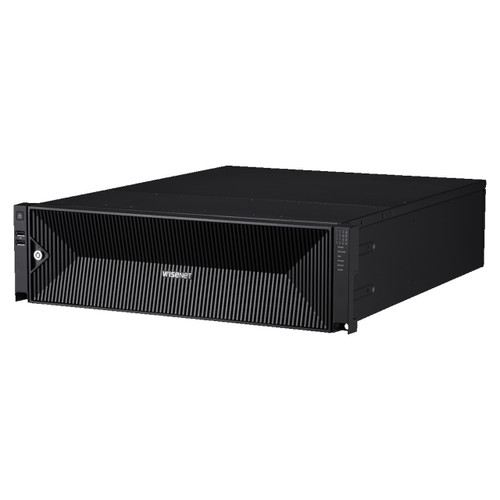
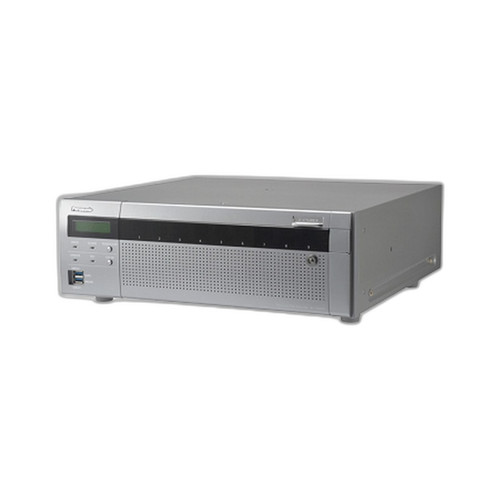
Both the Hanwha PRN-6400DB4 and the i-PRO WJ-NX400/3000T3 are rack-mount, 64-channel network video recorders targeting mid-to-large enterprise physical-security deployments. This comparison evaluates them across recording capacity and throughput, storage architecture and redundancy, and integration and management ecosystem — the three axes that drive NVR procurement decisions at this channel count. Neither unit is an accessory or a different device class; both support ONVIF and H.265 compression at 64 channels, making them legitimate cross-shop candidates for integrators specifying a new or replacement recorder.
In This Guide
- Which NVR delivers higher recording bandwidth and resolution capacity at 64 channels?
- How do the two units compare on installed storage, maximum expansion, and RAID redundancy?
- Which unit offers broader camera compatibility, AI analytics, and management software options?
- Which should you choose: the PRN-6400DB4 or the NX400/3000T3?
- Side-by-Side Specs
- FAQ
Which NVR delivers higher recording bandwidth and resolution capacity at 64 channels?
The PRN-6400DB4 specifies a maximum recording bandwidth of 400 Mbps and supports camera inputs up to 32MP resolution, with H.265 decoding rated at 32MP @ 15 fps and 1080p @ 480 fps across 64 channels. Simultaneous playback reaches 112 channels (64 local, 16 per remote user across up to 3 remote users), and live unicast supports up to 10 users with multicast up to 20.
The WJ-NX400/3000T3 specs do not state a maximum recording bandwidth figure, and the listed maximum resolution is 2MP. No decoding throughput in fps or multi-stream simultaneous playback channel count is provided in the supplied specifications. ONVIF Profile S compliance is confirmed, but high-resolution or high-throughput performance figures are absent from the available data.
For deployments requiring high-megapixel cameras (4K, 8K, multi-imager) or sustained aggregate bandwidth above what a 2MP-rated pipeline implies, the PRN-6400DB4 provides explicit, spec-backed headroom. Buyers evaluating the WJ-NX400/3000T3 for similar loads should request i-PRO's full datasheet, as the supplied specs do not address bandwidth ceiling or resolution above 2MP.
How do the two units compare on installed storage, maximum expansion, and RAID redundancy?
The PRN-6400DB4 ships without pre-installed drives but provides 16 hot-swappable SATA bays supporting up to 10TB HDDs each, yielding a maximum raw capacity of 160TB. It supports RAID 5 and RAID 6 across two arrays of up to 8 HDDs each, plus iSCSI external storage expansion. Hot-swap capability allows drive replacement without system downtime. The unit also supports N+1 failover and Automatic Recovery Backup (ARB) at the system level.
The WJ-NX400/3000T3 ships with 3TB installed (one 3TB drive) and specifies a maximum capacity of 324TB. It supports RAID modes 0, 1, 5, 6, and 10 — a wider RAID option set than the Hanwha. Local microSD storage is also listed. The number of internal HDD bays, hot-swap capability, and iSCSI or NAS expansion details are not provided in the supplied specifications.
The WJ-NX400/3000T3's stated 324TB maximum expansion ceiling is significantly higher than the PRN-6400DB4's 160TB internal maximum, and its RAID mode list adds RAID 0, 1, and 10 options absent from the Hanwha. However, the mechanism enabling 324TB — whether internal bays, eSATA, iSCSI, or a combination — is not specified, which makes direct architectural comparison impossible without i-PRO's full datasheet. The PRN-6400DB4's hot-swap and dual-SMPS power are explicitly documented resilience features.
Which unit offers broader camera compatibility, AI analytics, and management software options?
The PRN-6400DB4 supports Wisenet (Hanwha proprietary) and ONVIF Profile S protocols. AI search functions — person, face, vehicle, and license plate detection — are available when paired with Wisenet AI or P/X series cameras; these features are camera-dependent, not NVR-native inference. Management options include a local GUI (mouse/keyboard/SPC-2000 controller), web viewer on Windows 10 and macOS 10.13 via Chrome, Edge, and Safari, Smart Viewer CMS, Wisenet mobile (iOS and Android), and CGI/SUNAPI API access. PTZ control supports 300 presets. P2P QR-code setup and Hanwha DDNS are included. Security features include 802.1x, IP filtering, user access logging, device certificates, and signed firmware.
The WJ-NX400/3000T3 specifies ONVIF Profile S compliance and compatibility with i-PRO IP cameras and major VMS platforms. Multi-site compatibility is noted. No AI analytics, mobile application, PTZ preset count, web viewer OS/browser requirements, API protocol list, or security feature set is provided in the supplied specifications. Power is specified as 12V DC.
The PRN-6400DB4 provides a fully documented integration and management stack, including a named API (SUNAPI/CGI), explicit VMS/CMS options, mobile clients, and a defined security posture. The WJ-NX400/3000T3's 'major VMS platform' compatibility claim and multi-site designation are noteworthy for enterprise multi-recorder environments, but the absence of supporting detail in the supplied specs prevents verification. Installations locked to the Wisenet camera ecosystem gain the most from the PRN-6400DB4's AI features; mixed or VMS-centric environments need i-PRO's full documentation before evaluating the NX400.
Which should you choose: the PRN-6400DB4 or the NX400/3000T3?
Our take: The PRN-6400DB4 is the stronger choice when the deployment requires explicitly documented high-bandwidth recording, AI-assisted forensic search, and a fully specified management ecosystem. On throughput, the Hanwha specifies 400 Mbps versus no stated figure for the i-PRO. On resolution, the PRN-6400DB4 supports 32MP inputs; the WJ-NX400/3000T3 lists a 2MP maximum. On management, the PRN-6400DB4 documents SUNAPI, mobile clients, 802.1x, signed firmware, and 300 PTZ presets — none of which appear in the i-PRO's supplied specs. The WJ-NX400/3000T3's stated 324TB capacity ceiling exceeds the Hanwha's 160TB internal maximum, and its additional RAID modes (0, 1, 10) offer more flexibility — but the expansion mechanism is unspecified. Buyers standardizing on Wisenet AI cameras benefit from the PRN-6400DB4's native AI search; those running a VMS-centric or multi-brand site should obtain i-PRO's complete datasheet before ruling out the NX400.
Side-by-Side Comparison
Spec-for-spec, from manufacturer data.
| Specification | Hanwha PRN-6400DB4 | i-PRO NX400/3000T3 |
|---|---|---|
| Product Type | NVR | NVR |
| Camera Channels | 64 | 64 |
| Max Recording Bandwidth | 400 Mbps | — |
| Max Camera Resolution | 32MP | 2MP |
| Video Compression | H.265, H.264, MJPEG, WiseStream | H.265, H.264 |
| ONVIF | Profile S | Profile S |
| Installed Storage | None (drives sold separately) | 3TB (1 × 3TB HDD) |
| Max Storage Capacity | 160TB (16 × 10TB internal) | 324TB (expansion method unspecified) |
| Internal HDD Bays | 16 SATA, hot-swap | — |
| RAID Support | RAID 5, 6 | RAID 0, 1, 5, 6, 10 |
| External Storage | iSCSI | — |
| Local Display Output | Dual HDMI: 4K@30Hz + 1080p@60Hz | — |
| Max Simultaneous Playback | 112CH (64 local + 16/user remote) | — |
| AI Analytics | Person, face, vehicle, LPR (requires Wisenet AI/P/X camera) | — |
| Power Supply | 100–240 VAC ±10%, Dual SMPS, Max 285W | 12V DC |
| N+1 Failover / ARB | Yes (both) | — |
Frequently Asked Questions
Which should you choose: the PRN-6400DB4 or the NX400/3000T3?
The PRN-6400DB4 is the stronger choice when the deployment requires explicitly documented high-bandwidth recording, AI-assisted forensic search, and a fully specified management ecosystem. On throughput, the Hanwha specifies 400 Mbps versus no stated figure for the i-PRO. On resolution, the PRN-6400DB4 supports 32MP inputs; the WJ-NX400/3000T3 lists a 2MP maximum. On management, the PRN-6400DB4 documents SUNAPI, mobile clients, 802.1x, signed firmware, and 300 PTZ presets — none of which appear in the i-PRO's supplied specs. The WJ-NX400/3000T3's stated 324TB capacity ceiling exceeds the Hanwha's 160TB internal maximum, and its additional RAID modes (0, 1, 10) offer more flexibility — but the expansion mechanism is unspecified. Buyers standardizing on Wisenet AI cameras benefit from the PRN-6400DB4's native AI search; those running a VMS-centric or multi-brand site should obtain i-PRO's complete datasheet before ruling out the NX400.
Is the PRN-6400DB4 or WJ-NX400/3000T3 better for larger, high-resolution camera deployments?
Based on the supplied specifications, the PRN-6400DB4 is the better-documented choice for high-resolution deployments: it explicitly supports up to 32MP camera inputs at 400 Mbps aggregate bandwidth across 64 channels. The WJ-NX400/3000T3 lists a 2MP maximum resolution and provides no bandwidth ceiling in its available specs, making it impossible to confirm suitability for 4K or higher-resolution cameras without consulting i-PRO's full datasheet.
Which NVR gives me more storage expansion room?
The WJ-NX400/3000T3 specifies a higher maximum capacity — 324TB versus the PRN-6400DB4's 160TB internal ceiling (16 SATA bays × 10TB). The i-PRO also lists a wider RAID option set including RAID 0, 1, and 10 in addition to RAID 5 and 6. However, the supplied i-PRO specs do not describe how 324TB is achieved (number of bays, external expansion type), so integrators should verify the expansion path and bay count directly with i-PRO before designing around that figure. The PRN-6400DB4 additionally documents iSCSI external storage support.
Can I use either of these NVRs with cameras from other manufacturers?
Both units support ONVIF Profile S, which enables interoperability with third-party ONVIF-compliant cameras. The PRN-6400DB4 also lists Wisenet proprietary protocol support and provides SUNAPI/CGI for VMS integration. The WJ-NX400/3000T3 notes compatibility with i-PRO cameras and 'major VMS platforms,' but does not specify which VMS products or integration protocols beyond ONVIF in the supplied specifications. For AI analytics features on the PRN-6400DB4 — person, face, vehicle, and license plate detection — Wisenet AI or P/X series cameras are required; those features are not available with generic ONVIF cameras on that platform.
Get a Second Opinion on Your Camera Choice
Share your site layout, coverage goals, and budget. Our team will validate the camera selection, flag anything we would change, and recommend products that match the use case.