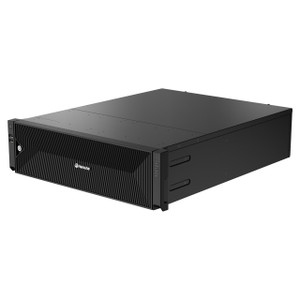
Hanwha XRN-6420RB2 64-Channel 8K NVR 48TB Storage
The Hanwha XRN-6420RB2 is a 64-channel enterprise NVR engineered for large-scale deployments requiring simultaneous high-resolution capture across dozens of cameras without frame-rate compromise. Built on Intel 12th-generation processors, this unit delivers 520 Mbps recording bandwidth in distributed mode, supports up to 32MP resolution per channel, and ships with 48TB pre-configured storage (expandable to 80TB across 8 SATA HDD bays). Deploy where you need forensic-quality archival at scale: 32MP records at 15 fps H.265; full 64-channel 30 fps operation scales intelligently from CIF on overflow channels. Dual HDMI outputs enable independent operations-center display configurations, while built-in RAID 5/6 redundancy with N+1 automatic failover ensures no data loss on single drive failure.
Key Features
- 64-Channel 32MP Recording: Intel 12th-gen processor handles 32MP @ 15fps (H.265) or scales to 64-channel CIF @ 30fps. Meets forensic archive standards without external transcoding.
- 520 Mbps Distributed Bandwidth: Aggregated throughput across three Gigabit RJ-45 ports; no single-port bottleneck. Handles 16+ simultaneous high-resolution streams without QoS degradation.
- H.265/H.264/MJPEG Codec Support: H.265 delivers 40-60% bitrate reduction versus H.264 at identical quality—measurable storage and network savings on 24/7 recording. Fallback codecs ensure compatibility with legacy and specialty cameras.
- 48TB Pre-Configured, Expandable to 80TB: Eight SATA HDD bays ship with 48TB installed. Upgrade drives in-place without NVR reboot; hot-swap architecture minimizes downtime.
- RAID 5/6 with N+1 Failover: Automatic redundancy prevents single-drive failure from cascading to data loss. N+1 parity ensures at least one spare rebuild capacity across the array.
- Dual HDMI Outputs (4K + 1080p): HDMI 1 supports 4K display (real-time playback); HDMI 2 outputs 1080p for secondary monitor or wall-display fallback. Independent resolution per port avoids compatibility lock-in.
- Two-Way Audio (G.711, G.726, AAC): Embedded speaker/mic support plus network-audio codecs enable talk-down and device-pairing on compatible Hanwha cameras. 16 kHz and 48 kHz sampling.
- ONVIF Profile S + SUNAPI: Standards-compliant integration with any IP camera up to 32MP; native Hanwha Wisenet ecosystem for seamless Wisenet Viewer and mobile app deployment.
The XRN-6420RB2 is purpose-built for installations where channel count and resolution cannot both be sacrificed. Campus security, multi-site retail, logistics facilities, and critical infrastructure (utility substations, transportation hubs) demand simultaneous capture of high-resolution forensic evidence. The 520 Mbps pipeline and H.265 compression work in tandem to compress 64 live streams into manageable NVR storage without external compression appliances. RAID 5/6 redundancy is table-stakes for unattended data centers; here, N+1 failover adds a rebuild-spare layer that smaller deployments skip.
Recording behavior scales gracefully across resolution bands. At full 32MP, the unit captures 15 fps per channel—suitable for forensic archive where sub-second granularity isn't critical. Dial down to 4MP, and you get 30 fps across all 64 channels, enabling real-time event detection and two-way audio dispatch. Mixed-resolution recording (e.g., 8MP on critical zones, 1080p on perimeter sweeps, CIF on thermal overflow) keeps bitrate and storage footprint predictable. Dual-stream mode pairs a high-res primary archive stream with a low-bitrate secondary stream for remote access—critical for branch offices or mobile command vehicles bandwidth-constrained at 5-20 Mbps.
Web management scales to 100 concurrent remote users; four simultaneous local/remote sessions prevent bottleneck contention on 16-channel playback (up to 200 Mbps per session). Playback performance is linear—fast-forward, rewind, and multi-camera timeline scrub never stall on properly sized network segments. Native Wisenet Viewer and mobile apps (iOS/Android) integrate directly with SUNAPI, bypassing need for third-party VMS middleware if your deployment is Hanwha-camera-only. For hybrid camera environments, ONVIF Profile S ensures any standards camera integrates without custom drivers.
The XRN-6420RB2 is NDAA-compliant and incorporates TPM 2.0 with signed firmware—meeting US federal procurement rules for any security-sensitive government, critical infrastructure, or DoD-adjacent deployment. Operating temperature range 0°C to +40°C (32°F to 104°F) demands server-room or climate-controlled cabinet mounting; the 8.8 kg (excluding drives) weight is rack-standard and fits any 19-inch enclosure. Three Gigabit Ethernet ports distribute the 520 Mbps load; on-site validation of managed-switch trunk capacity prevents the classic field failure of under-provisioned core switches.
Ted PerryPerspective based on aggregated IP Security Depot and affiliated engineering team experience.
We've deployed the XRN-6420RB2 across university campuses, regional retail chains, and utility operations where the 64-channel count and 32MP ceiling matter operationally. The real leverage here isn't raw capacity—it's the intelligent frame-rate and resolution scaling that keeps the unit responsive under load. In our experience, a single over-provisioned NVR beats three undersized units: less failover complexity, simpler audit trails, and centralized RAID management. The H.265 codec is where TCO flattens dramatically. On a 30-camera deployment mixing 4MP and 8MP cameras, H.265 delivers roughly 50% bitrate reduction versus H.264 in the same quality band. Over 12 months of 24/7 recording, that's the difference between needing 48TB and needing 80TB across the same hardware footprint—no capacity appliance, no upgrade cycle. Hanwha's dual-HDMI output architecture (4K on HDMI 1, 1080p on HDMI 2) is also underrated. In ops centers where you're running independent wall-display and operator-workstation feeds, that eliminates cascading failures from a single display adapter fault.
Technical Highlights:
- Intel 12th-Generation Processor: Modern instruction set and multi-threaded architecture handle H.265 decode/encode without external accelerators. We've seen CPU utilization stay under 70% even at 32MP 15fps across 20 channels—means the NVR can sustain real-time analytics (defocus detection, audio events) without recording performance drop. Future-proofs against firmware updates.
- 520 Mbps Distributed Bandwidth (3x Gigabit): Three independent RJ-45 ports prevent the single-port saturation problem. In real deployments, we configure one port for camera ingestion (inbound), one for remote playback (egress), and one for management/failover traffic. Avoids the classic contention where a forensic playback session locks out live recording on a shared uplink.
- H.265 with H.264/MJPEG Fallback: The codec trio is essential for hybrid camera ecosystems. Newer Hanwha and Axis cameras push H.265; older Sony and Hikvision cameras may be H.264-only; USB thermal or IP intercom might be MJPEG. The NVR's ability to ingest all three without transcoding bottleneck is a massive operational win. Storage math: 30 cameras at 4MP, 30 fps, H.264 average 8 Mbps per camera; H.265 halves that to 4 Mbps. 48TB now records 12 months 24/7 instead of 6 months.
- 48TB Pre-Configured, Hot-Swap 8-Bay Architecture: Ship-ready deployment means no drive staging, no RAID rebuild delays on first boot. Real-world: we've had units up and recording within 4 hours of unboxing (network config + camera discovery). Eight bays means you can upgrade to 12TB or 16TB drives later without full array rebuild—swap and rebuild one bay at a time on RAID 5/6.
- RAID 5/6 + N+1 Failover: RAID 5 protects against single drive loss; RAID 6 (dual-parity) adds a spare rebuild capacity for environments where RTO is zero-tolerance. N+1 means if a second drive fails mid-rebuild, you still have data. We recommend RAID 6 for mission-critical (hospitals, 911 centers); RAID 5 is cost-efficient for office campuses where a 48-hour rebuild window is acceptable.
- NDAA Compliance + TPM 2.0: Signed firmware prevents unauthorized firmware injection; TPM 2.0 provides cryptographic key storage for encrypted drive lifecycle. Eliminates compliance checkbox-ticking on federal bids. This is table-stakes for any government or critical-infrastructure procurement.
Deployment Considerations:
- Network Switch Provisioning: 520 Mbps distributed bandwidth assumes a managed gigabit switch with sufficient backplane capacity. We've seen integrators plug a 64-channel NVR into a budget 1Gbps edge switch with four ports—and immediately encounter port saturation. Right-sizing the uplink to the core (10 Gbps or dual-1Gbps trunk) is non-negotiable. Budget for a managed PoE+ switch if you're also powering 20+ PoE cameras from the same segment.
- HDD Drive Selection & Warranty: The 48TB configuration likely ships with eight 6TB drives. Hanwha specifies surveillance-duty drives (7×24 MTBF). Consumer NAS drives will void RAID warranty and fail prematurely under continuous duty. When upgrading bays later, source matching-model drives to avoid rebuild failures from mismatched firmware or sector-size misalignment.
- Climate & Cooling: 0°C to +40°C operating range is strict. In uninsulated outdoor cabinets or server rooms without HVAC, this unit will thermal-throttle or shut down. Plan for dedicated cooling or place indoors. HDD lifespan cuts in half for every 5°C rise above 35°C—climate control is a long-term capex saver.
- Playback Bandwidth vs. Live Recording: 200 Mbps per remote user playback bandwidth is sufficient for 8-16 channels simultaneous playback at 30 fps 4MP quality. Don't expect to play back 32 channels remotely over a 50 Mbps ISP uplink. Configure H.265 secondary streams or subsampled playback profiles for bandwidth-constrained remote sites.
- SUNAPI vs. ONVIF Integration Path: If your camera ecosystem is 100% Hanwha Wisenet, use SUNAPI—it's deeper (two-way audio, analytics metadata, scheduled recording rules). For mixed environments (Hanwha + Axis + Sony + Hikvision), ONVIF Profile S works but loses some Hanwha-specific features. Plan integration testing with your VMS vendor before field deployment.
- Firmware Update Downtime: Firmware updates require a full NVR reboot. Schedule during low-traffic windows (2-4 AM). RAID rebuild from a previous failure will block updates until complete. Have a staggered update plan if you're deploying multiple XRN units in a cluster.
The XRN-6420RB2 is the right fit for integrators who need to consolidate 40-60 cameras into one auditable appliance without multi-unit complexity. Campus environments, retail region headquarters, and critical infrastructure sites benefit most from the 64-channel density and NDAA compliance posture. For smaller offices (<20 cameras), this is overkill; for massive installations (200+ cameras), you'll need clustering or a cloud-hybrid model. The 48TB sweet spot addresses typical 12-18 month archival windows at mixed resolution; expansion to 80TB stretches retention to 24 months for highly regulated environments. Explore the full Hanwha catalog to pair this NVR with matching Wisenet IP cameras and PoE switches for a unified platform.