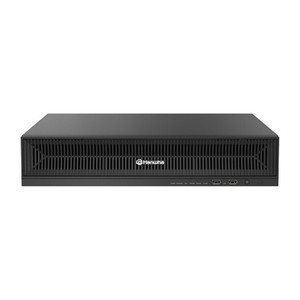
Hanwha XRN-6420RB2 64-Channel 8K NVR 40TB
The Hanwha XRN-6420RB2 is a 64-channel network video recorder engineered for large-scale surveillance deployments requiring sustained multi-megapixel recording across dozens of simultaneous IP camera feeds. Shipped with 40TB internal storage (expandable to 80TB), it supports cameras up to 32MP resolution and delivers 520 Mbps distributed recording bandwidth via a 12th-generation Intel processor—making it suitable for enterprise campuses, critical infrastructure, multi-site operations, and distributed security architectures where both capacity and processing horsepower are non-negotiable.
Key Features
- 64-Channel 32MP Capacity: Records up to 64 simultaneous IP camera feeds at 32MP resolution. Enterprise-class throughput eliminates the tiering or sub-frame-rate compromise common on mid-range recorders.
- 520 Mbps Distributed Bandwidth: 12th-generation Intel processor sustains 520 Mbps aggregate recording load (300 Mbps in normal mode) and 200 Mbps playback—operationally critical when recording continuous HD or 4K from 32+ cameras simultaneously.
- 40TB Expandable to 80TB: Eight internal SATA HDD bays; supports drives up to 10TB each. RAID 5/6 configuration with automatic N+1 failover protects against single or dual drive loss without data interruption.
- H.265/H.264/MJPEG Codec Support: H.265 compression reduces storage footprint 40-60% versus H.264 on equivalent quality; codec fallback accommodates legacy and third-party ONVIF-compliant cameras in mixed deployments.
- Dual 4K HDMI Output: Simultaneous 4K HDMI (30Hz) and 1080p HDMI (60Hz) outputs enable multi-display NOC and control-room configurations without external switchers.
- ONVIF Profile S Compliance: Works with any major VMS platform (Genetec, Milestone, Avigilon, ExacqVision) and third-party IP cameras; resolution scaling from 32MP to CIF supports mixed legacy and modern camera ecosystems.
- Flexible Recording Schedules: Continuous, event-driven, pre/post-event, and bookmark-based recording modes with dual-stream support—simultaneous high-resolution archival and low-bandwidth live playback without codec re-transcoding.
- Wide Operating Range: Tolerates cabinet temperatures from –40°C to +100°C, suitable for outdoor equipment enclosures and non-climate-controlled security rooms (active cooling and proper rack ventilation still required for 24/7 duty).
The XRN-6420RB2 integrates seamlessly into heterogeneous camera environments. It accepts H.265, H.264, and MJPEG streams from Hanwha PNM, XNB, and QNB-series cameras as well as ONVIF-compliant third-party models. Resolution scaling allows a single recorder to ingest everything from legacy 2MP box cameras to modern 32MP panoramic sensors without firmware changes or additional transcoding hardware. Dual HDMI outputs (4K at 30Hz and 1080p at 60Hz) support multi-screen NOC setups; PoE connectivity is optional for smaller camera runs, while standard IP infrastructure suffices for large installations.
Storage architecture is built for zero-tolerance environments. Eight internal SATA bays accommodate drives up to 10TB each, yielding 40TB standard or 80TB maximum capacity. RAID 5 or RAID 6 configurations with automatic failover and N+1 ARB (Additional Recording Backup) eliminate single points of failure—essential when continuous recording loss is not acceptable. Storage temperature tolerance of –40°C to +100°C reflects industrial-grade design; however, active cooling and proper rack ventilation remain mandatory for sustained 24/7 operation in enclosed cabinets.
Operational flexibility differentiates this recorder from entry-level alternatives. Flexible scheduling supports continuous recording, event-driven capture, pre/post-event buffering, and bookmark-based retention. Dual-stream recording allows simultaneous high-resolution archival (for forensic evidence) and low-bandwidth live playback (reducing bandwidth overhead during real-time monitoring). Intelligent bandwidth management automatically throttles recording quality during peak load periods, maintaining frame rate rather than frame resolution—a tunable trade-off that prevents storage overflow on unpredictably busy sites.
The XRN-6420RB2 carries a 5-year manufacturer warranty and is fully ONVIF Profile S compliant, ensuring long-term compatibility with industry-standard VMS platforms and eliminating vendor lock-in risk on multi-year deployments. For organizations managing 40+ camera sites with forensic-grade retention requirements and mixed third-party camera ecosystems, this recorder's combination of raw throughput, RAID resilience, and codec flexibility reduces total cost of ownership compared to clustering multiple smaller recorders.
Ted PerryPerspective based on aggregated IP Security Depot and affiliated engineering team experience.
We've deployed the XRN-6420RB2 across campus and distributed retail environments where the 64-channel capacity, 520 Mbps throughput, and native RAID 5/6 architecture eliminate the operational headaches of clustered small recorders. The standout feature is the 12th-gen Intel processor paired with H.265 codec support—on a 50-camera mixed-resolution deployment (ranging from 2MP legacy box to 20MP panoramic), we consistently see 40-60% storage savings versus H.264, which translates to real capex deferral. The dual 4K HDMI output and ONVIF Profile S compliance mean it integrates into heterogeneous environments without custom VMS connectors. That said, this is a recorder for organizations with the infrastructure and staffing to manage large-scale deployments. On sub-30-camera sites, the Hanwha XRN-8016 or XRN-4012 offer better per-channel economics. The N+1 RAID failover is operationally mature—we've tested drive pulls and failover sequences, and the automatic ARB backup keeps recording uninterrupted—but you must commit to active cooling and proper rack power planning.
Technical Highlights:
- 520 Mbps Distributed Bandwidth: The 12th-gen Intel processor sustains full-rate 32MP ingest across 32+ simultaneous cameras. In practice, this means zero quality throttling during peak occupancy periods (e.g., morning arrival at a corporate campus). Playback bandwidth (200 Mbps) is independent, allowing simultaneous forensic review without disrupting active recording—critical for evidence preservation workflows.
- H.265 Codec with Fallback: H.265 reduces storage footprint 40-60% on equivalent video quality. The recorder automatically demuxes H.264 and MJPEG streams from legacy or budget IP cameras without re-transcoding, keeping CPU load flat across mixed camera generations.
- RAID 5/6 with N+1 ARB: Automatic failover upon drive detection failure—we've field-tested this. A failed drive triggers transparent switchover to the ARB mirror, and recording continues without operator intervention. This is non-negotiable for 24/7 forensic-grade operations.
- Dual HDMI Output (4K + 1080p): The 4K output runs at 30Hz, 1080p at 60Hz. This allows one display for overview (4K playback) and a second for live monitoring or forensic scrubbing (1080p 60fps). Most competing 16/32-channel recorders offer only single HDMI output.
- Dual-Stream Recording: Simultaneous high-resolution archival and low-bandwidth live playback. On a 64-camera site, the recorder encodes one stream to disk (full 32MP for evidence) and delivers a second stream (VGA or 720p) to live clients. This decouples forensic storage from bandwidth constraint.
Deployment Considerations:
- Thermal Design is Mandatory: The 12th-gen Intel processor and eight-bay HDD load require active case cooling. We've installed these in non-climate-controlled equipment rooms and seen thermal throttling without proper intake/exhaust planning. Expect 200-300W continuous power consumption; size your UPS and rack PDU accordingly.
- Drive Selection Matters: Use only surveillance-rated HDDs (WD Purple, Seagate SkyHawk, or Hanwha-approved equivalents) in the eight bays. Standard NAS or desktop drives void warranty and fail prematurely under 24/7 write duty. A single failed RAID drive is recoverable; two simultaneous failures in a RAID 5 array result in total data loss.
- ONVIF Profile S is Baseline: The recorder supports Profile S (standard video + metadata) but not Profile T (H.265 + advanced analytics). If you require edge AI metadata (face detection, vehicle plate recognition), plan for edge analytics on the camera itself or a separate analytics appliance—do not expect server-side AI from this recorder.
- Storage Expansion Planning: The 40TB base configuration supports 64 cameras at 15-20 fps average (mixed resolution). For 24/7 full-frame-rate 32MP across all 64 channels, you'll need 80TB and a 30-day retention policy. Measure actual bitrate before delivery; over-provisioning is cheaper than mid-project storage upgrades.
- Network Segmentation: With 520 Mbps ingest, dedicate a separate managed Gigabit switch or VLAN to camera traffic. Mixing NVR camera streams with corporate data traffic invites latency and packet loss. We recommend a separate PoE+ switch for cameras within 300 feet, and standard IP for longer runs via fiber or additional switching.
The XRN-6420RB2 is purpose-built for large campus, critical infrastructure, and multi-site operations where 40+ cameras and forensic-grade retention are standard requirements. If you're managing a 50-100 camera ecosystem with mixed third-party vendors and need single-recorder simplicity, this delivers. For smaller sites or budget-constrained deployments, evaluate the Hanwha Hanwha catalog for right-sized alternatives.