
Hanwha XRN-1620B2 vs Hanwha PRN-1600B2: Specification Comparison
The XRN-1620B2 and PRN-1600B2 are both Hanwha 16-channel network video recorders running embedded Linux, accepting the same 32MP–CIF camera inputs via SUNAPI and ONVIF. Both share an 8-slot SATA chassis capable of up to 80TB, N+1 failover, ARB, and identical VMS compatibility. The meaningful differences lie in recording bandwidth, display architecture, storage resiliency, alarm I/O capacity, AI analytics depth, and power envelope — factors that separate a standard enterprise NVR from a higher-tier control-room or mission-critical deployment.
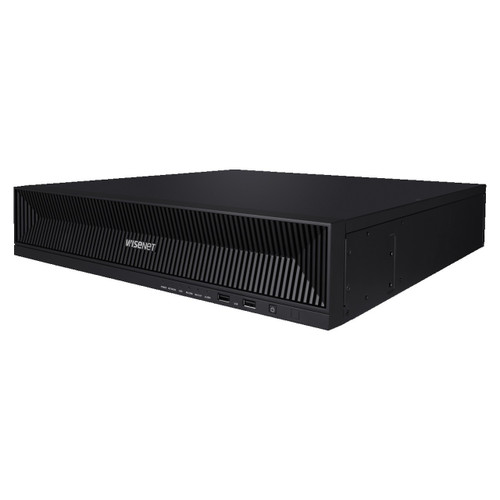
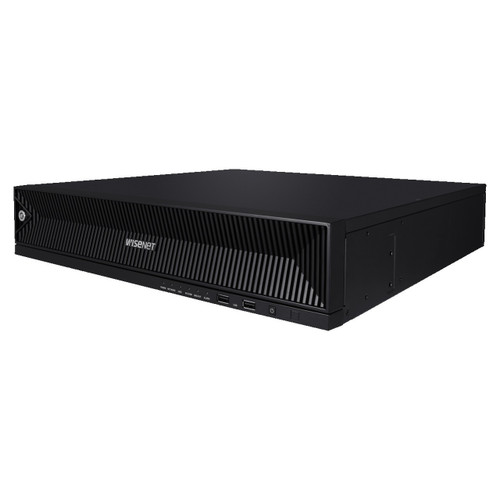
In This Guide
- Which recorder delivers more recording bandwidth and storage resiliency?
- How do the display outputs, alarm I/O, connectivity, and physical footprint compare?
- What are the differences in AI analytics capability, power consumption, and VMS/integration support?
- Which should you choose: the XRN-1620B2 or the PRN-1600B2?
- Side-by-Side Specs
- FAQ
Which recorder delivers more recording bandwidth and storage resiliency?
The PRN-1600B2 specifies a maximum recording bandwidth of 250 Mbps versus 140 Mbps on the XRN-1620B2 — a 79% increase. For installations running multiple high-resolution cameras at peak bitrate simultaneously, the PRN-1600B2 provides substantially more headroom before throughput becomes a bottleneck.
Both units offer 8× SATA slots with a 10TB per-drive ceiling, yielding an identical 80TB raw maximum. However, the PRN-1600B2 adds hardware RAID-5 and RAID-6 (single array) plus iSCSI external storage expansion. The XRN-1620B2 specifies no RAID capability and no external storage interface. RAID-5/6 provides drive-failure tolerance and protects recorded evidence; iSCSI allows capacity to scale beyond the internal chassis. The PRN-1600B2 also specifies a RAID indicator on its front panel. Playback bandwidth on the PRN-1600B2 is 64 Mbps in RAID mode and 32 Mbps in non-RAID mode; the XRN-1620B2 specifies a flat 32 Mbps playback bandwidth.
For deployments where storage integrity and bandwidth ceiling are primary concerns — forensic, municipal, or 24/7 control-room — the PRN-1600B2's RAID and higher throughput are material differentiators. Where standard SATA JBOD and 140 Mbps are sufficient, the XRN-1620B2's storage architecture is adequate.
How do the display outputs, alarm I/O, connectivity, and physical footprint compare?
Display: The PRN-1600B2 provides dual HDMI outputs — HDMI 1 at 4K/30Hz and HDMI 2 at 1080p/60Hz — enabling two simultaneous independent monitors. The XRN-1620B2 provides one HDMI (4K/30Hz) and one VGA (1080p/60Hz). In a control-room with two operators on separate screens, the PRN-1600B2's dual-HDMI configuration is the cleaner fit; the XRN-1620B2's VGA output requires a VGA-capable display or an active adapter.
Decoding throughput: The PRN-1600B2 specifies 32MP@15fps, 12MP@30fps, 8.3MP@120fps, and 1080p@480fps local decode. The XRN-1620B2 specifies 1080p@240fps local decode. The PRN-1600B2 supports higher-resolution decode rates that are relevant when playing back or displaying 4K and 12MP streams simultaneously.
Alarm I/O: The PRN-1600B2 provides 8 alarm inputs and 4 alarm outputs. The XRN-1620B2 provides 4 alarm inputs and 2 alarm outputs. Installations requiring direct wiring to access-control panels, door contacts, or output relays benefit from the PRN-1600B2's doubled I/O count.
Network ports: The PRN-1600B2 specifies 3× RJ-45 Gigabit ports (LAN/WAN); the XRN-1620B2 specifies 2× RJ-45 Gigabit ports. An additional NIC supports network segmentation — separating camera-side and management-side traffic without a managed switch.
USB: The PRN-1600B2 has 4× USB ports (2× USB 2.0 front, 2× USB 3.0 rear); the XRN-1620B2 has 3× USB ports (2× USB 2.0 front, 1× USB 3.0 rear).
Physical: The XRN-1620B2 measures 440×89.8×428.4 mm and weighs 5.71 kg. The PRN-1600B2 measures 438×86×434.9 mm and weighs approximately 9.1 kg (HDDs not included). Both are 2U-class rackmount metal chassis. The PRN-1600B2 also specifies an HDD key lock, which the XRN-1620B2 does not.
What are the differences in AI analytics capability, power consumption, and VMS/integration support?
AI Search: The PRN-1600B2 specifies on-device AI object attribute search for Human, Face, Vehicle, and License Plate, including LPR (English and numeric characters) via Wisenet AI P/X-series cameras. The XRN-1620B2 specifies AI Search compatibility only for Wisenet AI cameras, without listing discrete object classes or LPR in its specification. For operators who need to search recordings by person, vehicle, or plate directly at the NVR — without a separate analytics server — the PRN-1600B2's declared attributes and LPR capability are a concrete advantage.
Power: The XRN-1620B2 specifies a maximum of 130W. The PRN-1600B2 specifies a maximum of 205W with 8× 10TB HDDs installed — 58% higher. Both accept 100–240VAC, 50/60Hz. Rack power budgeting and UPS sizing must account for this difference, particularly in dense deployments.
VMS and integration: Both units support WAVE, SSM, Webviewer, Smart Viewer, Wisenet mobile, and SUNAPI CGI for third-party VMS integration. Both implement ONVIF Profile-S, the same protocol stack (IPv4/IPv6, RTSP, SNMP, HTTPS, 802.1x, signed firmware, Hanwha Techwin Root CA device certificates), and identical remote user limits (Search 3, Live Unicast 10, Multicast 20). The fisheye dewarping spec differs: the PRN-1600B2 supports local 1-channel dewarping plus CMS; the XRN-1620B2 specifies dewarping via CMS only. Neither unit's specification lists a built-in PoE switch.
Which should you choose: the XRN-1620B2 or the PRN-1600B2?
Our take: The PRN-1600B2 is the stronger choice when recording bandwidth, storage resiliency, expanded I/O, or on-device AI search are decision criteria. Its 250 Mbps bandwidth eclipses the XRN-1620B2's 140 Mbps, RAID-5/6 and iSCSI protect and extend storage where the XRN-1620B2 offers neither, alarm I/O doubles (8 in/4 out vs. 4 in/2 out), a third Gigabit NIC enables network segmentation, and declared AI attributes — Human, Face, Vehicle, License Plate, LPR — go beyond the XRN-1620B2's stated AI-camera compatibility. The XRN-1620B2 is the practical choice when the site's camera count stays at 16, standard JBOD storage is acceptable, 140 Mbps aggregate is sufficient for deployed bitrates, and the lower 130W power draw matters for rack or UPS constraints. Both share identical VMS integration, protocol support, OS, remote-user limits, and codec support, making either a fit on Wisenet or SUNAPI-compatible platforms.
Side-by-Side Comparison
Spec-for-spec, from manufacturer data.
| Specification | Hanwha XRN-1620B2 | Hanwha PRN-1600B2 |
|---|---|---|
| Max Camera Inputs | 16 CH | 16 CH |
| Max Input Resolution | 32MP | 32MP |
| Recording Bandwidth | 140 Mbps | 250 Mbps |
| Playback Bandwidth | 32 Mbps | 64 Mbps (RAID) / 32 Mbps (Non-RAID) |
| HDD Slots | 8× SATA | 8× SATA |
| Max Internal Storage | 80TB (8× 10TB) | 80TB (8× 10TB, Non-RAID mode) |
| RAID Support | — | RAID-5/6 (Single Array) |
| External Storage | — | iSCSI |
| Display Outputs | 1× HDMI 4K/30Hz + 1× VGA 1080p/60Hz | 2× HDMI (4K/30Hz + 1080p/60Hz) |
| Alarm Inputs / Outputs | 4 In / 2 Out | 8 In / 4 Out |
| Ethernet Ports | 2× RJ-45 1Gbps | 3× RJ-45 1Gbps |
| USB Ports | 3 (2× USB 2.0 front, 1× USB 3.0 rear) | 4 (2× USB 2.0 front, 2× USB 3.0 rear) |
| AI Search Attributes | Wisenet AI Camera compatible (classes not specified) | Human, Face, Vehicle, License Plate; LPR |
| Local Fisheye Dewarping | CMS only | Local 1CH + CMS |
| Max Power Consumption | 130W | 205W (with 8× 10TB HDDs) |
| Weight | 5.71 kg (12.59 lb) | ~9.1 kg (20.1 lb, HDDs excluded) |
Frequently Asked Questions
Which should you choose: the XRN-1620B2 or the PRN-1600B2?
The PRN-1600B2 is the stronger choice when recording bandwidth, storage resiliency, expanded I/O, or on-device AI search are decision criteria. Its 250 Mbps bandwidth eclipses the XRN-1620B2's 140 Mbps, RAID-5/6 and iSCSI protect and extend storage where the XRN-1620B2 offers neither, alarm I/O doubles (8 in/4 out vs. 4 in/2 out), a third Gigabit NIC enables network segmentation, and declared AI attributes — Human, Face, Vehicle, License Plate, LPR — go beyond the XRN-1620B2's stated AI-camera compatibility. The XRN-1620B2 is the practical choice when the site's camera count stays at 16, standard JBOD storage is acceptable, 140 Mbps aggregate is sufficient for deployed bitrates, and the lower 130W power draw matters for rack or UPS constraints. Both share identical VMS integration, protocol support, OS, remote-user limits, and codec support, making either a fit on Wisenet or SUNAPI-compatible platforms.
Does the PRN-1600B2 support RAID and how does that differ from the XRN-1620B2?
Yes. The PRN-1600B2 specifies RAID-5 and RAID-6 (single array) across its 8 SATA slots, plus iSCSI external storage expansion. The XRN-1620B2 does not specify any RAID capability or external storage interface. RAID-5/6 provides drive-failure tolerance — one or two drives can fail respectively without data loss — which is critical for evidence integrity in regulated or mission-critical environments.
Can I connect two monitors simultaneously to each of these NVRs?
Both NVRs support dual-monitor output, but with different connector types. The PRN-1600B2 has two HDMI outputs: HDMI 1 at 4K/30Hz and HDMI 2 at 1080p/60Hz. The XRN-1620B2 has one HDMI output at 4K/30Hz and one VGA output at 1080p/60Hz. If your monitoring station uses two HDMI displays, the PRN-1600B2 connects natively; the XRN-1620B2 requires a VGA-capable display or an active HDMI-to-VGA adapter for the second monitor.
Which NVR is better for sites that need license plate recognition at the recorder level?
The PRN-1600B2 specifies on-device LPR (English characters and numbers) via Wisenet AI P/X-series cameras, along with AI attribute search for Human, Face, Vehicle, and License Plate. The XRN-1620B2's specification notes AI Search compatibility for Wisenet AI cameras but does not list discrete object classes or LPR as supported features. For deployments where plate-based search at the NVR is a requirement, the PRN-1600B2 is the specified-capable option.
Get a Second Opinion on Your Camera Choice
Share your site layout, coverage goals, and budget. Our team will validate the camera selection, flag anything we would change, and recommend products that match the use case.