
Hanwha XNV-8083RZ vs i-PRO X25700-V2LN: Specification Comparison
Both the Hanwha XNV-8083RZ and the i-PRO WV-X25700-V2LN are 6MP fixed outdoor dome cameras with motorized varifocal lenses, IR illumination, PoE+ power, and AI-assisted analytics — a configuration commonly cross-shopped by integrators deploying perimeter or parking-lot coverage. This comparison examines how their imaging capabilities, physical installation requirements, and VMS/analytics integration profiles differ, drawing exclusively from the published specifications for each model.
In This Guide
How do the imaging specs compare?
Both cameras use an approximately 1/1.8" progressive CMOS sensor and deliver 6MP at 30 fps, but their output resolutions differ: the XNV-8083RZ outputs 3328×1872 while the WV-X25700-V2LN outputs 3840×2160 (4K UHD). The i-PRO lens spans 4.3–8.6 mm (2.0× optical zoom) versus Hanwha's 4.4–9.3 mm (2.1× zoom) — functionally equivalent ranges. The i-PRO aperture is faster at wide end (F1.5 vs F1.3 for Hanwha), though Hanwha quotes F1.3. Minimum illumination is identical at 0.03 Lux color for both; the XNV-8083RZ adds a 0 Lux IR floor spec while the i-PRO does not state a 0 Lux figure. WDR is a meaningful differentiator: Hanwha claims extremeWDR at 120 dB; i-PRO's Super Dynamic reaches a stated maximum of 132 dB at the highest setting.
IR range diverges significantly: the XNV-8083RZ is rated for 15 m standard and 30 m in a wall-mount scenario, whereas the WV-X25700-V2LN is rated to 70 m — more than double. For detection-range calculations using DORI metrics, the i-PRO also outperforms at tele: 157.5 m detect vs 153.1 m for Hanwha — close at tele but the i-PRO leads at wide (63.3 m vs 44.1 m). The i-PRO also specifies a built-in gyro image stabilizer; the XNV-8083RZ lists digital image stabilization. The i-PRO additionally provides AI Sound Classification (gunshot, yell, vehicle horn, glass break), a capability absent from the Hanwha spec sheet.
What about installation and environment?
Both cameras carry IP66, IK10, and NEMA 4X ratings. The i-PRO adds IP67 and specifies 50 J impact resistance (IEC 60068-2-75) and wind resistance up to 40 m/s. The XNV-8083RZ adds IP6K9K (high-pressure/steam wash) and IK10+ designations not listed for the i-PRO. Operating temperature ranges are similar: Hanwha −50 °C to +55 °C; i-PRO −40 °C to +55 °C (with PoE+ active start limited to −30 °C per its spec). Both are PoE+ Class 4; the i-PRO also accepts DC 12V 1.2A as an alternative power source, which the XNV-8083RZ does not list.
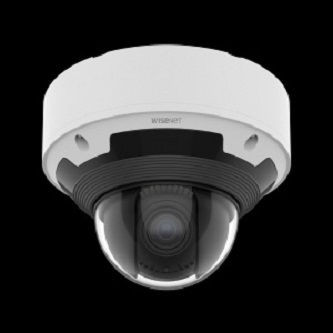
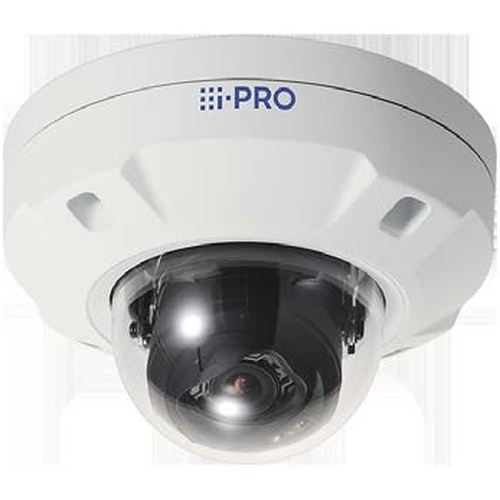
The XNV-8083RZ is physically larger and heavier: ø180 × 135 mm at 2,000 g versus the i-PRO's ø154 × 105 mm at 1,100 g — nearly half the weight. Hanwha specifies a pan/tilt/rotate adjustment range of 0–350°/0–85°/0–340°; i-PRO lists −194° to +166° pan, −30° to +85° tilt, and ±100° yaw. Hanwha lists conduit compatibility (19.1 mm / M25) and a named hanging mount accessory (SBP-187HMW); i-PRO conduit accessory details are not enumerated in the provided specs.
Which fits your VMS and analytics better?
Both cameras support ONVIF Profiles G, S, T, and M, ensuring broad VMS compatibility. Video compression is identical in codec support: H.265, H.264 (with CBR/VBR), and MJPEG. The XNV-8083RZ adds Hanwha's WiseStream II and WiseStream III smart codecs for bandwidth reduction. Streaming differs: Hanwha supports up to 20 unicast users and 10 profiles with 3 virtual channels; i-PRO supports up to 14 simultaneous users. The i-PRO is based on an Ambarella CV52 SoC, which is specified; Hanwha's SoC is not named in the provided data. Both support MQTT and SNMPv1/v2c/v3.
On-board edge storage: the XNV-8083RZ provides two microSD/SDHC/SDXC slots supporting up to 1 TB (2 × 512 GB); the i-PRO provides a single microSD/SDHC/SDXC slot up to 512 GB. For AI analytics, Hanwha detects person, face, vehicle, and license plate with vehicle sub-type classification (car, bus, truck, motorcycle, bicycle), virtual line/area logic, and people counting. i-PRO specifies AI motion, face, and vehicle detection plus AI Sound Classification. The i-PRO also lists audio input/output jacks (3.5 mm) and 4× alarm I/O terminals in hardware; the XNV-8083RZ requires the external SPM-4210 NW I/O Box for alarm I/O. The i-PRO additionally notes signed firmware and secure boot in its spec; these are not listed for the Hanwha.
Which should you choose: the XNV-8083RZ or the X25700-V2LN?
Our take: The WV-X25700-V2LN is the stronger choice when IR range and native audio I/O are primary requirements; the XNV-8083RZ is the stronger choice when license-plate analytics, dual-slot edge redundancy, or extreme cold-start performance is the deciding factor. The i-PRO's 70 m IR reach is more than double the Hanwha's 30 m wall-mount figure — a decisive gap for large open-area coverage. Its 132 dB Super Dynamic WDR also edges Hanwha's stated 120 dB extremeWDR. Conversely, the XNV-8083RZ delivers license plate detection and vehicle sub-type classification not listed for the i-PRO, supports 1 TB dual-slot edge storage versus the i-PRO's single 512 GB slot, and is rated to −50 °C versus −40 °C (−30 °C PoE+ active). Integrators on Hanwha's Wisenet VMS ecosystem will benefit from native SUNAPI support; those on Panasonic/i-PRO infrastructure gain the CV52 SoC and built-in audio hardware without external modules.
Side-by-Side Comparison
Spec-for-spec, from manufacturer data.
| Specification | Hanwha XNV-8083RZ | i-PRO X25700-V2LN |
|---|---|---|
| Resolution | 3328×1872 | 3840×2160 |
| Image Sensor | 1/1.8" Progressive CMOS | Approx. 1/1.8" CMOS |
| Focal Length / Zoom | 4.4–9.3 mm, 2.1× motorized | 4.3–8.6 mm, 2.0× motorized |
| Max Aperture (Wide) | F1.3 | F1.5 |
| Minimum Illumination | 0.03 Lux color / 0 Lux IR | 0.03 Lux (BW, 50IRE, F1.5, 1/30s) |
| IR Range | 15 m standard; 30 m wall install | 70 m |
| WDR | extremeWDR 120 dB | Super Dynamic max 132 dB |
| Max Frame Rate | 30 fps @ 6MP | 30 fps |
| Video Compression | H.265, H.264, MJPEG + WiseStream II/III | H.265, H.264, MJPEG |
| IP Rating | IP66 / IP67 / IP6K9K / NEMA 4X | IP66 / IP67 / NEMA 4X |
| Impact Rating | IK10+ | IK10 / 50 J (IEC 60068-2-75) |
| Operating Temperature | −50 °C to +55 °C | −40 °C to +55 °C (PoE+ start: −30 °C) |
| Power Input / PoE Class | PoE+ 802.3at Class 4 (max 22.5W) | PoE+ 802.3at Class 4 (14W) or DC 12V 1.2A |
| Edge Storage | 2× microSD/SDHC/SDXC, max 1 TB | 1× microSD/SDHC/SDXC, max 512 GB |
| Audio | Not listed (requires SPM-4210 for I/O) | 3.5 mm audio in/out jacks; AI sound classification |
| Alarm I/O | Requires external SPM-4210 NW I/O Box | 4× alarm I/O terminals (built-in) |
| Dimensions | ø180 × 135 mm | ø154 × 105 mm |
| Weight | 2,000 g (4.41 lb) | 1,100 g (2.43 lb) |
| Warranty | 3-year | 5-year |
Frequently Asked Questions
Which should you choose: the XNV-8083RZ or the X25700-V2LN?
The WV-X25700-V2LN is the stronger choice when IR range and native audio I/O are primary requirements; the XNV-8083RZ is the stronger choice when license-plate analytics, dual-slot edge redundancy, or extreme cold-start performance is the deciding factor. The i-PRO's 70 m IR reach is more than double the Hanwha's 30 m wall-mount figure — a decisive gap for large open-area coverage. Its 132 dB Super Dynamic WDR also edges Hanwha's stated 120 dB extremeWDR. Conversely, the XNV-8083RZ delivers license plate detection and vehicle sub-type classification not listed for the i-PRO, supports 1 TB dual-slot edge storage versus the i-PRO's single 512 GB slot, and is rated to −50 °C versus −40 °C (−30 °C PoE+ active). Integrators on Hanwha's Wisenet VMS ecosystem will benefit from native SUNAPI support; those on Panasonic/i-PRO infrastructure gain the CV52 SoC and built-in audio hardware without external modules.
Is the XNV-8083RZ or WV-X25700-V2LN better for low-light performance?
Both cameras share an identical minimum illumination spec of 0.03 Lux color. However, the WV-X25700-V2LN has a significantly longer IR illumination range — 70 m versus 15–30 m for the XNV-8083RZ — making it the stronger choice in large unlit areas where targets are at distance. The Hanwha specifies 0 Lux in IR mode; the i-PRO does not state a 0 Lux IR floor in the provided specs.
Which camera is easier to install in tight conduit or lightweight-mount scenarios?
The WV-X25700-V2LN is substantially lighter (1.1 kg vs 2.0 kg) and smaller (ø154 × 105 mm vs ø180 × 135 mm), which simplifies installation on lighter junction boxes or pole mounts. The XNV-8083RZ specifies explicit conduit compatibility (19.1 mm / M25) and a named accessory hanging mount (SBP-187HMW); equivalent conduit accessory detail is not provided in the i-PRO spec sheet.
Which camera supports license plate recognition out of the box?
Based on the provided specifications, only the Hanwha XNV-8083RZ lists license plate as a classified object type in its AI analytics engine. The i-PRO WV-X25700-V2LN specifies AI motion, face, and vehicle detection but does not list license plate detection in the provided spec data.
Get a Second Opinion on Your Camera Choice
Share your site layout, coverage goals, and budget. Our team will validate the camera selection, flag anything we would change, and recommend products that match the use case.