
Hanwha XNV-8083RZ vs i-PRO S22600-V2LG: Specification Comparison
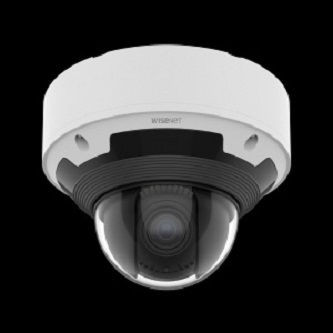
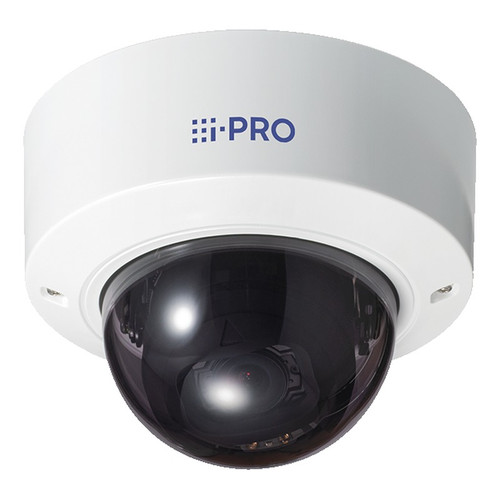
This comparison examines two 6MP fixed dome IP cameras targeting professional security installations: the Hanwha XNV-8083RZ, a motorized varifocal outdoor dome with IR, and the i-PRO WV-S22600-V2LG, a vandal-resistant indoor dome with motorized zoom. Both share a 1/1.8" CMOS sensor and 30fps at 6MP, making them legitimate cross-shop candidates for buyers deciding between outdoor/harsh-environment deployment and indoor installations where audio I/O and extended warranty matter.
In This Guide
How do the imaging specs compare?
The XNV-8083RZ delivers 3328×1872 native resolution at 30fps with a 4.4–9.3mm (2.1x) motorized varifocal P-iris lens, F1.3 wide to F2.15 tele. Minimum color illumination is 0.03 lux, dropping to 0 lux with its IR LEDs rated at 15m typical and 30m in wall-installation scenarios. Its extremeWDR is rated at 120dB. DORI Detect reaches 44.1m wide / 153.1m tele, Identify 4.4m wide / 15.3m tele. AI-driven WiseNRII noise reduction and Digital Image Stabilization are included, along with defog support.
The WV-S22600-V2LG outputs up to 3072×1728 in 16:9 (or 3072×2304 in 4:3) at 30fps through a 4.3–8.6mm (2.0x) motorized zoom/focus lens, F1.5 wide to F2.4 tele — a slightly faster wide-end aperture ratio compared to the Hanwha at tele but narrower at wide. Minimum color illumination is 0.12 lux, with B&W at 0.09 lux and 0 lux with IR active; IR range is 25m at 30IRE / 20m at 50IRE. Super Dynamic WDR is rated at a maximum 132dB at level 31, exceeding Hanwha's 120dB claim. DORI Detect is 54.9m wide / 136.5m tele; Identify is 5.5m wide / 13.6m tele. The i-PRO also includes AI Sound Classification (gunshot, yell, vehicle horn, glass break) as a supplementary detection layer.
What about installation and environment?
The XNV-8083RZ is explicitly rated for outdoor and harsh environments: IP66/IP67/IP6K9K, NEMA4X, and IK10+ impact resistance, with an operating temperature range of -50°C to +55°C. It requires PoE+ (IEEE 802.3at Class 4, max 22.5W, typical 12.1W), meaning the switch or injector must support 802.3at — standard 802.3af ports will not suffice. The unit weighs 2,000g with an ø180×135mm footprint and an aluminum body with hard-coated dome bubble.
The WV-S22600-V2LG carries IK10 impact resistance but no outdoor IP rating is listed in the provided specifications — it is described as indoor-rated. Operating temperature is -10°C to +50°C ambient, with power-on requiring 0°C or above. It runs on standard PoE 802.3af (Class 0, max 12W), which is widely available on existing switches without infrastructure upgrades. The unit is significantly smaller and lighter at ø129.5×102.5mm and 800g, easing low-profile ceiling installation. It includes hardwired alarm I/O terminals (3× alarm in, 1× alarm out, 1× aux out) and a composite monitor output for optical adjustment — hardware I/O absent from the Hanwha's listed specifications.
Which fits your VMS and analytics better?
Both cameras support ONVIF Profile G/M/S/T and major streaming protocols including H.265, H.264, MJPEG, RTSP, SRTP, MQTT, SNMPv3, and 802.1X authentication. The XNV-8083RZ connects at 10/100/1000BASE-T (Gigabit); the WV-S22600-V2LG tops out at 100Base-TX. Hanwha supports up to 20 simultaneous unicast users and 10 stream profiles with 3 virtual channels; i-PRO supports up to 14 simultaneous users. Security posture differs: Hanwha uses TPM 2.0 (FIPS 140-2 Level 2) with a pre-installed device certificate; i-PRO implements FIPS 140-2 Level 3 via an NXP SE050F hardware secure element, a higher cryptographic assurance tier.
On analytics, the XNV-8083RZ provides AI-based object detection classifying Person, Face, Vehicle (car/bus/truck/motorcycle/bicycle), and License Plate, plus virtual line crossing, virtual area, and people counting. Edge storage supports dual microSD slots up to 1TB total (2×512GB). The WV-S22600-V2LG offers 8-type AI Video Analytics and adds AI Sound Classification — a capability not listed in Hanwha's provided specifications. Its edge storage is a single microSD slot up to 512GB. The i-PRO includes full-duplex audio with 3.5mm mic input and audio output plus G.711/G.726 compression, enabling two-way audio without additional hardware; the Hanwha provides no audio I/O in the provided specifications.
Which should you choose: the XNV-8083RZ or the S22600-V2LG?
Our take: The WV-S22600-V2LG is the stronger choice for indoor installations where audio I/O, higher cryptographic security, and 802.3af compatibility with existing switch infrastructure are priorities, while the XNV-8083RZ is the clear choice for any outdoor or harsh-environment deployment. Key spec deltas: the Hanwha operates from -50°C to +55°C versus the i-PRO's 0°C to +50°C power-on range and carries IP66/IP67/IP6K9K/NEMA4X outdoor ratings the i-PRO does not list; the i-PRO's Super Dynamic WDR reaches 132dB versus Hanwha's 120dB; and the Hanwha's minimum color illumination of 0.03 lux is four times lower than the i-PRO's 0.12 lux. The i-PRO's 5-year warranty versus Hanwha's 3-year warranty and built-in alarm terminals add operational value in indoor deployments. Choose the XNV-8083RZ for outdoor perimeter, parking, or industrial environments; choose the WV-S22600-V2LG for indoor spaces where audio monitoring, alarm relay integration, and lower PoE requirements matter.
Side-by-Side Comparison
Spec-for-spec, from manufacturer data.
| Specification | Hanwha XNV-8083RZ | i-PRO S22600-V2LG |
|---|---|---|
| Resolution | 3328×1872 (6MP) | 3072×1728 16:9 / 3072×2304 4:3 (6MP) |
| Image Sensor | 1/1.8" progressive CMOS | Approx. 1/1.8" CMOS |
| Lens / Focal Length | 4.4–9.3mm motorized varifocal (2.1x) | 4.3–8.6mm motorized zoom/focus (2.0x) |
| Max Aperture | F1.3 (Wide) / F2.15 (Tele) | F1.5 (Wide) / F2.4 (Tele) |
| Min Illumination (Color) | 0.03 lux | 0.12 lux |
| IR Range | 15m typical / 30m wall-mount scenario | 25m (30IRE) / 20m (50IRE) |
| WDR / Dynamic Range | extremeWDR 120dB | Super Dynamic max 132dB (level 31) |
| Max Frame Rate | 30fps @ 6MP | 30fps |
| Video Compression | H.265 / H.264 / MJPEG | H.265 / H.264 / MJPEG |
| IP Rating | IP66 / IP67 / IP6K9K / NEMA4X | Not specified (indoor rated) |
| IK / Impact Rating | IK10+ | IK10 |
| Operating Temperature | -50°C to +55°C | 0°C to +50°C (power-on); -10°C to +50°C ambient |
| Power Input / PoE Class | PoE+ 802.3at Class 4 / max 22.5W | PoE 802.3af Class 0 / max 12W |
| Edge Storage | Dual microSD up to 1TB (2×512GB) | Single microSD up to 512GB |
| Audio I/O | — | Full-duplex; 3.5mm mic in + audio out |
| Dimensions | ø180×135mm | ø129.5×102.5mm |
| Weight | 2,000g (4.41 lb) | 800g (1.77 lb) |
| Warranty | 3-year | 5-year |
Frequently Asked Questions
Which should you choose: the XNV-8083RZ or the S22600-V2LG?
The WV-S22600-V2LG is the stronger choice for indoor installations where audio I/O, higher cryptographic security, and 802.3af compatibility with existing switch infrastructure are priorities, while the XNV-8083RZ is the clear choice for any outdoor or harsh-environment deployment. Key spec deltas: the Hanwha operates from -50°C to +55°C versus the i-PRO's 0°C to +50°C power-on range and carries IP66/IP67/IP6K9K/NEMA4X outdoor ratings the i-PRO does not list; the i-PRO's Super Dynamic WDR reaches 132dB versus Hanwha's 120dB; and the Hanwha's minimum color illumination of 0.03 lux is four times lower than the i-PRO's 0.12 lux. The i-PRO's 5-year warranty versus Hanwha's 3-year warranty and built-in alarm terminals add operational value in indoor deployments. Choose the XNV-8083RZ for outdoor perimeter, parking, or industrial environments; choose the WV-S22600-V2LG for indoor spaces where audio monitoring, alarm relay integration, and lower PoE requirements matter.
Is the XNV-8083RZ or WV-S22600-V2LG better for low-light performance?
The XNV-8083RZ has a lower minimum color illumination — 0.03 lux versus the WV-S22600-V2LG's 0.12 lux — and a wider maximum aperture of F1.3 versus F1.5, giving it an edge in low-light color imaging. Both cameras reach 0 lux with IR active, though the Hanwha's wall-mount IR range extends to 30m compared to the i-PRO's 25m at 30IRE.
Can I power the WV-S22600-V2LG from a standard PoE switch?
Yes. The WV-S22600-V2LG operates on standard 802.3af PoE (Class 0, 12W max), compatible with virtually any managed or unmanaged PoE switch. The XNV-8083RZ requires PoE+ (802.3at Class 4, up to 22.5W), so existing 802.3af-only switch ports would need to be upgraded or supplemented with a PoE+ injector.
Which camera offers better cybersecurity for a high-compliance environment?
The WV-S22600-V2LG implements FIPS 140-2 Level 3 security via an NXP SE050F hardware secure element, a higher assurance tier than the XNV-8083RZ's TPM 2.0 at FIPS 140-2 Level 2. Both support 802.1X, HTTPS, and SNMPv3. For environments with strict cybersecurity compliance requirements, the i-PRO's Level 3 hardware root of trust provides a stronger cryptographic foundation.
Get a Second Opinion on Your Camera Choice
Share your site layout, coverage goals, and budget. Our team will validate the camera selection, flag anything we would change, and recommend products that match the use case.