
Hanwha XNO-8030R vs i-PRO S15500-V3LK: Specification Comparison
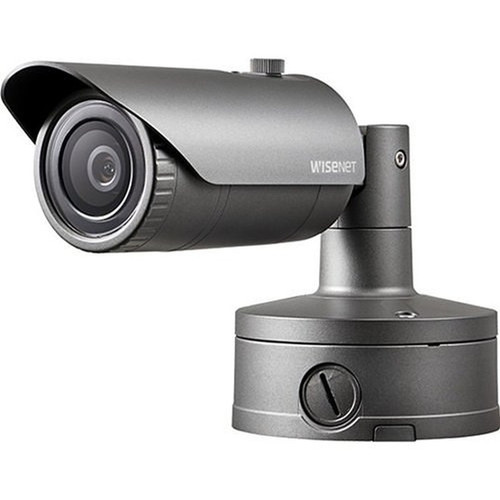
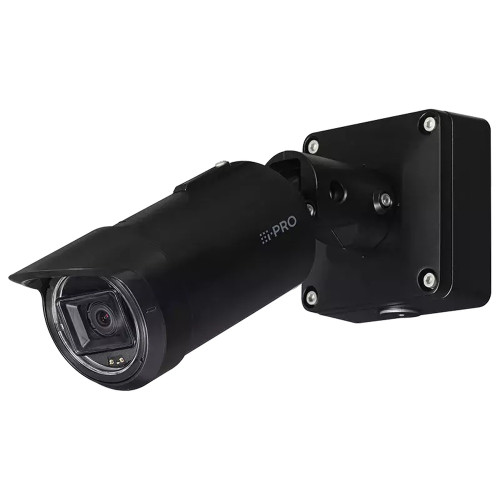
Both the Hanwha XNO-8030R and the i-PRO WV-S15500-V3LK are 5MP outdoor bullet IP cameras aimed at commercial and light-industrial perimeter surveillance. They share the same resolution class, bullet form factor, PoE power delivery, IP66/IK10 environmental ratings, and H.265/H.264/MJPEG compression. Where they diverge is in lens architecture (fixed vs. motorized zoom), IR range, low-light sensitivity, dynamic range ceiling, AI analytics depth, and security-certification level — all factors a security integrator or IT buyer must weigh before specifying either unit.
In This Guide
How do the imaging specs compare?
The XNO-8030R uses a 1/1.8-inch 6MP CMOS sensor delivering a 5MP output at 30fps through a fixed 4.6mm f/1.6 lens, producing a 77.9° horizontal field of view. Its Wide Dynamic Range is rated at 120dB, and minimum color illumination is 0.16 lux, dropping to 0 lux with its built-in IR illuminator rated at 30m (98.4ft). The WV-S15500-V3LK uses a smaller approx. 1/2.8-inch CMOS sensor but achieves a notably lower minimum illumination of 0.05 lux color and 0.04 lux in B&W mode, with the IR illuminator extending to 70m (50IRE) or 50m (50IRE at higher reflectance threshold) — more than double the XNO-8030R's 30m reach.
The WV-S15500-V3LK's Super Dynamic mode reaches a maximum 132dB dynamic range (at Level 30+, 15fps), versus the XNO-8030R's 120dB WDR — a 12dB advantage for the i-PRO unit in high-contrast scenes. The i-PRO also adds a 3.1x motorized optical zoom (2.9–9mm focal length, 34°–106° horizontal FOV) plus up to 9.3x extra digital zoom, making scene composition adjustable post-installation. The Ambarella CV22 SoC is listed for the WV-S15500-V3LK; no SoC is specified for the XNO-8030R. The XNO-8030R's larger 1/1.8-inch sensor is a notable physical-light-gathering advantage on the silicon side, partially offsetting its higher lux floor.
What about installation and environment?
Both cameras carry IP66 and IK10 ratings, and both meet NEMA 4X. The XNO-8030R adds an IP67 rating (full immersion) not listed for the WV-S15500-V3LK. The i-PRO unit specifies wind resistance up to 40m/s (~89 mph), salt-damage resistance per ISO 14993, and an active anti-condensation system (Temish element plus heater plus moisture-absorption gel) — none of these are listed for the XNO-8030R. Operating temperature for the XNO-8030R spans -30°C to +55°C; the WV-S15500-V3LK extends that range to -40°C to +60°C, a meaningful advantage in arctic or high-heat deployments.
Power delivery differs at the PoE class level: the XNO-8030R is IEEE 802.3af Class 3 (max 10.3W PoE, 9.3W at 12VDC), while the WV-S15500-V3LK is listed as PoE Class 0 with 11.5W PoE consumption — Class 0 means the switch must budget up to 15.4W per port rather than the tighter 15.4W Class 3 allocation, a minor but real switch-port-budget consideration. The i-PRO unit is physically larger and heavier (ø133×383mm, 2.4kg / 5.3lbs) versus the XNO-8030R (ø70×296mm, 1.22kg / 2.69lbs). The WV-S15500-V3LK documents ceiling and wall mount pan/tilt/yaw adjustment ranges; the XNO-8030R does not specify mount adjustment ranges in its provided specs.
Which fits your VMS and analytics better?
Both cameras support ONVIF Profile S, G, and T. The WV-S15500-V3LK additionally carries ONVIF Profile M, which covers metadata including AI-event streaming — relevant for VMS platforms that consume structured analytics data. The XNO-8030R exposes Hanwha's SUNAPI (HTTP API) and the Wisenet Open Platform for third-party app development, which the WV-S15500-V3LK does not list. Security posture differs significantly: the WV-S15500-V3LK specifies FIPS 140-2 Level 3 certification backed by an NXP SE050F secure element, plus signed firmware; the XNO-8030R lists HTTPS/SSL, 802.1X (EAP-TLS, EAP-LEAP), and IP filtering, but does not claim FIPS 140-2 or a hardware secure element.
Analytics depth varies. The XNO-8030R provides a broad list including directional detection, virtual line, appear/disappear, enter/exit, loitering, face detection, digital auto tracking, and business-intelligence features (people counting, queue management, heatmap) across up to 32 polygonal privacy zones and 8-zone motion detection. The WV-S15500-V3LK specifies AI Video Analytics with 8 detection types, AI Sound Classification (gunshot, yell, vehicle horn, glass break), 4 VMD zones, 1 Scene Change Detection zone, and 8 privacy zones — fewer analytics categories listed but with explicit AI sound classification. Audio hardware differs: the XNO-8030R integrates mic/line input via internal terminal; the WV-S15500-V3LK provides 3.5mm stereo mini jacks for both input and output with half/full-duplex support and additionally supports AAC-LC compression alongside G.726 and G.711. Both support microSD/SDXC up to 512GB for edge storage.
Which should you choose: the XNO-8030R or the S15500-V3LK?
Our take: The WV-S15500-V3LK is the stronger choice when IR range, extreme-temperature operation, cybersecurity certification, or motorized zoom flexibility is the priority. Its 70m IR reach more than doubles the XNO-8030R's 30m, its 132dB Super Dynamic rating exceeds the XNO-8030R's 120dB by 12dB, and its -40°C to +60°C operating range outspans the XNO-8030R's -30°C to +55°C by 10°C at the cold end. FIPS 140-2 Level 3 with a hardware secure element and a 5-year warranty versus the XNO-8030R's 3-year warranty add weight in regulated or federal-adjacent deployments. Conversely, the XNO-8030R's larger 1/1.8-inch sensor offers a physical light-gathering advantage, its analytics suite includes business-intelligence features not listed for the i-PRO, and its smaller, lighter form factor suits tighter mounting conditions. Choose the XNO-8030R where broad on-camera analytics and compact install matter most; choose the WV-S15500-V3LK where long-range IR, coastal/arctic environmental resilience, and stringent cybersecurity mandates are non-negotiable.
Side-by-Side Comparison
Spec-for-spec, from manufacturer data.
| Specification | Hanwha XNO-8030R | i-PRO S15500-V3LK |
|---|---|---|
| Resolution | 5MP @ 30fps | 5MP @ 30fps |
| Image Sensor | 1/1.8" 6MP CMOS | Approx. 1/2.8" CMOS |
| Lens / Focal Length | 4.6mm fixed, f/1.6 | 2.9–9mm motorized zoom, f/1.3–f/2.5 |
| Optical Zoom | — | 3.1x motorized |
| Horizontal Field of View | 77.9° (fixed) | 34°–106° (variable) |
| Min. Illumination (Color) | 0.16 lux | 0.05 lux |
| Min. Illumination (B&W) | 0 lux (IR on) | 0.04 lux |
| IR Range | 30m (98.4ft) | 70m at 30IRE / 50m at 50IRE |
| Wide Dynamic Range | 120dB | 132dB (Super Dynamic, Level 30+, 15fps) |
| IP Rating | IP67 / IP66 / NEMA 4X | IP66 / NEMA 4X |
| Impact / Vandal Rating | IK10 | IK10 |
| Operating Temperature | -30°C to +55°C | -40°C to +60°C |
| Power Input / PoE Class | PoE 802.3af Class 3 / 12VDC; max 10.3W | PoE Class 0 (11.5W) / DC12V (12W) |
| Edge Storage | microSD/SDXC up to 512GB (2 slots) | microSD/SDXC up to 512GB (1 slot) |
| ONVIF Profiles | S, G, T | G, M, S, T |
| Cybersecurity Certification | — | FIPS 140-2 Level 3, NXP SE050F secure element |
| Alarm I/O | 1 input / 1 output | 3 inputs / 1 output / 1 AUX output |
| Weight | 1.22kg (2.69 lbs) | 2.4kg (5.3 lbs) |
| Dimensions | Ø70 × 296mm | Ø133 × 383mm |
| Warranty | 3 years | 5 years |
Frequently Asked Questions
Which should you choose: the XNO-8030R or the S15500-V3LK?
The WV-S15500-V3LK is the stronger choice when IR range, extreme-temperature operation, cybersecurity certification, or motorized zoom flexibility is the priority. Its 70m IR reach more than doubles the XNO-8030R's 30m, its 132dB Super Dynamic rating exceeds the XNO-8030R's 120dB by 12dB, and its -40°C to +60°C operating range outspans the XNO-8030R's -30°C to +55°C by 10°C at the cold end. FIPS 140-2 Level 3 with a hardware secure element and a 5-year warranty versus the XNO-8030R's 3-year warranty add weight in regulated or federal-adjacent deployments. Conversely, the XNO-8030R's larger 1/1.8-inch sensor offers a physical light-gathering advantage, its analytics suite includes business-intelligence features not listed for the i-PRO, and its smaller, lighter form factor suits tighter mounting conditions. Choose the XNO-8030R where broad on-camera analytics and compact install matter most; choose the WV-S15500-V3LK where long-range IR, coastal/arctic environmental resilience, and stringent cybersecurity mandates are non-negotiable.
Is the XNO-8030R or WV-S15500-V3LK better for low-light performance?
The WV-S15500-V3LK reaches 0.05 lux color and 0.04 lux B&W before switching to IR, compared to the XNO-8030R's 0.16 lux color threshold. The WV-S15500-V3LK's IR illuminator also extends to 70m versus the XNO-8030R's 30m. On passive low-light sensitivity and active IR range, the WV-S15500-V3LK has the measurable advantage. The XNO-8030R's larger 1/1.8-inch sensor (vs. the i-PRO's approx. 1/2.8-inch) partially compensates through greater photon collection area, but neither spec sheet provides a direct comparison of scene performance at equivalent gain settings.
Which camera is better suited for a cybersecurity-conscious or government deployment?
The WV-S15500-V3LK specifies FIPS 140-2 Level 3 certification backed by an NXP SE050F hardware secure element, signed firmware, and ONVIF Profile M for structured AI-metadata streaming. The XNO-8030R lists HTTPS/SSL, 802.1X (EAP-TLS and EAP-LEAP), and IP filtering, but does not claim FIPS 140-2 certification or a hardware secure element in the provided specifications. For deployments where FIPS 140-2 compliance is a hard requirement, only the WV-S15500-V3LK satisfies that criterion based on the specs provided.
Can I adjust the field of view after installation with either camera?
The WV-S15500-V3LK includes a 3.1x motorized optical zoom (2.9–9mm, 34°–106° horizontal FOV) with motorized focus, meaning the field of view can be changed remotely or during commissioning without physically accessing the camera. The XNO-8030R uses a fixed 4.6mm lens with a fixed 77.9° horizontal FOV; field of view cannot be adjusted optically after mounting. If post-installation zoom flexibility is required, the WV-S15500-V3LK is the only option between these two.
Get a Second Opinion on Your Camera Choice
Share your site layout, coverage goals, and budget. Our team will validate the camera selection, flag anything we would change, and recommend products that match the use case.