
Hanwha C8083R vs i-PRO S15500-V3LK: Specification Comparison
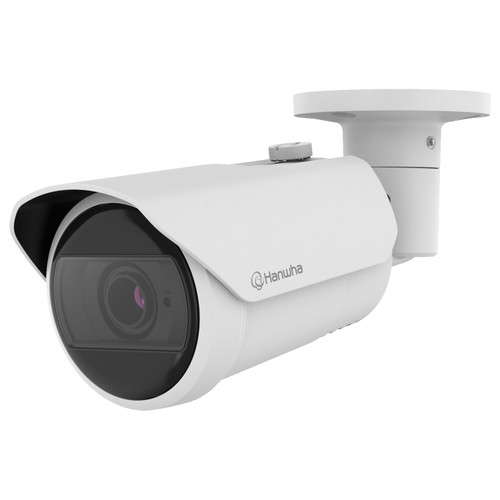
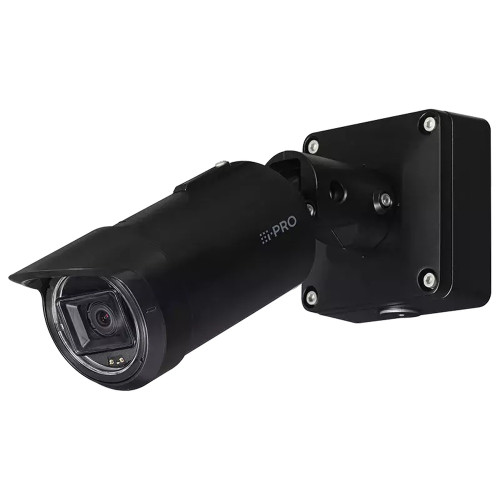
Both the Hanwha QNO-C8083R and the i-PRO WV-S15500-V3LK are wired, outdoor, fixed-bullet IP cameras rated at 5MP with motorized varifocal lenses, IR illumination, PoE power, and IP66/IK10 environmental ratings. They target the same perimeter and general-surveillance installation tier and are routinely cross-shopped by integrators specifying outdoor bullet cameras for commercial and light-industrial sites. The comparison below is driven entirely by the published specifications for each model.
In This Guide
How do the imaging specs compare?
Both cameras use an approximately 1/2.8-inch CMOS sensor delivering 5MP at 30fps, and both support H.265/H.264/MJPEG compression with CBR and VBR bitrate control. The i-PRO WV-S15500-V3LK reaches a minimum color illumination of 0.05 lux (0.04 lux B&W), while the Hanwha QNO-C8083R is rated at 0.07 lux color with 0 lux in IR mode. On dynamic range, the i-PRO claims up to 132 dB (Super Dynamic On, Level 30+, 15fps), whereas the Hanwha specifies 120 dB WDR. The i-PRO's 132 dB figure is achieved only at 15fps; both cameras deliver 30fps in standard operation.
Lens ranges differ measurably: the Hanwha covers 3.2–10.2mm (3.2x motorized varifocal) with a horizontal field of view from 95° wide to an unlisted tele value, and a maximum aperture of F1.6 (wide)/F3.1 (tele). The i-PRO covers 2.9–9mm (3.1x motorized zoom/focus) with a horizontal FOV of 34°–106° and a maximum aperture of F1.3 (wide)/F2.5 (tele). The i-PRO's wider aperture (F1.3 vs F1.6 wide) and lower lux rating give it a measurable low-light edge. IR illumination differs substantially: the i-PRO specifies 70m at 30 IRE / 50m at 50 IRE, while the Hanwha specifies 30m. On DORI metrics, the i-PRO outreaches the Hanwha at both wide and tele distances across all four DORI categories.
What about installation and environment?
Both cameras carry IP66 and IK10 ratings. The i-PRO additionally lists NEMA 4X and ISO 14993 salt-damage resistance, and specifies wind resistance up to 40 m/s (~89 mph) — none of those supplemental ratings are listed in the Hanwha spec. The i-PRO also incorporates an anti-condensation system (Temish element + heater + moisture-absorption gel), which is not mentioned in the Hanwha spec. Operating temperature ranges are -40°C to +60°C for the i-PRO versus -30°C to +55°C for the Hanwha, giving the i-PRO a broader thermal envelope on both ends.
Power: the Hanwha is PoE Class 3 (IEEE 802.3af), drawing a maximum of 12W (typical 5.3W). The i-PRO is listed as PoE Class 0 drawing 11.5W via PoE, and also accepts DC 12V at 1.0A (12W); the dual-input option is absent from the Hanwha spec. Physical size and weight differ: the Hanwha measures ø93.4×245.8mm at 930g (2.05 lb), while the i-PRO is ø133×133×383mm at approximately 2.4 kg (5.3 lb) — the i-PRO is substantially larger and heavier. The Hanwha lists pan/tilt/rotate ranges (0–360°/0–100°/0–360°) and compatible gangbox and backbox accessories; the i-PRO documents ceiling and wall mounting orientation ranges (±180° pan, 0–100° tilt, ±190° yaw for ceiling). The Hanwha spec notes a Micro USB Type B video output (1280×720) for installation alignment; the i-PRO provides a VBS 1.0V composite monitor output for the same purpose.
Which fits your VMS and analytics better?
Both cameras declare ONVIF Profile S/G/T/M compliance. The Hanwha additionally exposes SUNAPI (HTTP API) and supports up to 20 unicast users and 5 simultaneous streaming profiles. The i-PRO supports up to 14 simultaneous users and adds SFTP and MQTT protocol support, which are not listed in the Hanwha spec. Network authentication via IEEE 802.1X is supported by both. The i-PRO specifies FIPS 140-2 Level 3 with an NXP SE050F secure element; the Hanwha lists secure boot, signed firmware, firmware encryption, AES encryption, SD card partition encryption, and a Hanwha Private Root CA device certificate — but does not cite FIPS 140-2.
On analytics: the Hanwha runs AI-based person and vehicle detection (with vehicle-type sub-classification: car/bus/truck/motorcycle/bicycle), virtual line crossing, virtual area intrusion, plus business-intelligence features including people counting, vehicle counting, queue management, and heatmap — all on-device. The i-PRO lists 8 AI detection types and AI sound classification (gunshot, yell, vehicle horn, glass break); the i-PRO spec also lists facial recognition as a feature. The Hanwha does not list AI sound classification or facial recognition in its provided spec. Both support on-board microSD/SDXC storage: the Hanwha lists up to 256GB (1 slot); the i-PRO lists up to 512GB. Audio: the Hanwha provides selectable mic/line input and line output; the i-PRO provides a 3.5mm stereo mic/line input (plug-in power, 2kΩ, -10dBV) and a 3.5mm stereo line output (600Ω, -20dBV), plus half/full-duplex modes and AAC-LC compression in addition to G.726/G.711. Alarm I/O: the Hanwha has 1 input/1 output; the i-PRO has 3 alarm inputs, 1 alarm output, and 1 AUX output.
Which should you choose: the C8083R or the S15500-V3LK?
Our take: The i-PRO WV-S15500-V3LK is the stronger choice when maximum IR range, broader environmental hardening, and hardware-rooted security certification are the primary requirements. Its 70m IR reach (vs the Hanwha's 30m) is more than double, its operating range extends to -40°C/+60°C versus the Hanwha's -30°C/+55°C, it adds NEMA 4X and salt-resistance ratings absent from the Hanwha spec, and it carries FIPS 140-2 Level 3 — a requirement in federal and critical-infrastructure deployments. The i-PRO also allows up to 512GB edge storage versus 256GB. Conversely, the Hanwha QNO-C8083R weighs 930g vs 2.4kg, draws PoE Class 3 (802.3af-compliant without a PoE+ switch), and provides richer on-device business-intelligence analytics (queue management, heatmap, vehicle-type sub-classification) not enumerated in the i-PRO spec. The Hanwha also carries a 3-year warranty; the i-PRO carries 5 years. Choose the i-PRO for long-range coastal or federally regulated sites; choose the Hanwha where weight, PoE budget, and AI-BI analytics depth matter.
Side-by-Side Comparison
Spec-for-spec, from manufacturer data.
| Specification | Hanwha C8083R | i-PRO S15500-V3LK |
|---|---|---|
| Resolution | 5MP (2592×1944) | 5MP (2048×1536 max 4:3) |
| Image Sensor | 1/2.8" CMOS | Approx. 1/2.8" CMOS |
| Lens / Focal Length | 3.2–10.2mm, 3.2x motorized varifocal | 2.9–9mm, 3.1x motorized zoom/focus |
| Max Aperture (Wide/Tele) | F1.6 (Wide) / F3.1 (Tele) | F1.3 (Wide) / F2.5 (Tele) |
| Min. Illumination (Color) | 0.07 lux | 0.05 lux |
| Min. Illumination (B&W / IR) | 0 lux (IR) | 0.04 lux (B&W); 0 lux not stated |
| IR Range | 30m (850nm LEDs) | 70m at 30 IRE / 50m at 50 IRE |
| Wide Dynamic Range | 120 dB | 132 dB (Super Dynamic On, Level 30+, 15fps) |
| Max Frame Rate | 30fps @ 5MP | 30fps (132dB WDR only at 15fps) |
| Video Compression | H.265 / H.264 / MJPEG | H.265 / H.264 / MJPEG |
| IP Rating | IP66 | IP66, NEMA 4X |
| Impact / Vandal Rating | IK10 | IK10 |
| Operating Temperature | -30°C to +55°C | -40°C to +60°C |
| Power Input / PoE Class | PoE IEEE 802.3af, Class 3 (max 12W) | PoE Class 0 (11.5W) or DC 12V 1.0A |
| Edge Storage | microSD/SDHC/SDXC up to 256GB | microSD/SDHC/SDXC up to 512GB |
| Alarm I/O | 1 input / 1 output | 3 inputs / 1 output / 1 AUX output |
| ONVIF Profile | S / G / T / M | G / M / S / T |
| Hardware Security | Secure boot, signed firmware, AES, device cert (Hanwha CA) | FIPS 140-2 Level 3, NXP SE050F |
| Weight | 930g (2.05 lb) | Approx. 2.4 kg (5.3 lb) |
| Warranty | 3 years | 5 years |
Frequently Asked Questions
Which should you choose: the C8083R or the S15500-V3LK?
The i-PRO WV-S15500-V3LK is the stronger choice when maximum IR range, broader environmental hardening, and hardware-rooted security certification are the primary requirements. Its 70m IR reach (vs the Hanwha's 30m) is more than double, its operating range extends to -40°C/+60°C versus the Hanwha's -30°C/+55°C, it adds NEMA 4X and salt-resistance ratings absent from the Hanwha spec, and it carries FIPS 140-2 Level 3 — a requirement in federal and critical-infrastructure deployments. The i-PRO also allows up to 512GB edge storage versus 256GB. Conversely, the Hanwha QNO-C8083R weighs 930g vs 2.4kg, draws PoE Class 3 (802.3af-compliant without a PoE+ switch), and provides richer on-device business-intelligence analytics (queue management, heatmap, vehicle-type sub-classification) not enumerated in the i-PRO spec. The Hanwha also carries a 3-year warranty; the i-PRO carries 5 years. Choose the i-PRO for long-range coastal or federally regulated sites; choose the Hanwha where weight, PoE budget, and AI-BI analytics depth matter.
Is the QNO-C8083R or WV-S15500-V3LK better for low-light performance?
Based on published specs, the i-PRO WV-S15500-V3LK has a measurable low-light advantage: it is rated at 0.05 lux color / 0.04 lux B&W versus the Hanwha's 0.07 lux color, and its wide-end aperture is F1.3 versus F1.6 for the Hanwha. The i-PRO also provides 70m IR illumination compared to the Hanwha's 30m, which matters significantly on large open sites where subjects are beyond 30m. Both cameras reach 0 lux when IR is active.
Can either camera be powered by a standard 802.3af PoE switch?
The Hanwha QNO-C8083R is specified as PoE IEEE 802.3af Class 3 (max 12W, typical 5.3W), which is within the 15.4W budget of a standard 802.3af port. The i-PRO WV-S15500-V3LK is listed as PoE Class 0 drawing 11.5W via PoE, which also falls within 802.3af limits; it additionally supports DC 12V input. Neither camera requires PoE+ (802.3at) based on the provided specifications.
Which camera is better suited for government or critical-infrastructure deployments requiring hardware security certification?
The i-PRO WV-S15500-V3LK specifies FIPS 140-2 Level 3 with an NXP SE050F hardware secure element, which is a commonly mandated certification in federal and critical-infrastructure procurement. The Hanwha QNO-C8083R lists secure boot, signed firmware, AES encryption, SD partition encryption, and a private-CA device certificate, but does not cite FIPS 140-2 compliance in the provided specifications. If FIPS 140-2 Level 3 is a contract requirement, the i-PRO meets it as specified; the Hanwha's compliance with that standard cannot be confirmed from the available spec data.
Get a Second Opinion on Your Camera Choice
Share your site layout, coverage goals, and budget. Our team will validate the camera selection, flag anything we would change, and recommend products that match the use case.