
Hanwha QNO-8080R vs i-PRO S15500-V3LK: Specification Comparison
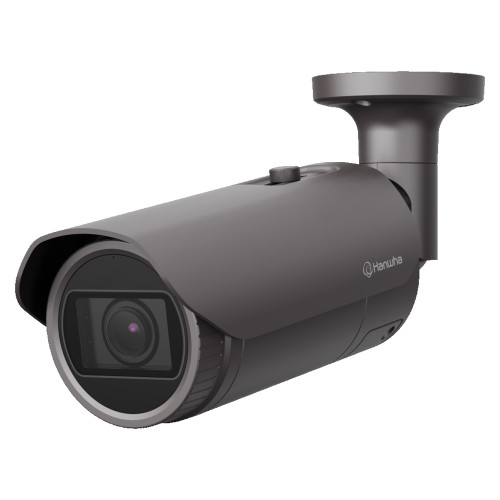
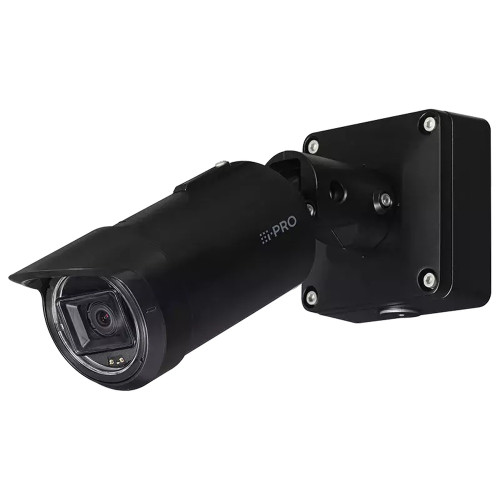
Both the Hanwha QNO-8080R and the i-PRO WV-S15500-V3LK are 5MP outdoor fixed bullet cameras with 3.1x motorized varifocal lenses, PoE power, IP66/IK10 ratings, and H.265/H.264/MJPEG compression. They occupy the same resolution class and form factor, making them genuine cross-shop candidates for perimeter and parking-lot deployments where installers are evaluating mid-range 5MP bullets from competing manufacturers.
In This Guide
How do the imaging specs compare?
Both cameras use an approximately 1/2.8-inch CMOS sensor at 5MP and deliver 30fps. Low-light performance differs noticeably: the i-PRO S15500-V3LK reaches 0.05 lux color and 0.04 lux B&W, while the Hanwha QNO-8080R is rated at 0.15 lux color, with both reaching 0 lux in IR mode. The S15500-V3LK also claims a wider dynamic range of 132 dB (at Super Dynamic level 30 or above, 15fps) versus the QNO-8080R's 120 dB. IR illumination range further separates them: the S15500-V3LK covers 70 m at 30 IRE versus the QNO-8080R's 30 m, a meaningful difference for long-range perimeter coverage.
Lens ranges are similar but not identical. The QNO-8080R offers a 3.2–10mm motorized varifocal with F1.6 maximum aperture at wide end; the S15500-V3LK covers 2.9–9mm with F1.3 at wide, giving it a slight light-gathering advantage. DORI figures from the provided specs show the S15500-V3LK outperforms the QNO-8080R at both wide and tele ends across all four DORI thresholds—for example, tele-end detection distance is 201 m for the S15500-V3LK versus 185.7 m for the QNO-8080R. The S15500-V3LK also adds digital extra zoom up to 9.3x at 640×360 resolution, which the QNO-8080R does not list.
What about installation and environment?
Both cameras are rated IP66 and IK10, suitable for outdoor vandal-exposed mounting. The QNO-8080R operates from −30°C to +55°C; the S15500-V3LK extends that range to −40°C to +60°C and adds an active anti-condensation system (Temish element, heater, and moisture absorption gel), NEMA 4X, ISO 14993 salt-damage resistance, and wind resistance up to 40 m/s (approximately 89 mph)—specs not listed for the QNO-8080R. The S15500-V3LK also holds UL 62368-1, c-UL, CE, FCC Part 15 Class A, and ICES-003 Class A safety certifications; the QNO-8080R lists IP66 and IK10 but does not list UL or FCC certifications in the provided specs.
On power, the QNO-8080R is PoE IEEE 802.3af Class 3 (max 9.5 W). The S15500-V3LK accepts PoE at 11.5 W or DC 12V at 1.0 A (12 W), giving installers a dual-power option not present on the QNO-8080R. The S15500-V3LK is physically larger and heavier (ø133×383mm, 2.4 kg vs. ø91×322.9mm, 1.19 kg), which may influence bracket and housing selection. The QNO-8080R lists a compatible backbox (SBO-126B); the S15500-V3LK does not list a companion backbox in the provided specs.
Which fits your VMS and analytics better?
Both cameras support ONVIF Profile S, G, and T. The S15500-V3LK additionally lists ONVIF Profile M, which covers metadata for analytics events—relevant for VMS platforms that consume AI analytics via ONVIF. The S15500-V3LK specifies an Ambarella CV22 SoC and lists AI Video Analytics covering 8 detection types plus AI Sound Classification (gunshot, yell, vehicle horn, glass break), audio detection, and Scene Change Detection. The QNO-8080R provides motion detection, tampering, defocus detection, virtual area (intrusion/enter/exit), and virtual line (crossing/direction) analytics under its WiseStream II smart codec, but does not list an identified SoC or AI sound classification in the provided specs.
Audio hardware is present on the S15500-V3LK (3.5mm stereo mic input and audio output, G.726/G.711/AAC-LC compression, half/full duplex); the QNO-8080R does not list audio input or output in the provided specs. Edge storage capacity is higher on the S15500-V3LK (microSD/SDHC/SDXC up to 512 GB) versus the QNO-8080R (up to 128 GB). The S15500-V3LK supports up to 14 simultaneous users; the QNO-8080R supports unicast up to 6 users plus multicast. The S15500-V3LK lists FIPS 140-2 Level 3 and NXP SE050F as security certifications; the QNO-8080R lists firmware encryption, 802.1X (EAP-TLS/LEAP/PEAP), HTTPS/SRTP, and SD card partition encryption, but does not claim FIPS 140-2 in the provided specs. The QNO-8080R includes SUNAPI and Wisenet Open Platform APIs; the S15500-V3LK does not list a proprietary open-platform SDK in the provided specs.
Which should you choose: the QNO-8080R or the S15500-V3LK?
Our take: The i-PRO WV-S15500-V3LK is the stronger choice when the deployment demands longer IR reach, broader environmental hardening, or AI-driven audio and video analytics integrated into an ONVIF Profile M-capable VMS. Its 70m IR versus the QNO-8080R's 30m is decisive for perimeter detection; its 132 dB Super Dynamic versus 120 dB WDR provides more headroom in high-contrast scenes; and its −40°C lower operating floor plus NEMA 4X, salt-resistance, and active anti-condensation make it the better fit for coastal, arctic, or industrial environments. The QNO-8080R is the more practical selection when the VMS is Wisenet-native (SUNAPI/Wisenet Open Platform), when PoE budget is constrained to 802.3af Class 3, or when project cost is a primary driver and the site does not require long IR throw, audio, or FIPS-certified secure elements.
Side-by-Side Comparison
Spec-for-spec, from manufacturer data.
| Specification | Hanwha QNO-8080R | i-PRO S15500-V3LK |
|---|---|---|
| Resolution | 2592×1944 (5MP) | 5MP (2048×1536 max 4:3 @ 30fps) |
| Image Sensor | 1/2.8" CMOS | Approx. 1/2.8" CMOS |
| Lens / Focal Length | 3.2–10mm motorized varifocal (3.1x) | 2.9–9mm motorized varifocal (3.1x) |
| Max Aperture (Wide) | F1.6 | F1.3 |
| Min Illumination (Color) | 0.15 lux | 0.05 lux |
| Min Illumination (B&W) | Not specified | 0.04 lux |
| IR Range | 30m (850nm LED) | 70m at 30 IRE / 50m at 50 IRE |
| Wide Dynamic Range | 120 dB | 132 dB (Super Dynamic On, Level ≥30, 15fps) |
| Max Frame Rate | 30fps @ 5MP | 30fps |
| Video Compression | H.265 / H.264 / MJPEG | H.265 / H.264 / MJPEG |
| ONVIF Profiles | S, G, T | G, M, S, T |
| IP Rating | IP66 | IP66, NEMA 4X |
| Impact Rating | IK10 | IK10 |
| Operating Temperature | −30°C to +55°C | −40°C to +60°C |
| Power Input / PoE Class | PoE 802.3af Class 3 (max 9.5W) | PoE 11.5W or DC 12V 1.0A; PoE Class 0 |
| Edge Storage | microSD/SDHC/SDXC up to 128GB | microSD/SDHC/SDXC up to 512GB |
| Audio I/O | Not specified | 3.5mm mic input + 3.5mm audio output |
| Alarm I/O | 1 input / 1 output | 3 inputs / 1 alarm output / 1 AUX output |
| AI Analytics | Motion, tampering, defocus, virtual area/line | AI Video Analytics (8 types) + AI Sound Classification |
| Dimensions (W×D) | ø91×322.9mm | ø133×383mm |
| Weight | 1.19 kg (2.62 lb) | 2.4 kg (5.3 lb) |
| Warranty | 3 years | 5 years |
Frequently Asked Questions
Which should you choose: the QNO-8080R or the S15500-V3LK?
The i-PRO WV-S15500-V3LK is the stronger choice when the deployment demands longer IR reach, broader environmental hardening, or AI-driven audio and video analytics integrated into an ONVIF Profile M-capable VMS. Its 70m IR versus the QNO-8080R's 30m is decisive for perimeter detection; its 132 dB Super Dynamic versus 120 dB WDR provides more headroom in high-contrast scenes; and its −40°C lower operating floor plus NEMA 4X, salt-resistance, and active anti-condensation make it the better fit for coastal, arctic, or industrial environments. The QNO-8080R is the more practical selection when the VMS is Wisenet-native (SUNAPI/Wisenet Open Platform), when PoE budget is constrained to 802.3af Class 3, or when project cost is a primary driver and the site does not require long IR throw, audio, or FIPS-certified secure elements.
Is the QNO-8080R or the S15500-V3LK better for low-light performance?
Based on the provided specifications, the i-PRO S15500-V3LK has a lower minimum color illumination (0.05 lux versus 0.15 lux for the QNO-8080R) and a lower B&W threshold (0.04 lux). Both reach 0 lux in IR mode, but the S15500-V3LK's IR range is 70m versus 30m for the QNO-8080R, giving it a meaningful advantage in unlit outdoor environments.
Can I power either camera with a standard PoE switch?
The Hanwha QNO-8080R is IEEE 802.3af Class 3 (max 9.5W), so any 802.3af-compliant port will power it. The i-PRO S15500-V3LK draws 11.5W over PoE; 802.3af ports are rated for up to 15.4W at the switch and 12.95W at the device, so most 802.3af ports will satisfy this, but verify your switch's per-port budget. The S15500-V3LK also accepts DC 12V as an alternative, which the QNO-8080R does not list.
Which camera is better suited for extreme weather or coastal installations?
The i-PRO S15500-V3LK provides several additional environmental certifications not listed for the QNO-8080R: NEMA 4X, ISO 14993 salt-damage resistance, wind resistance up to 40 m/s, and an active anti-condensation system. It also operates down to −40°C versus −30°C for the QNO-8080R. For coastal, high-wind, or arctic deployments, the S15500-V3LK's documented environmental ratings are more comprehensive based on the provided specs.
Get a Second Opinion on Your Camera Choice
Share your site layout, coverage goals, and budget. Our team will validate the camera selection, flag anything we would change, and recommend products that match the use case.