
Hanwha QNO-8010R vs i-PRO S15500-V3LK: Specification Comparison
This comparison examines two 5MP outdoor bullet IP cameras aimed at professional security integrators and IT buyers: the Hanwha QNO-8010R and the i-PRO WV-S15500-V3LK. Both are fixed-mount bullet-form cameras sharing the same 5MP resolution class and 1/2.8" CMOS sensor format, powered via PoE, and rated IP66/IK10. Key differentiators include optics (fixed wide-angle vs. motorized varifocal zoom), IR range, low-light sensitivity, AI analytics depth, audio support, and environmental hardening—factors that drive installation and total-cost-of-ownership decisions on real deployments.
In This Guide
How do the imaging specs compare?
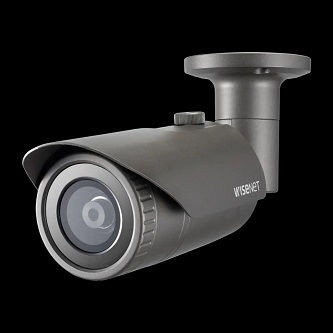
The QNO-8010R uses a 2.8 mm fixed focal lens with a wide 105° horizontal field of view, a maximum aperture of F2.0, and IR illumination rated to 20 m (65.6 ft). Its minimum illumination is 0.15 Lux in color and 0 Lux with IR active. WDR is rated at 120 dB using Hanwha's SSDR processing. DORI identify range tops out at 4.0 m and detect at 40.0 m, consistent with a wide fixed lens.
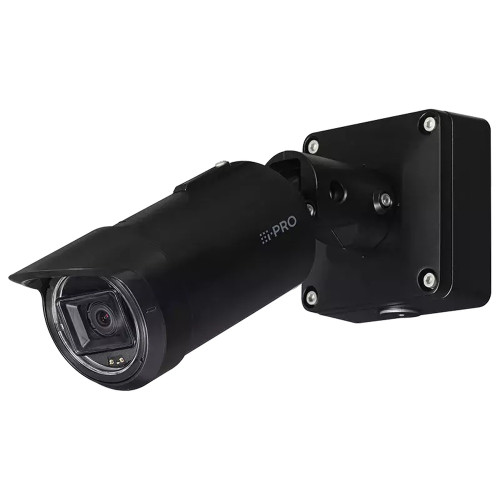
The WV-S15500-V3LK mounts a 2.9–9 mm motorized varifocal lens delivering 3.1× optical zoom (extendable to 9.3× via extra zoom at reduced resolution), with a horizontal field of view spanning 34°–106°. Minimum illumination is 0.05 Lux color and 0.04 Lux B&W—three times more sensitive in color than the QNO-8010R. IR reach is rated 70 m at 30 IRE and 50 m at 50 IRE, versus the Hanwha's 20 m. Super Dynamic WDR reaches 132 dB at 15 fps. At tele end, DORI identify extends to 20.1 m and detect to 201.0 m, dramatically outranging the fixed-lens model at distance.
What about installation and environment?
Both cameras carry IP66 ingress protection and IK10 impact resistance. The QNO-8010R is PoE only (IEEE 802.3af Class 3, max 7.5 W), operates from −30 °C to +55 °C, and weighs 680 g in an aluminum housing measuring ø70 × 246 mm. The WV-S15500-V3LK accepts either DC 12 V (12 W) or PoE (11.5 W), operates from −40 °C to +60 °C with an integrated anti-condensation system (Temish element, heater, moisture-absorption gel), adds NEMA 4X certification, wind resistance up to 40 m/s (~89 mph), and ISO 14993 salt-damage resistance. It is substantially larger and heavier at ø133 × 383 mm and 2.4 kg, requiring heavier mounting hardware. The i-PRO unit's motorized lens requires lens-position calibration at commissioning; the Hanwha fixed lens is plug-and-verify.
Power class matters on legacy switches: the QNO-8010R draws a typical 6.1 W (max 7.5 W) and fits any 802.3af port. The WV-S15500-V3LK draws 11.5 W over PoE, requiring an 802.3at (PoE+) port or the DC 12 V alternative when 802.3at is unavailable.
Which fits your VMS and analytics better?
Both cameras declare ONVIF Profiles S, G, and T. The WV-S15500-V3LK adds ONVIF Profile M (metadata/analytics). The QNO-8010R exposes Hanwha SUNAPI and the Wisenet open platform, enabling tight integration with Wisenet WAVE and partner VMS platforms. Analytics on the QNO-8010R include motion detection, tampering, defocus detection, virtual area (intrusion/enter/exit), and virtual line (crossing/direction); it does not list AI-classified audio events. The WV-S15500-V3LK provides AI Video Analytics with 8 detection types plus AI Sound Classification (gunshot, yell, vehicle horn, glass break), scene change detection, and audio detection, all backed by an Ambarella CV22 SoC. Edge storage on the QNO-8010R supports microSD/SDHC/SDXC up to 128 GB; the WV-S15500-V3LK supports up to 512 GB. The i-PRO model adds a 3.5 mm audio input and output with G.726, G.711, and AAC-LC compression, plus SFTP and MQTT protocol support not listed in the Hanwha spec sheet. The QNO-8010R provides one alarm input and one alarm output; the WV-S15500-V3LK provides three alarm inputs, one alarm output, and one AUX output.
Which should you choose: the QNO-8010R or the S15500-V3LK?
Our take: The WV-S15500-V3LK is the stronger choice when long-range coverage, low-light performance, and AI audio classification are required on a single camera mount. Its 3.1× motorized varifocal lens pushes DORI detect range to 201 m at tele versus the QNO-8010R's fixed 40 m, IR reach is 70 m versus 20 m, and minimum color illumination is 0.05 Lux versus 0.15 Lux—a 3× sensitivity advantage. The i-PRO unit also extends operating temperature to −40 °C and adds NEMA 4X, wind, and salt-damage ratings that matter on exposed coastal or extreme-cold deployments. The QNO-8010R is the practical choice when budget, switch compatibility (802.3af vs. 802.3at), and tight Wisenet VMS integration take priority, or where a wide 105° fixed field of view satisfies coverage without pan-tilt adjustments. Integrators on Wisenet WAVE should verify WV-S15500-V3LK SUNAPI compatibility before specifying it in a Wisenet-centric system.
Side-by-Side Comparison
Spec-for-spec, from manufacturer data.
| Specification | Hanwha QNO-8010R | i-PRO S15500-V3LK |
|---|---|---|
| Resolution | 2592x1944 (5MP) | 2048x1536 / 1920x1080 (5MP, 4:3 / 16:9) |
| Image Sensor | 1/2.8" CMOS | Approx. 1/2.8" CMOS |
| Lens / Focal Length | 2.8 mm fixed | 2.9-9 mm motorized varifocal (3.1x optical) |
| Horizontal FOV | 105° (fixed) | 34°-106° (wide to tele) |
| Min. Illumination (Color) | 0.15 Lux | 0.05 Lux |
| Min. Illumination (B&W) | 0 Lux (IR on) | 0.04 Lux |
| IR Range | 20 m (65.6 ft) | 70 m at 30 IRE / 50 m at 50 IRE |
| WDR | 120 dB | 132 dB (Super Dynamic, 15 fps) |
| Max Frame Rate | 30 fps @ 5MP | 30 fps |
| Video Compression | H.265 / H.264 / MJPEG | H.265 / H.264 / MJPEG |
| IP Rating | IP66 | IP66 / NEMA 4X |
| IK / Impact Rating | IK10 | IK10 |
| Operating Temperature | -30 C to +55 C | -40 C to +60 C |
| Power Input | PoE IEEE 802.3af Class 3 (max 7.5 W) | DC 12 V (12 W) or PoE 802.3at (11.5 W) |
| Edge Storage | microSD/SDHC/SDXC up to 128 GB | microSD/SDHC/SDXC up to 512 GB |
| Audio | — | 3.5 mm in/out; G.726, G.711, AAC-LC |
| Alarm I/O | 1 in / 1 out | 3 in / 1 out / 1 AUX out |
| ONVIF Profiles | S / G / T | G / M / S / T |
| AI Analytics | Motion, tamper, defocus, virtual line/area | 8-type AI Video Analytics + AI Sound Classification |
| DORI Detect | 40.0 m (fixed lens) | Wide: 46.3 m / Tele: 201.0 m |
| DORI Identify | 4.0 m (fixed lens) | Wide: 4.6 m / Tele: 20.1 m |
| Dimensions | 70 x 246 mm | 133 x 383 mm |
| Weight | 680 g (1.50 lb) | Approx. 2.4 kg (5.3 lb) |
| Warranty | 3-year | 5-year |
Frequently Asked Questions
Which should you choose: the QNO-8010R or the S15500-V3LK?
The WV-S15500-V3LK is the stronger choice when long-range coverage, low-light performance, and AI audio classification are required on a single camera mount. Its 3.1× motorized varifocal lens pushes DORI detect range to 201 m at tele versus the QNO-8010R's fixed 40 m, IR reach is 70 m versus 20 m, and minimum color illumination is 0.05 Lux versus 0.15 Lux—a 3× sensitivity advantage. The i-PRO unit also extends operating temperature to −40 °C and adds NEMA 4X, wind, and salt-damage ratings that matter on exposed coastal or extreme-cold deployments. The QNO-8010R is the practical choice when budget, switch compatibility (802.3af vs. 802.3at), and tight Wisenet VMS integration take priority, or where a wide 105° fixed field of view satisfies coverage without pan-tilt adjustments. Integrators on Wisenet WAVE should verify WV-S15500-V3LK SUNAPI compatibility before specifying it in a Wisenet-centric system.
Is the QNO-8010R or WV-S15500-V3LK better for low-light performance?
The WV-S15500-V3LK has a lower minimum color illumination (0.05 Lux vs. 0.15 Lux) and a longer IR range (70 m at 30 IRE vs. 20 m), making it the stronger performer in low-light and zero-light conditions. The QNO-8010R reaches 0 Lux only with IR active and at shorter distances.
Can both cameras run on a standard 802.3af PoE switch?
No. The QNO-8010R draws a maximum of 7.5 W and is classified as IEEE 802.3af Class 3, compatible with standard PoE switches. The WV-S15500-V3LK consumes 11.5 W over PoE and requires an 802.3at (PoE+) port, or an alternative DC 12 V power supply.
Which camera offers more on-board edge storage?
The WV-S15500-V3LK supports microSD/SDHC/SDXC cards up to 512 GB, compared to a 128 GB maximum on the QNO-8010R—four times the local recording capacity for extended edge retention without NAS dependency.
Get a Second Opinion on Your Camera Choice
Share your site layout, coverage goals, and budget. Our team will validate the camera selection, flag anything we would change, and recommend products that match the use case.