
Digital Watchdog DWC-XSBE05Mi vs Hanwha C8083R: Specification Comparison
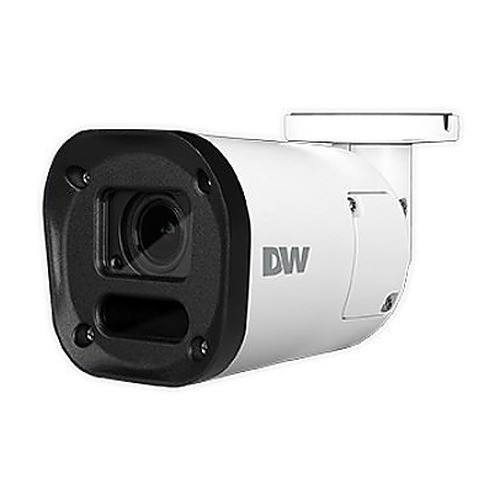
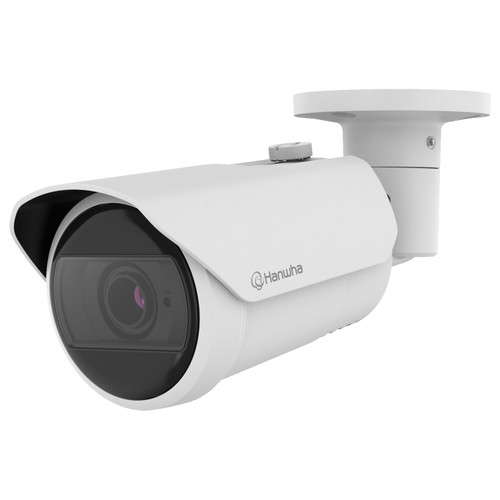
Both the Digital Watchdog DWC-XSBE05Mi and the Hanwha QNO-C8083R are 5MP outdoor bullet cameras targeting perimeter and general surveillance applications. They share the same 2592×1944 resolution, 1/2.8" CMOS sensors, motorized varifocal lenses, H.265/H.264/MJPEG compression, IR illumination, IK10 impact resistance, PoE power, and microSD edge storage. This comparison examines where their imaging, environmental, and integration specs diverge to help installers and IT buyers select the right camera for their deployment conditions.
In This Guide
How do the imaging specs compare?
Both cameras use a 5MP 1/2.8" CMOS sensor producing 2592×1944 active pixels at 30fps. Low-light performance diverges: the DWC-XSBE05Mi achieves 0.04 lux in color and 0.0 lux in B/W (per spec), while the QNO-C8083R is rated 0.07 lux in color and 0 lux with IR active. Both claim 120dB True WDR. The DW camera's motorized varifocal spans 2.7–13.5mm (5× optical zoom) with a horizontal FOV of 98.3°–31.6°, giving a wider zoom range. The Hanwha lens covers 3.2–10.2mm (3.2× zoom) with H: 95°–29° (estimated tele), a narrower range but featuring F1.6 maximum aperture at wide end and DC auto iris with IR correction.
IR range differs materially: the DWC-XSBE05Mi specifies 120ft (≈36.6m) Smart IR, whereas the QNO-C8083R specifies 30m (98.4ft) using long-life 850nm LEDs—nearly identical distance once converted, with DW holding a slight edge. The Hanwha spec sheet also provides DORI distances (Detect at wide 42.7m / tele 186.9m; Identify at wide 4.3m / tele 18.7m), which DW does not publish, giving Hanwha an advantage in forensic-coverage planning. The QNO-C8083R adds Hallway View (90°/270° rotation) and LDC (lens distortion correction), neither of which is listed in the DW spec.
What about installation and environment?
The DWC-XSBE05Mi carries an IP67 ingress rating (dust-tight, immersion to 1m) and IK10 impact resistance in an aluminum die-cast housing weighing 2.13 lbs (0.97 kg). Its operating temperature range is −4°F to 122°F (−20°C to +50°C) with 10–90% non-condensing humidity. It draws a maximum of 8.8W and is classified PoE Class 1, meaning it operates within the lowest PoE budget tier.
The QNO-C8083R is rated IP66 (dust-tight, powerful water jets—not immersion) and IK10, in an aluminum housing weighing 2.05 lbs (930g). Its operating range is −30°C to +55°C (−22°F to +131°F) with 0–95% RH non-condensing, representing a significantly broader cold-end capability (10°C colder at minimum) and a higher humidity ceiling. It draws up to 12W typical 5.3W and is PoE Class 3, requiring a switch port that can supply Class 3 budget. The Hanwha spec lists gangbox compatibility (single, double, 4" octagon) and an optional backbox (SBO-140BW); the DW spec notes mounting accessories are optional and sold separately without listing compatible gangbox types.
Which fits your VMS and analytics better?
Both cameras are ONVIF-conformant. The DWC-XSBE05Mi lists ONVIF in its protocol stack and is explicitly compatible with DW Spectrum IPVMS and any ONVIF-compliant CMS. The QNO-C8083R supports ONVIF Profile S/G/T/M and adds SUNAPI (Hanwha HTTP API), providing four ONVIF profiles versus DW's unspecified profile count. The Hanwha camera also supports IPv6, SRTP, WSS (WebSocket Secure), AES data encryption, SD card partition encryption, signed firmware, secure boot, and a device certificate tied to Hanwha's private root CA—a materially deeper cybersecurity stack. The DW camera lists 802.1x, HTTPS/TLS, digest authentication, and IP filtering.
On analytics, the DWC-XSBE05Mi uses deep learning for object tracking with zones, lines, intrusion, counting, dwell, and tailgating filters. The QNO-C8083R's AI engine classifies Person and Vehicle (with vehicle sub-type: car/bus/truck/motorcycle/bicycle), supports virtual line crossing with direction, virtual area detection, and adds business-intelligence features (people counting, vehicle counting, queue management, heatmap) not listed for the DW. The Hanwha camera supports up to 5 simultaneous streaming profiles versus DW's triple streaming (third stream MJPEG only). Both offer 1-in/1-out alarm I/O and audio I/O with G.711; Hanwha additionally lists G.726 (ADPCM). Edge storage: DW supports up to 1TB microSD; Hanwha specifies up to 256GB microSD. DW spec includes 2GB RAM / 1GB Flash; Hanwha main spec lists the same (one source lists 4GB RAM / 512MB Flash—values are inconsistent across provided spec fields and should be verified with Hanwha directly).
Which should you choose: the DWC-XSBE05Mi or the C8083R?
Our take: The QNO-C8083R is the stronger choice when cybersecurity posture, wider operating temperature range, and richer AI analytics classification matter most; the DWC-XSBE05Mi is the stronger choice when longer motorized zoom range, higher edge-storage capacity, and a lower PoE power budget are the primary constraints. Concretely: the DW camera's 5× optical zoom (2.7–13.5mm) outreaches the Hanwha's 3.2× (3.2–10.2mm), its PoE Class 1 max 8.8W is gentler on switch budgets than Hanwha's Class 3 max 12W, and it supports up to 1TB microSD versus Hanwha's 256GB cap. Conversely, the Hanwha operates down to −30°C versus −20°C for the DW, adds vehicle sub-type AI classification and business-intelligence analytics absent from the DW spec, and delivers a significantly deeper cybersecurity feature set (secure boot, signed firmware, AES/SRTP/WSS, device certificate). Choose DW for zoom flexibility and storage depth on constrained PoE infrastructure; choose Hanwha for cold-climate deployments, advanced AI classification, or enterprise networks with strict cybersecurity requirements.
Side-by-Side Comparison
Spec-for-spec, from manufacturer data.
| Specification | Digital Watchdog DWC-XSBE05Mi | Hanwha C8083R |
|---|---|---|
| Resolution | 5MP (2592×1944) | 5MP (2592×1944) |
| Image Sensor | 1/2.8" CMOS | 1/2.8" CMOS |
| Lens / Focal Length | Motorized varifocal 2.7–13.5mm (5× optical zoom) | Motorized varifocal 3.2–10.2mm (3.2× zoom) |
| Max Aperture | — | F1.6 (Wide) / F3.1 (Tele) |
| Horizontal FOV | 98.3°–31.6° | 95° (Wide) / ~29° (Tele, per DORI data) |
| Min Illumination (Color / B/W) | 0.04 lux color / 0.0 lux B/W | 0.07 lux color / 0 lux IR |
| IR Range | 120ft (≈36.6m) Smart IR | 30m (98.4ft), 850nm LEDs |
| Wide Dynamic Range | 120dB True WDR | 120dB WDR |
| Max Frame Rate | 30fps at all resolutions | 30fps @ 5MP |
| Video Compression | H.265, H.264, MJPEG | H.265, H.264, MJPEG |
| IP Rating | IP67 | IP66 |
| IK / Impact Rating | IK10 | IK10 |
| Operating Temperature | −20°C to +50°C (−4°F to 122°F) | −30°C to +55°C (−22°F to +131°F) |
| Power Input / PoE Class | PoE, Class 1, max 8.8W | PoE (IEEE 802.3af), Class 3, max 12W |
| Edge Storage | microSD/SDHC/SDXC up to 1TB | microSD/SDHC/SDXC up to 256GB |
| Audio | 1 in / 1 out, G.711 | Selectable mic/line in; line out; G.711, G.726 |
| ONVIF Profiles | ONVIF (profile count not specified) | ONVIF Profile S/G/T/M |
| AI Analytics | Deep learning: object tracking, intrusion, counting, dwell, tailgating | AI: Person/Vehicle classification, vehicle sub-type, people counting, queue management, heatmap |
| Privacy Masking | 16 programmable zones | 32 zones (4-point quadrangle) |
| Alarm I/O | 1 input / 1 output | 1 input / 1 output |
| Dimensions | 197.5×86mm (7.77"×3.38") | ø93.4×245.8mm (ø3.68"×9.68") |
| Weight | 0.97 kg (2.13 lbs) | 930g (2.05 lbs) |
| Warranty | 5-year | 3-year |
Frequently Asked Questions
Which should you choose: the DWC-XSBE05Mi or the C8083R?
The QNO-C8083R is the stronger choice when cybersecurity posture, wider operating temperature range, and richer AI analytics classification matter most; the DWC-XSBE05Mi is the stronger choice when longer motorized zoom range, higher edge-storage capacity, and a lower PoE power budget are the primary constraints. Concretely: the DW camera's 5× optical zoom (2.7–13.5mm) outreaches the Hanwha's 3.2× (3.2–10.2mm), its PoE Class 1 max 8.8W is gentler on switch budgets than Hanwha's Class 3 max 12W, and it supports up to 1TB microSD versus Hanwha's 256GB cap. Conversely, the Hanwha operates down to −30°C versus −20°C for the DW, adds vehicle sub-type AI classification and business-intelligence analytics absent from the DW spec, and delivers a significantly deeper cybersecurity feature set (secure boot, signed firmware, AES/SRTP/WSS, device certificate). Choose DW for zoom flexibility and storage depth on constrained PoE infrastructure; choose Hanwha for cold-climate deployments, advanced AI classification, or enterprise networks with strict cybersecurity requirements.
Is the DWC-XSBE05Mi or QNO-C8083R better for low-light performance?
Both cameras achieve 0 lux in B/W with IR active. In color mode, the DWC-XSBE05Mi is rated 0.04 lux versus the QNO-C8083R at 0.07 lux per their respective spec sheets, giving the DW a marginal color low-light advantage on paper. IR range is nearly equivalent: DW specifies 120ft (≈36.6m) and Hanwha specifies 30m (98.4ft). Both use 120dB WDR to handle high-contrast scenes. Neither camera's spec provides identical test-condition details, so real-world results may vary.
Which camera handles colder outdoor temperatures better?
The Hanwha QNO-C8083R operates down to −30°C (−22°F), compared to −20°C (−4°F) for the Digital Watchdog DWC-XSBE05Mi. For deployments in northern climates, high-altitude sites, or unheated enclosures where ambient temperatures regularly fall below −20°C, the QNO-C8083R's wider cold-end rating is the relevant differentiator.
Does either camera support more advanced AI analytics than the other?
Both cameras use AI/deep learning analytics, but their scope differs. The DWC-XSBE05Mi provides deep learning object tracking with zones, lines, intrusion, counting, dwell, and tailgating. The QNO-C8083R classifies detected objects as Person or Vehicle, further sub-classifying vehicles by type (car, bus, truck, motorcycle, bicycle), and adds business-intelligence functions—people counting, vehicle counting, queue management, and heatmap—not listed in the DW spec. For deployments requiring vehicle-type forensics or occupancy analytics, the Hanwha offers a broader AI feature set per the provided specifications.
Get a Second Opinion on Your Camera Choice
Share your site layout, coverage goals, and budget. Our team will validate the camera selection, flag anything we would change, and recommend products that match the use case.