
Hanwha C8083R vs i-PRO X15500-V3L: Specification Comparison
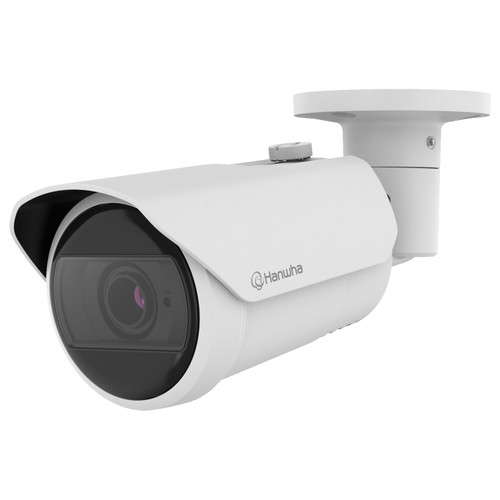
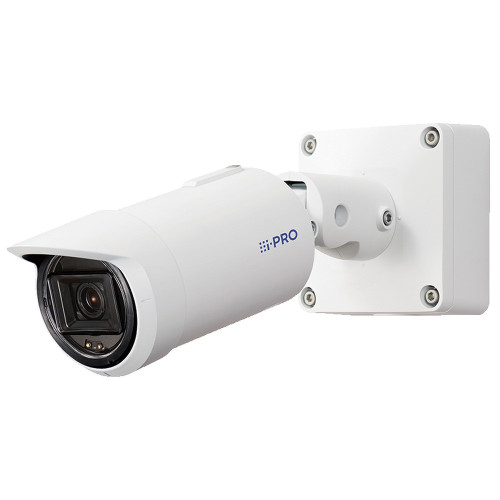
Both the Hanwha QNO-C8083R and the i-PRO WV-X15500-V3L are 5MP outdoor bullet cameras targeting perimeter and site-security installations where AI-based analytics, motorized varifocal lenses, and ruggedized housings are required. Though they share a resolution class and form factor, they differ meaningfully in sensor sensitivity, dynamic range, IR reach, power standard, and warranty depth—factors that matter when specifying for high-contrast or low-light environments and long-term serviceability.
In This Guide
How do the imaging specs compare?
Both cameras use an approximately 1/2.8-inch CMOS sensor and deliver 5MP output at 30fps, but their native resolutions differ: the QNO-C8083R outputs 2592×1944 (4:3 aspect), while the WV-X15500-V3L outputs 3072×1728 (16:9 aspect), which affects how field-of-view translates to usable pixels in widescreen VMS layouts. Low-light performance separates them clearly: the QNO-C8083R specifies 0.07 lux color / 0 lux IR, while the WV-X15500-V3L specifies 0.02 lux (B&W, 50IRE, F1.3, 1/30s)—a roughly 3.5× sensitivity advantage for the i-PRO in color-light-marginal conditions before IR cuts in.
WDR is a major differentiator. The QNO-C8083R claims 120dB WDR via BLC/WDR/SSDR processing. The WV-X15500-V3L specifies a maximum of 132dB with Super Dynamic On at level 31—a 12dB published advantage, meaningful at entryways with mixed sunlight and shadow. IR illumination range also diverges significantly: the QNO-C8083R reaches 30m (98ft) with 850nm LEDs, while the WV-X15500-V3L extends to 70m (230ft)—more than double—relevant for long driveways or parking areas. Lens zoom ratios are similar (QNO-C8083R: 3.2–10.2mm 3.2×, F1.6 wide; WV-X15500-V3L: 2.9–9mm 3.1×, F1.3 wide), but the i-PRO's F1.3 maximum aperture versus F1.6 contributes directly to its lower-lux sensitivity figure.
What about installation and environment?
Both cameras are IP66-rated and IK10-rated, suitable for exposed outdoor mounting subject to water jets and moderate physical impact. The WV-X15500-V3L adds IP67 and NEMA 4X compliance, providing full temporary immersion protection and UL-listed enclosure rating—useful in flood-prone or industrial wash-down environments. Both share an operating temperature floor of -40°C, with a common upper limit of +55°C. The WV-X15500-V3L additionally publishes a wind resistance rating of up to 40 m/s (approx. 89 mph), which the QNO-C8083R's spec sheet does not include.
Power requirements differ in a way that affects infrastructure planning. The QNO-C8083R draws a maximum of 12W and is powered by PoE IEEE 802.3af Class 3—compatible with any standard PoE switch port. The WV-X15500-V3L requires PoE+ (802.3at) at up to 14W (Class 4), meaning the switch or injector must support 802.3at; standard 802.3af ports will not reliably power it. The WV-X15500-V3L is significantly heavier and larger (approx. 2.5 kg / 5.6 lbs, 133×133×383mm) versus the QNO-C8083R (930g / 2.05 lbs, ø93.4×245.8mm), a factor in bracket and conduit load calculations. The QNO-C8083R also includes a Micro USB Type B port for 1280×720 local installation preview.
Which fits your VMS and analytics better?
Both cameras support ONVIF Profiles S, G, T, and M, making them broadly compatible with major VMS platforms. The QNO-C8083R exposes SUNAPI (Hanwha's HTTP API), which is natively supported in Wisenet WAVE/SSM and third-party platforms with Wisenet plug-ins. The WV-X15500-V3L runs on an Ambarella CV52 SoC and is natively integrated into i-PRO's Video Insight and third-party VMSes supporting i-PRO's API. Simultaneous stream limits differ: QNO-C8083R supports up to 20 unicast users across 5 profiles; the WV-X15500-V3L supports up to 14 simultaneous users. The WV-X15500-V3L also supports SFTP and MQTT in addition to standard protocols.
On-board AI analytics differ in scope. The QNO-C8083R provides person/vehicle detection with attribute classification (car/bus/truck/motorcycle/bicycle), virtual line crossing, virtual area detection, people counting, vehicle counting, queue management, and heatmap—all listed as AI-engine-based. The WV-X15500-V3L specifies AI motion, face, vehicle, and occupancy detection plus AI sound classification (gunshot, yell, vehicle horn, glass break)—a unique audio intelligence feature absent from the QNO-C8083R spec sheet. Both support onboard microSD/SDXC edge storage up to 256GB (QNO-C8083R) and up to 512GB (WV-X15500-V3L). Audio I/O is present on both; the WV-X15500-V3L specifies four alarm I/O terminals (IN1, IN2, IN3, OUT, AUX) versus the QNO-C8083R's one input / one output. The WV-X15500-V3L carries a FIPS 140-2 Level 3 security certification; the QNO-C8083R does not list this certification.
Which should you choose: the C8083R or the X15500-V3L?
Our take: The WV-X15500-V3L is the stronger choice when IR range, low-light sensitivity, dynamic range headroom, and security certification depth are the primary criteria. It outperforms on three concrete spec deltas: IR illumination is 70m versus the QNO-C8083R's 30m—more than double; published WDR is 132dB versus 120dB; and minimum illumination is 0.02 lux versus 0.07 lux in comparable modes. It also adds IP67/NEMA 4X ingress protection, 512GB edge storage support, four alarm I/O terminals, AI sound classification, and a 5-year warranty versus the QNO-C8083R's 3-year coverage. The trade-off is real: the WV-X15500-V3L requires PoE+ (802.3at) infrastructure and weighs 2.5 kg against the QNO-C8083R's 930g, raising switch and mounting costs. Specify the QNO-C8083R where standard 802.3af PoE switches are in place, Wisenet WAVE/SSM is the VMS, or budget and infrastructure constraints favor the lighter, lower-power unit.
Side-by-Side Comparison
Spec-for-spec, from manufacturer data.
| Specification | Hanwha C8083R | i-PRO X15500-V3L |
|---|---|---|
| Resolution | 2592×1944 (5MP, 4:3) | 3072×1728 (5MP, 16:9) |
| Image Sensor | 1/2.8" CMOS | Approx. 1/2.8" CMOS |
| Lens / Focal Length | 3.2–10.2mm, 3.2× motorized varifocal | 2.9–9mm, 3.1× motorized varifocal |
| Max. Aperture (Wide) | F1.6 | F1.3 |
| Min. Illumination | 0.07 lux color / 0 lux IR | 0.02 lux (B&W, 50IRE, F1.3, 1/30s) |
| IR Range | 30m (98ft), 850nm LED | 70m (230ft) |
| Wide Dynamic Range | 120dB | 132dB (Super Dynamic On, Level 31) |
| Max Frame Rate | 30fps @ 5MP | 30fps @ 5MP |
| Video Compression | H.265, H.264, MJPEG | H.265, H.264, MJPEG |
| IP Rating | IP66 | IP66 / IP67 / NEMA 4X |
| IK / Impact Rating | IK10 | IK10 |
| Operating Temperature | -30°C to +55°C | -40°C to +55°C |
| Power Input / PoE Class | PoE 802.3af, Class 3, max 12W | PoE+ 802.3at, Class 4, max 14W |
| Edge Storage | microSD/SDHC/SDXC, 1 slot, max 256GB | microSDXC, max 512GB |
| Alarm I/O | 1 input / 1 output | 4 terminals (IN1, IN2, IN3, OUT, AUX) |
| Audio I/O | Mic/line in; line out 0.5Vrms | 3.5mm stereo mic in; 3.5mm stereo out, 600Ω |
| AI Analytics | Person/vehicle detection, line/area crossing, counting, queue, heatmap | Motion, face, vehicle, occupancy detection; AI sound classification |
| ONVIF Profiles | S / G / T / M | S / G / T / M |
| Weight | 930g (2.05 lbs) | Approx. 2.5 kg (5.6 lbs) |
| Warranty | 3 years | 5 years |
Frequently Asked Questions
Which should you choose: the C8083R or the X15500-V3L?
The WV-X15500-V3L is the stronger choice when IR range, low-light sensitivity, dynamic range headroom, and security certification depth are the primary criteria. It outperforms on three concrete spec deltas: IR illumination is 70m versus the QNO-C8083R's 30m—more than double; published WDR is 132dB versus 120dB; and minimum illumination is 0.02 lux versus 0.07 lux in comparable modes. It also adds IP67/NEMA 4X ingress protection, 512GB edge storage support, four alarm I/O terminals, AI sound classification, and a 5-year warranty versus the QNO-C8083R's 3-year coverage. The trade-off is real: the WV-X15500-V3L requires PoE+ (802.3at) infrastructure and weighs 2.5 kg against the QNO-C8083R's 930g, raising switch and mounting costs. Specify the QNO-C8083R where standard 802.3af PoE switches are in place, Wisenet WAVE/SSM is the VMS, or budget and infrastructure constraints favor the lighter, lower-power unit.
Is the QNO-C8083R or WV-X15500-V3L better for low-light and long-range IR coverage?
The WV-X15500-V3L has a clear advantage on both counts. Its specified minimum illumination is 0.02 lux (B&W, F1.3, 1/30s) versus the QNO-C8083R's 0.07 lux color, and its IR illumination reaches 70m (230ft) versus 30m (98ft) for the QNO-C8083R. If the scene involves long driveways, parking lots, or minimal ambient light, the WV-X15500-V3L's specs support superior coverage.
Can I power either camera from a standard PoE switch I already have?
The QNO-C8083R is powered by PoE IEEE 802.3af (Class 3, max 12W), compatible with any standard PoE switch port. The WV-X15500-V3L requires PoE+ IEEE 802.3at (Class 4, up to 14W); a standard 802.3af-only port will not reliably power it. If your existing infrastructure is 802.3af-only, the QNO-C8083R avoids a switch upgrade cost.
Which camera offers more built-in analytics—people counting, sound detection, or facial recognition?
The QNO-C8083R includes people counting, vehicle counting, queue management, and heatmap analytics in addition to person/vehicle detection and virtual line/area crossing. The WV-X15500-V3L adds AI sound classification (gunshot, yell, vehicle horn, glass break) and face detection, features not listed in the QNO-C8083R spec sheet. The QNO-C8083R's business intelligence suite (counting, queue, heatmap) is not listed for the WV-X15500-V3L. Buyers should verify which analytics are licensed vs. native on the specific firmware version deployed.
Get a Second Opinion on Your Camera Choice
Share your site layout, coverage goals, and budget. Our team will validate the camera selection, flag anything we would change, and recommend products that match the use case.