
Hanwha XNB-8000 vs i-PRO S15500-V3LK: Specification Comparison
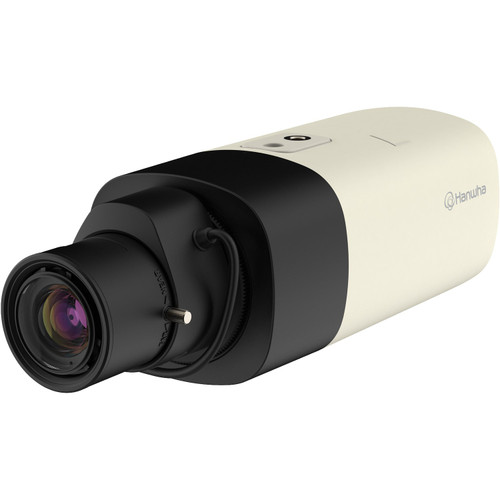
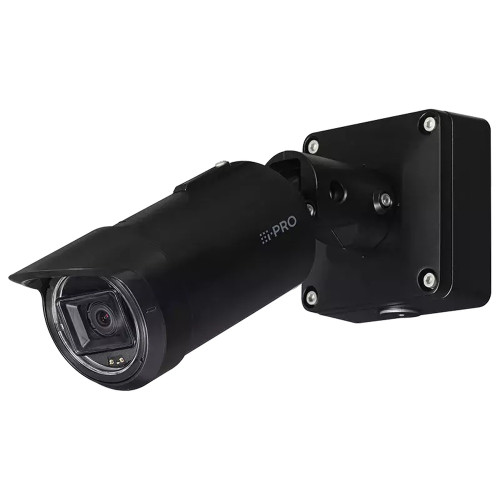
Both the Hanwha XNB-8000 and the i-PRO WV-S15500-V3LK are 5MP wired outdoor bullet IP cameras aimed at professional security integrators needing daytime and night-vision coverage in demanding environments. The XNB-8000 is a fixed-lens boxstyle bullet requiring a separately purchased lens, while the S15500-V3LK ships with a built-in 3.1× motorized varifocal lens. This comparison covers imaging performance, physical installation requirements, and platform integration based solely on published specifications for each model.
In This Guide
How do the imaging specs compare?
Both cameras deliver 5MP resolution at 30fps and support H.265/H.264/MJPEG compression. Sensor size differs: the XNB-8000 uses a larger 1/1.8" 6MP CMOS (cropped to 5MP output at 2560×1920), whereas the S15500-V3LK uses a 1/2.8" CMOS with a scanning area of 5.12mm × 3.84mm and native 5MP output. A larger sensor generally captures more light. The XNB-8000 specifies minimum illumination of 0.07 lux color / 0.007 lux B/W; the S15500-V3LK specifies 0.05 lux color / 0.04 lux B/W in color mode — the i-PRO edges out color sensitivity, while the XNB-8000 claims a lower B/W floor. WDR is 120dB on the XNB-8000 versus a specified maximum of 132dB (Super Dynamic, level 30+, 15fps) on the S15500-V3LK.
The lens situation is a critical differentiator. The XNB-8000 is a lens-less box camera accepting C-mount or CS-mount lenses with DC auto-iris or P-iris control and simple manual focus — the buyer must source and specify a lens separately. The S15500-V3LK ships with a built-in 2.9–9mm motorized varifocal lens (3.1× optical zoom, extendable to 9.3× digital at 640×360), auto-focus, and published DORI distances: Detect 46.3m (wide) to 201m (tele), Identify 4.6m (wide) to 20.1m (tele). IR range on the S15500-V3LK is 70m (30IRE) / 50m (50IRE); the XNB-8000 specifies IR capability (ICR auto day/night) but no IR throw distance is published in the provided specs.
What about installation and environment?
The S15500-V3LK carries an IP66 / NEMA 4X water and dust rating plus IK10 impact resistance, an anti-condensation system (Temish element + heater + moisture absorption gel), ISO 14993 salt-damage resistance, and wind resistance to 40 m/s (~89 mph). It operates from −40°C to +60°C. The XNB-8000 is described as weatherproof outdoor rated but no specific IP or IK ingress/impact rating is stated in the provided specifications. Operating temperature for the XNB-8000 is −10°C to +55°C. For coastal, high-wind, or impact-risk deployments the S15500-V3LK's published certifications are clearly more stringent.
Power inputs also differ. The XNB-8000 accepts PoE (IEEE 802.3af, Class 3), 24VAC, or 12VDC at a maximum of 8.5W (the spec sheet also references 12.95W PoE max — buyers should verify against the authoritative datasheet). The S15500-V3LK accepts DC 12V at 1.0A (12W) or PoE at 11.5W; its PoE class is listed as Class 0. The XNB-8000 is significantly smaller and lighter (73.1×66.6×147.8mm, 420g) compared to the S15500-V3LK (ø133×133×383mm, approximately 2.4kg / 5.3 lbs), reflecting the latter's integrated lens, heater, and ruggedized housing. The S15500-V3LK carries UL/c-UL/CE/IEC 62368-1 and FCC Part 15 Class A safety/EMC certifications; equivalent certifications are not listed for the XNB-8000 in the provided specs.
Which fits your VMS and analytics better?
Both cameras are ONVIF-compliant. The XNB-8000 supports ONVIF Profile S/G/T plus Hanwha's SUNAPI (HTTP API) and Wisenet open platform. The S15500-V3LK supports ONVIF Profile G/M/S/T — adding Profile M (which covers metadata for AI analytics interoperability) that the XNB-8000 does not list. The XNB-8000 supports up to 20 unicast users across up to 10 streaming profiles; the S15500-V3LK supports up to 14 simultaneous users. Edge storage is equivalent: both support microSD/SDHC/SDXC up to 512GB. The XNB-8000 provides 2 microSD slots; the S15500-V3LK provides 1. Security posture: the S15500-V3LK specifies FIPS 140-2 Level 3 with NXP SE050F hardware security element plus signed firmware; the XNB-8000 lists encrypted firmware / FirmwareProtect but does not cite FIPS 140-2.
On analytics, the XNB-8000 includes motion detection, loitering, directional detection, fog detection, digital auto-tracking, sound classification, and handover — all on-camera via WiseStream II. The S15500-V3LK includes AI Video Analytics (8 detection types), VMD (4 areas), Scene Change Detection, audio detection, and AI Sound Classification (gunshot, yell, vehicle horn, glass break). Audio connectivity differs: the XNB-8000 provides selectable mic/line input with built-in mic and line output via terminal block; the S15500-V3LK uses 3.5mm stereo mini jacks for both input and output, and supports half/full-duplex with AAC-LC compression in addition to G.726 and G.711. Alarm I/O: the XNB-8000 provides 1 input / 1 output; the S15500-V3LK provides 3 alarm inputs / 1 alarm output / 1 AUX output. Warranty: 3 years for the XNB-8000 vs. 5 years for the S15500-V3LK.
Which should you choose: the XNB-8000 or the S15500-V3LK?
Our take: The S15500-V3LK is the stronger choice when the installation site demands certified outdoor ruggedization, a built-in motorized varifocal lens, and hardware-rooted cybersecurity. Concretely: its IP66/IK10/NEMA 4X and salt-resistance ratings and −40°C lower operating floor far exceed the XNB-8000's unpublished IP rating and −10°C minimum; its 3.1× motorized optical zoom (2.9–9mm) eliminates a separate lens purchase and enables remote focus adjustment, while the XNB-8000 ships without any lens and requires manual focus; and its FIPS 140-2 Level 3 hardware security element exceeds the XNB-8000's firmware-level encryption alone. The XNB-8000 is the more cost-effective platform when the deployer already specifies a preferred C/CS-mount lens, needs dual microSD redundancy, operates in a Hanwha/Wisenet VMS ecosystem, or requires 24VAC or 12VDC power that the S15500-V3LK does not support via those inputs. Confirm IP rating and PoE class specifics against each manufacturer's current datasheet before final BOM submission.
Side-by-Side Comparison
Spec-for-spec, from manufacturer data.
| Specification | Hanwha XNB-8000 | i-PRO S15500-V3LK |
|---|---|---|
| Resolution | 5MP (2560×1920) | 5MP (2048×1536 max 4:3 / 1920×1080 max 16:9) |
| Image Sensor | 1/1.8" 6MP CMOS | Approx. 1/2.8" CMOS |
| Lens / Focal Length | C/CS-mount (not included); DC auto-iris or P-iris | Built-in 2.9–9mm motorized varifocal (3.1× optical) |
| Min. Illumination (Color) | 0.07 lux | 0.05 lux |
| Min. Illumination (B/W) | 0.007 lux | 0.04 lux |
| IR Range | Not stated in provided specs | 70m (30IRE) / 50m (50IRE) |
| Wide Dynamic Range | 120 dB | 132 dB (Super Dynamic, level 30+, 15fps) |
| Max. Frame Rate | 30fps | 30fps |
| Video Compression | H.265 / H.264 / MJPEG | H.265 / H.264 / MJPEG |
| IP Rating | Not stated in provided specs | IP66 / NEMA 4X |
| IK / Impact Rating | Not stated in provided specs | IK10 (IEC 62262) |
| Operating Temperature | −10°C to +55°C | −40°C to +60°C |
| Power Input / PoE Class | PoE 802.3af Class 3; 24VAC; 12VDC (max 8.5W) | PoE Class 0 (11.5W); DC 12V 1.0A (12W) |
| Edge Storage | 2× microSD/SDHC/SDXC up to 512GB each | 1× microSD/SDHC/SDXC up to 512GB |
| Alarm I/O | 1 input / 1 output | 3 inputs / 1 output / 1 AUX output |
| ONVIF Profiles | S / G / T | G / M / S / T |
| Cybersecurity | Encrypted firmware / FirmwareProtect | FIPS 140-2 Level 3; NXP SE050F; signed firmware |
| Dimensions | 73.1×66.6×147.8mm (2.88×2.62×5.82") | ø133×133×383mm (ø5-1/4"×5-1/4"×15-3/32") |
| Weight | 420g (0.93 lb) | Approx. 2.4kg (5.3 lbs) |
| Warranty | 3 years | 5 years |
Frequently Asked Questions
Which should you choose: the XNB-8000 or the S15500-V3LK?
The S15500-V3LK is the stronger choice when the installation site demands certified outdoor ruggedization, a built-in motorized varifocal lens, and hardware-rooted cybersecurity. Concretely: its IP66/IK10/NEMA 4X and salt-resistance ratings and −40°C lower operating floor far exceed the XNB-8000's unpublished IP rating and −10°C minimum; its 3.1× motorized optical zoom (2.9–9mm) eliminates a separate lens purchase and enables remote focus adjustment, while the XNB-8000 ships without any lens and requires manual focus; and its FIPS 140-2 Level 3 hardware security element exceeds the XNB-8000's firmware-level encryption alone. The XNB-8000 is the more cost-effective platform when the deployer already specifies a preferred C/CS-mount lens, needs dual microSD redundancy, operates in a Hanwha/Wisenet VMS ecosystem, or requires 24VAC or 12VDC power that the S15500-V3LK does not support via those inputs. Confirm IP rating and PoE class specifics against each manufacturer's current datasheet before final BOM submission.
Is the XNB-8000 or S15500-V3LK better for low-light performance?
Based on published specs, the S15500-V3LK achieves 0.05 lux color minimum illumination versus the XNB-8000's 0.07 lux color — a modest advantage in dim color imaging. In black-and-white mode the XNB-8000 specifies 0.007 lux versus 0.04 lux for the S15500-V3LK, suggesting the XNB-8000 may resolve more detail at very low ambient light in monochrome. The S15500-V3LK also publishes an IR throw of 70m (30IRE); no IR range distance is stated for the XNB-8000 in the provided specifications.
Which camera handles harsh outdoor environments better?
The S15500-V3LK is the more hardened option by a significant margin based on published certifications: IP66 water/dust ingress, NEMA 4X, IK10 impact resistance, ISO 14993 salt-damage resistance, wind resistance to 40 m/s, an active anti-condensation system, and an operating range of −40°C to +60°C. The XNB-8000 is described as weatherproof for outdoor use, but no specific IP ingress rating or IK impact rating is stated in the provided specifications, and its operating range starts at −10°C.
Do both cameras work with third-party VMS platforms?
Both support ONVIF, enabling integration with most standards-compliant VMS platforms. The S15500-V3LK adds ONVIF Profile M (metadata/analytics interoperability) that the XNB-8000 does not list. The XNB-8000 additionally exposes Hanwha's SUNAPI (HTTP API) and the Wisenet open platform SDK, which provide deeper integration within Wisenet/Hanwha ecosystems. Buyers should verify their VMS vendor's tested compatibility list for each model before specifying.
Get a Second Opinion on Your Camera Choice
Share your site layout, coverage goals, and budget. Our team will validate the camera selection, flag anything we would change, and recommend products that match the use case.