
Hanwha XNO-6020R vs i-PRO S1536LA: Specification Comparison
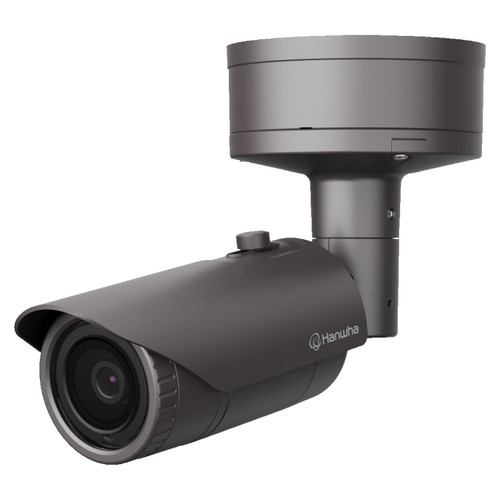
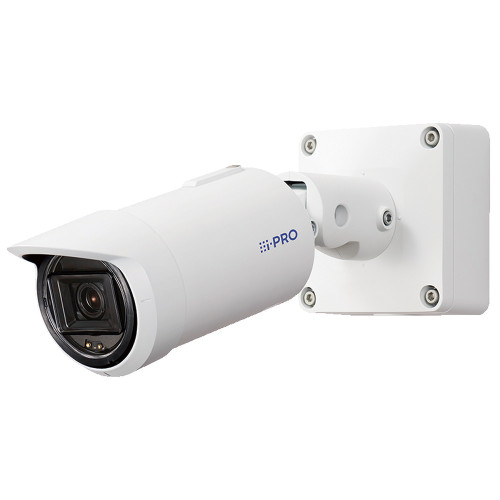
Both the Hanwha XNO-6020R and the i-PRO WV-S1536LA are 2MP outdoor bullet IP cameras aimed at perimeter and general surveillance applications. The XNO-6020R is a fixed-lens bullet powered by PoE 802.3af, while the S1536LA pairs a motorized varifocal lens with an Ambarella CV25M SoC and AI analytics engine. Installers and IT buyers evaluating these two will be weighing optical flexibility and IR reach against wide dynamic range and edge storage density, within the same resolution and form-factor class.
In This Guide
How do the imaging specs compare?
Both cameras use an approximately 1/2.8-inch 2MP CMOS sensor and deliver 1920×1080 at up to 60 fps via H.265. The Hanwha XNO-6020R ships with a fixed 4mm F1.4 lens yielding an 88.6° horizontal field of view, a minimum color illumination of 0.015 lux, and a 150dB Wide Dynamic Range rating via its SSDR/WDR engine. The i-PRO S1536LA uses a 2.9–9mm motorized varifocal lens (3.1× optical zoom, F1.3 wide–F2.5 tele) spanning 37°–117° horizontal FOV, a minimum color illumination of 0.007 lux, and a maximum Dynamic Range of 144dB with Super Dynamic enabled at level 31.
On IR illumination the gap is significant: the XNO-6020R specifies 30m (98.4 ft) built-in IR, reaching 0 lux in B&W mode. The S1536LA specifies 70m (230 ft) at 30IRE and 50m (164 ft) at 50IRE, with adjustable IR intensity. The S1536LA provides DORI distance data (Detect at 114.8m tele; Identify at 11.5m tele) which the XNO-6020R spec sheet does not include. The XNO-6020R's 150dB WDR exceeds the S1536LA's 144dB rating, while the S1536LA's lower minimum illumination figures (0.007 lux color / 0.005 lux B&W) indicate higher sensitivity in darkness.
What about installation and environment?
The Hanwha XNO-6020R carries IP67, IP66, and NEMA 4X ingress ratings plus IK10 impact resistance, and an operating temperature range of -30°C to +55°C. It is powered via PoE (IEEE 802.3af, Class 3, max 9.7W) or 12VDC (max 8.8W), weighs 1,220g (2.69 lb), and measures Ø70×296mm. The housing is aluminum finished in dark grey.
The i-PRO S1536LA carries IP66, Type 4X, and NEMA 4X ingress ratings plus IK10 impact resistance, and an operating temperature range of -40°C to +60°C (power-on floor is -30°C). It includes an active anti-condensation system (Temish element, heater, and moisture absorption gel) not mentioned in the XNO-6020R spec sheet. It is powered via PoE (802.3af, Class 0, 9.1W) or DC12V (710mA), weighs approximately 2.4kg (5.3 lb), and measures Ø133×133×383mm. The S1536LA specifies wind resistance up to 40 m/s (~89 mph); no equivalent figure appears in the XNO-6020R spec sheet. The XNO-6020R adds IP67 immersion protection that the S1536LA does not list.
Which fits your VMS and analytics better?
Both cameras declare ONVIF Profile S, G, and T compliance, ensuring broad VMS compatibility. The Hanwha XNO-6020R also lists ONVIF Profile M and adds SUNAPI (HTTP API) plus Wisenet Open Platform for native integration with Hanwha Wisenet VMS products. It supports SNMPv1/v2c/v3, SRTP, LLDP, and Bonjour, and streams to up to 20 unicast users across up to 10 configurable profiles. The i-PRO S1536LA also declares ONVIF Profile M and adds SFTP and MQTT protocol support (not listed for the XNO-6020R), limits simultaneous users to 14, and is confirmed compatible with iPad, iPhone, and Android mobile terminals.
On-board analytics differ in scope and AI depth. The XNO-6020R includes defocus detection, directional detection, fog detection, face detection, motion detection, digital auto tracking, appear/disappear, enter/exit, loitering, tampering, virtual line, audio detection, sound classification, people counting, queue management, and heatmap—a broad rule-based and business-intelligence suite. The S1536LA specifies AI video analytics with 8 detection modes and AI sound classification (gunshot, yell, vehicle horn, glass break); it also lists scene change detection (SCD) across 1 zone and VMD across 4 zones. Both include audio input and output; the XNO-6020R uses Micro-USB for installation monitoring, the S1536LA provides 3.5mm stereo mini-jacks for audio I/O and a composite monitor output. Edge storage is microSD/SDHC/SDXC up to 512GB on both. The S1536LA carries FIPS 140-2 Level 3 and a device certificate; the XNO-6020R lists 802.1X (EAP-TLS, EAP-LEAP), HTTPS/SSL, digest authentication, and IP filtering but does not cite FIPS 140-2. The S1536LA holds UL, c-UL, CE, FCC Part 15, and ICES-003 safety/EMC certifications; the XNO-6020R does not list equivalent marks in the provided specs. The XNO-6020R carries a 3-year warranty; the S1536LA carries a 5-year warranty.
Which should you choose: the XNO-6020R or the S1536LA?
Our take: The XNO-6020R is the stronger choice when a fixed wide-angle view with maximum WDR performance is the priority and the scene is well-defined at installation time. Its 150dB WDR rating exceeds the S1536LA's 144dB, and its IP67 immersion rating adds a margin of protection the IP66-only S1536LA does not match. However, the S1536LA outperforms on three specification-backed dimensions: IR reach (70m vs. 30m), low-light sensitivity (0.007 lux color vs. 0.015 lux), and lens flexibility (2.9–9mm motorized varifocal vs. fixed 4mm). The S1536LA also operates to -40°C, adds FIPS 140-2 Level 3 security, includes active anti-condensation hardware, carries listed UL/FCC certifications, and backs the product with a 5-year warranty versus the XNO-6020R's 3-year coverage. Specify the XNO-6020R for Wisenet-integrated deployments needing broad analytics and high WDR; specify the S1536LA for long-range perimeter, extreme cold, or compliance-driven environments.
Side-by-Side Comparison
Spec-for-spec, from manufacturer data.
| Specification | Hanwha XNO-6020R | i-PRO S1536LA |
|---|---|---|
| Resolution | 2MP (1920×1080) | 2MP (1920×1080) |
| Image Sensor | 1/2.8" 2MP CMOS | Approx. 1/2.8" CMOS |
| Lens / Focal Length | Fixed 4mm F1.4 | 2.9–9mm Motorized Varifocal, 3.1× Optical Zoom, F1.3–F2.5 |
| Horizontal Field of View | 88.6° | 37°–117° (16:9) |
| Min. Illumination (Color) | 0.015 lux | 0.007 lux (30IRE) |
| Min. Illumination (B&W) | 0 lux (IR) | 0.005 lux (50IRE, F1.3, 1/30s) |
| IR Range | 30m (98.4 ft) | 70m (30IRE) / 50m (50IRE) |
| Wide Dynamic Range | 150dB | Max. 144dB (Super Dynamic On, Level 31) |
| Max Frame Rate | 60fps | 60fps |
| Video Compression | H.265, H.264, MJPEG | H.265, H.264, MJPEG (JPEG) |
| IP Rating | IP67, IP66, NEMA 4X | IP66, Type 4X, NEMA 4X |
| IK / Impact Rating | IK10 | IK10 |
| Operating Temperature | -30°C to +55°C | -40°C to +60°C (Power On: -30°C to +60°C) |
| Power Input / PoE | PoE 802.3af Class 3 (max 9.7W) or 12VDC | PoE 802.3af Class 0 (9.1W) or DC12V 710mA |
| Edge Storage | microSD/SDHC/SDXC up to 512GB (2 slots) | microSD 2GB–512GB |
| Audio I/O | Mic/Line In (2.5VDC, 2kΩ); Line Out (1Vrms) | 3.5mm stereo mic/line in (2kΩ, -10dBV); 3.5mm stereo line out (600Ω) |
| Alarm I/O | 1 input / 1 output | 3 alarm IN / 1 alarm OUT / 1 AUX OUT |
| ONVIF Profiles | S, G, T, M | G, M, S, T |
| Security Certifications | 802.1X EAP-TLS/LEAP, HTTPS/SSL, IP filtering, user log | FIPS 140-2 Level 3, Device Certificate, HTTPS, IEEE 802.1X, brute-force protection |
| Safety / EMC Listings | Not specified in provided specs | UL (UL62368-1), c-UL, CE, IEC62368-1, FCC Part15 ClassA, ICES-003 ClassA |
| Dimensions | Ø70×296mm (Ø2.76"×11.65") | Ø133×133×383mm (Ø5-1/4"×5-1/4"×15-3/32") |
| Weight | 1,220g (2.69 lb) | Approx. 2.4kg (5.3 lb) |
| Warranty | 3 years | 5 years |
Frequently Asked Questions
Which should you choose: the XNO-6020R or the S1536LA?
The XNO-6020R is the stronger choice when a fixed wide-angle view with maximum WDR performance is the priority and the scene is well-defined at installation time. Its 150dB WDR rating exceeds the S1536LA's 144dB, and its IP67 immersion rating adds a margin of protection the IP66-only S1536LA does not match. However, the S1536LA outperforms on three specification-backed dimensions: IR reach (70m vs. 30m), low-light sensitivity (0.007 lux color vs. 0.015 lux), and lens flexibility (2.9–9mm motorized varifocal vs. fixed 4mm). The S1536LA also operates to -40°C, adds FIPS 140-2 Level 3 security, includes active anti-condensation hardware, carries listed UL/FCC certifications, and backs the product with a 5-year warranty versus the XNO-6020R's 3-year coverage. Specify the XNO-6020R for Wisenet-integrated deployments needing broad analytics and high WDR; specify the S1536LA for long-range perimeter, extreme cold, or compliance-driven environments.
Is the XNO-6020R or S1536LA better for low-light performance?
Based on the provided specs, the i-PRO S1536LA has lower minimum illumination figures—0.007 lux color and 0.005 lux B&W—compared to the Hanwha XNO-6020R's 0.015 lux color and 0 lux B&W (IR-assisted). The S1536LA also provides significantly longer IR illumination at 70m (30IRE) versus the XNO-6020R's 30m, making it the spec-supported choice for darker or longer-range scenes.
Which camera handles harsh weather and extreme temperatures better?
Both carry IK10 and NEMA 4X ratings. The i-PRO S1536LA operates from -40°C to +60°C (power-on floor -30°C) and includes an active anti-condensation system (Temish element, heater, moisture absorption gel) and a stated wind resistance of 40 m/s (~89 mph)—none of these appear in the XNO-6020R spec sheet. The XNO-6020R operates from -30°C to +55°C and adds IP67 immersion protection not listed for the S1536LA. For extreme cold or condensation-prone environments the S1536LA's additional protections are specified; for brief immersion exposure the XNO-6020R's IP67 rating applies.
Do both cameras work with third-party VMS platforms?
Yes. Both cameras declare ONVIF Profile S, G, M, and T compliance, which provides broad compatibility with third-party VMS platforms supporting those profiles. The Hanwha XNO-6020R additionally supports SUNAPI (HTTP API) and the Wisenet Open Platform for tighter integration with Hanwha VMS products. The i-PRO S1536LA adds SFTP and MQTT protocol support not listed in the XNO-6020R specs. Confirm your specific VMS vendor's tested compatibility list before specifying either camera.
Get a Second Opinion on Your Camera Choice
Share your site layout, coverage goals, and budget. Our team will validate the camera selection, flag anything we would change, and recommend products that match the use case.