
Hanwha XNO-6010R vs i-PRO X15300-V3L: Specification Comparison
Both the Hanwha XNO-6010R and the i-PRO WV-X15300-V3L are 2MP outdoor bullet IP cameras aimed at perimeter and general surveillance applications. This comparison examines how they differ across imaging capability, environmental and installation requirements, and platform integration—areas where spec-level differences directly affect deployment decisions for integrators and IT security buyers evaluating fixed bullet cameras in the same resolution class.
In This Guide
How do the imaging specs compare?
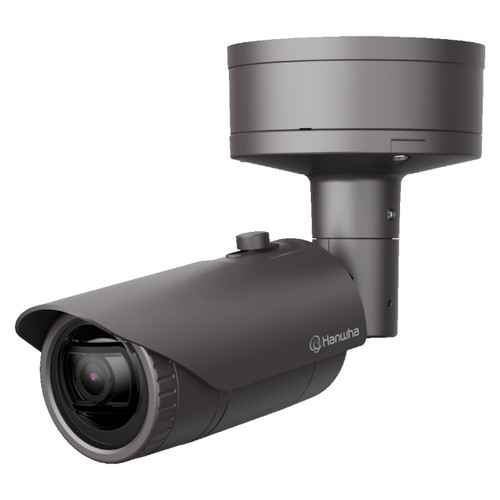
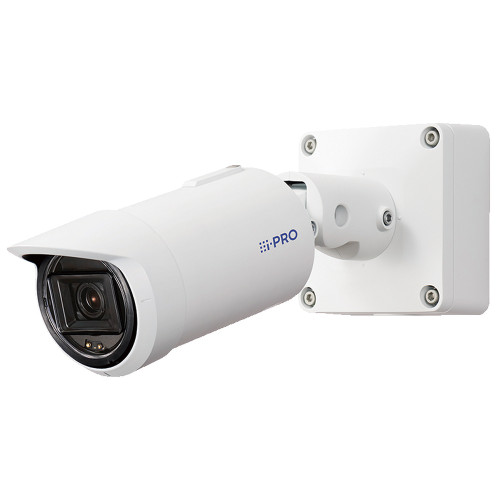
Both cameras share a 1/2.8" 2MP CMOS sensor and 1920×1080 resolution, but their lens systems diverge sharply. The XNO-6010R uses a fixed 2.4mm focal length delivering a wide 139° horizontal field of view—suited for open-area coverage where scene breadth matters. The X15300-V3L uses a motorized 2.9–9mm varifocal lens with 3.1x optical zoom (extendable to 9.3x digital zoom at reduced resolution), yielding a 37–117° horizontal range and enabling field adjustment post-installation without a ladder. DORI metrics published for the X15300-V3L place identification distance at 11.5m (tele) and detection at 114.8m (tele); no equivalent DORI data is provided for the XNO-6010R.
In low-light performance, the X15300-V3L has a significant edge: 0.007 lx color / 0.005 lx B&W minimum illumination versus the XNO-6010R's 0.055 lx color / 0 lux IR. IR range further separates them—70m on the X15300-V3L versus 20m on the XNO-6010R. Dynamic range also favors the i-PRO at 144dB (Super Dynamic) compared to the Hanwha's 150dB WDR; both figures are manufacturer-stated and measurement methodologies differ between brands, so direct comparison should be treated cautiously. The XNO-6010R supports image stabilization via software (DIS); the X15300-V3L uses a gyro-sensor-based stabilizer, which generally delivers more effective vibration compensation on pole or mast mounts.
What about installation and environment?
Both cameras carry IP66/IP67 and IK10 ratings, and both are NEMA 4X compliant, making them equivalently rated for outdoor vandal-resistant deployment. Operating temperature ranges are close but not identical: the XNO-6010R is rated –30°C to +55°C (power-on), while the X15300-V3L stores down to –40°C and powers on from –30°C to +55°C (with a note that ambient operation is rated –40°C to +55°C). The X15300-V3L additionally publishes a wind resistance rating of up to 40 m/s (~89 mph), which the XNO-6010R spec does not address.
Power requirements differ in class: the XNO-6010R draws a maximum of 9.7W over PoE (IEEE 802.3af, Class 3), while the X15300-V3L requires PoE+ (IEEE 802.3at, up to 14W, Class 4). Installers must verify switch port capability before deploying the i-PRO on existing 802.3af-only infrastructure. The XNO-6010R also accepts 12VDC as an alternative power source; the X15300-V3L lists DC12V as well as PoE+. The X15300-V3L's motorized lens supports ceiling (±180° pan, 0–100° tilt) and wall mounting with defined adjustment ranges; the XNO-6010R spec does not detail mounting adjustment parameters. Body materials are aluminum for the XNO-6010R; the X15300-V3L is aluminum die cast with stainless steel and PC resin. The X15300-V3L is substantially heavier at ~2.5 kg versus the XNO-6010R's 1.22 kg.
Which fits your VMS and analytics better?
Both cameras support ONVIF Profile S, G, and T. The X15300-V3L additionally supports ONVIF Profile M, which covers metadata streaming for AI analytics—relevant where VMS platforms consume structured analytics data. The XNO-6010R exposes Hanwha's SUNAPI (HTTP API) and Wisenet open platform in addition to ONVIF, which is an advantage for installations already on Wisenet VMS. Edge analytics depth differs: the XNO-6010R lists defocus detection, directional detection, fog detection, face detection, motion detection, digital auto tracking, appear/disappear, enter/exit, loitering, tampering, virtual line, and audio detection, plus business intelligence functions (people counting, queue management, heatmap). The X15300-V3L lists AI video detection, AI sound classification (gunshot, yell, vehicle horn, glass break), VMD (4 areas), scene change detection (1 area), and audio detection; detailed analytics specifics beyond these categories are not itemized in the provided spec sheet.
Audio hardware differs: the XNO-6010R provides a selectable mic/line input (2.5VDC, 2KΩ) and a line output (1Vrms), with connections unspecified as jacks; the X15300-V3L offers a 3.5mm stereo mini jack input and a 3.5mm stereo jack output (mono, 600Ω), supporting full duplex and AAC-LC in addition to G.711/G.726. The X15300-V3L also adds MQTT and SFTP protocol support not listed for the XNO-6010R. Alarm I/O is 1-in/1-out on the XNO-6010R versus 3-in/1-in/1-aux-out on the X15300-V3L. Both support microSD/SDXC edge storage up to 512GB. The X15300-V3L holds FIPS 140-2 Level 3 certification and explicitly lists secure boot and signed firmware; the XNO-6010R lists encrypted firmware and secure boot. Security certifications for the XNO-6010R beyond those flags are not detailed in the provided spec. The X15300-V3L carries UL/cUL, CE, and FCC Part 15 Class A safety and EMC listings; equivalent safety listings are not specified in the XNO-6010R data provided.
Which should you choose: the XNO-6010R or the X15300-V3L?
Our take: The XNO-6010R is the stronger choice when budget is constrained, PoE infrastructure is 802.3af-only, or the application demands a wide fixed field of view (139° H) with on-camera business intelligence analytics (people counting, heatmap, queue management) on a Wisenet VMS ecosystem. The X15300-V3L is the stronger choice when low-light performance and IR range are primary concerns: its 0.005 lx B&W sensitivity and 70m IR range compare to the XNO-6010R's 0.055 lx color and 20m IR—a 3.5× sensitivity advantage and 3.5× IR distance advantage. The motorized 3.1x optical zoom provides post-installation field-of-view flexibility the fixed-lens XNO-6010R cannot match. For installations requiring FIPS 140-2 Level 3 security compliance, ONVIF Profile M metadata streaming, or 3 alarm inputs, only the X15300-V3L qualifies. The XNO-6010R requires PoE Class 3 (9.7W max); the X15300-V3L requires PoE+ Class 4 (14W), which may necessitate switch upgrades.
Side-by-Side Comparison
Spec-for-spec, from manufacturer data.
| Specification | Hanwha XNO-6010R | i-PRO X15300-V3L |
|---|---|---|
| Resolution | 2MP (1920×1080) | 2MP (1920×1080) |
| Image Sensor | 1/2.8" 2MP CMOS | Approx. 1/2.8" type CMOS |
| Lens / Focal Length | 2.4mm fixed | 2.9–9mm motorized varifocal (3.1x optical) |
| Horizontal Field of View | 139° (fixed) | 37°–117° (zoom-dependent) |
| Min. Illumination (Color) | 0.055 lx | 0.007 lx @ 30IRE |
| Min. Illumination (B&W / IR) | 0 lux (IR) | 0.005 lx (B&W) / 0 lux (with IR) |
| IR Range | 20m (65.6 ft) | 70m (230 ft) |
| Wide Dynamic Range | 150dB WDR | 144dB Super Dynamic |
| Max Frame Rate | 60fps | 60fps |
| Video Compression | H.265 / H.264 / MJPEG | H.265 / H.264 / MJPEG |
| IP Rating | IP66 / IP67 / NEMA 4X | IP66 / IP67 / NEMA 4X (UL50E Type 4X) |
| Impact Rating | IK10 | IK10 |
| Operating Temperature | -30°C to +55°C | -40°C to +55°C (power-on: -30°C to +55°C) |
| Power Input / PoE Class | PoE 802.3af Class 3 / 12VDC; max 9.7W | PoE+ 802.3at Class 4 / DC12V; max 14W |
| Alarm I/O | 1 input / 1 output | 3 inputs / 1 output / 1 AUX output |
| Edge Storage | Dual microSD/SDHC/SDXC up to 512GB | microSD/SDHC/SDXC up to 512GB |
| ONVIF Profiles | S / G / T | G / S / T / M |
| Audio | Mic/Line in; Line out | 3.5mm stereo jack in; 3.5mm stereo jack out (mono) |
| Image Stabilization | Digital (software DIS) | Gyro sensor-based |
| Security Certifications | Encrypted firmware, Secure boot (details not listed) | FIPS 140-2 Level 3, HTTPS, Secure boot, Signed firmware |
| Safety / EMC Listings | Not specified in provided specs | UL (UL62368-1), c-UL, CE, FCC Part 15 Class A, ICES-003 |
| Dimensions | Ø70×296mm (Ø2.76"×11.65") | 133×133×383mm (5-1/4"×5-1/4"×15-3/32") |
| Weight | 1,220g (2.69 lb) | Approx. 2,500g (5.6 lb) |
| Warranty | 3-year | 5-year |
Frequently Asked Questions
Which should you choose: the XNO-6010R or the X15300-V3L?
The XNO-6010R is the stronger choice when budget is constrained, PoE infrastructure is 802.3af-only, or the application demands a wide fixed field of view (139° H) with on-camera business intelligence analytics (people counting, heatmap, queue management) on a Wisenet VMS ecosystem. The X15300-V3L is the stronger choice when low-light performance and IR range are primary concerns: its 0.005 lx B&W sensitivity and 70m IR range compare to the XNO-6010R's 0.055 lx color and 20m IR—a 3.5× sensitivity advantage and 3.5× IR distance advantage. The motorized 3.1x optical zoom provides post-installation field-of-view flexibility the fixed-lens XNO-6010R cannot match. For installations requiring FIPS 140-2 Level 3 security compliance, ONVIF Profile M metadata streaming, or 3 alarm inputs, only the X15300-V3L qualifies. The XNO-6010R requires PoE Class 3 (9.7W max); the X15300-V3L requires PoE+ Class 4 (14W), which may necessitate switch upgrades.
Is the XNO-6010R or X15300-V3L better for low-light and night vision?
The X15300-V3L has the advantage in both metrics. Its minimum illumination is 0.005 lx (B&W) versus 0.055 lx (color) for the XNO-6010R, and its built-in IR illuminator reaches 70m compared to 20m on the XNO-6010R. For scenes that are poorly lit or require identification at distance after dark, the X15300-V3L's specs are substantially stronger.
Can I power either camera from a standard 802.3af PoE switch?
Only the XNO-6010R is rated for 802.3af (PoE Class 3, max 9.7W). The X15300-V3L requires PoE+ (802.3at, Class 4, up to 14W). If your switch ports are 802.3af-only, you would need a PoE+ injector or switch upgrade to power the X15300-V3L.
Which camera offers more flexibility if I need to adjust the field of view after mounting?
The X15300-V3L provides 3.1x motorized optical zoom with a 2.9–9mm focal range, allowing field-of-view adjustment from 117° down to 37° horizontal without physically repositioning the camera. The XNO-6010R has a fixed 2.4mm lens at a fixed 139° horizontal field of view—once mounted, the field of view cannot be changed.
Get a Second Opinion on Your Camera Choice
Share your site layout, coverage goals, and budget. Our team will validate the camera selection, flag anything we would change, and recommend products that match the use case.