
Hanwha XNO-6010R vs i-PRO U1532LA: Specification Comparison
Both the Hanwha XNO-6010R and the i-PRO WV-U1532LA are 2MP outdoor bullet IP cameras designed for fixed perimeter surveillance, making them genuine cross-shop candidates for installers and IT buyers evaluating wired PoE deployments. The comparison covers imaging performance, environmental ratings, power draw, VMS integration, analytics depth, and edge storage — areas where the two cameras diverge meaningfully despite sharing the same resolution class and form factor.
In This Guide
How do the imaging specs compare?
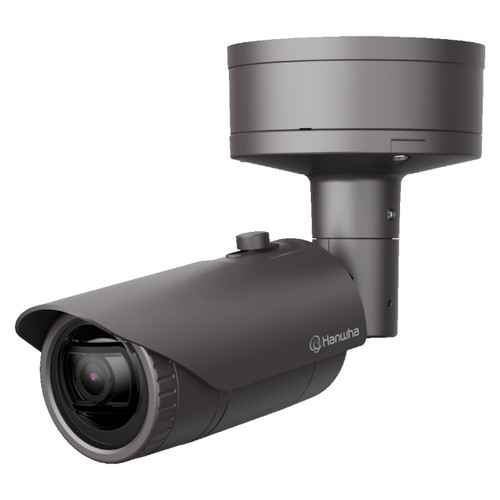
The XNO-6010R uses a 1/2.8" CMOS sensor with a fixed 2.4mm lens at F2.0, delivering a 139° horizontal field of view — wide enough for broad coverage at entry points or corridors. Its minimum illumination is 0.055 lux in color and 0 lux with IR active, with a rated IR range of 20m (65.6ft). WDR is specified at 150dB using Hanwha's SSDR/DWDR processing. Maximum frame rate is listed at 60fps, though the standard streaming rate is 30fps.
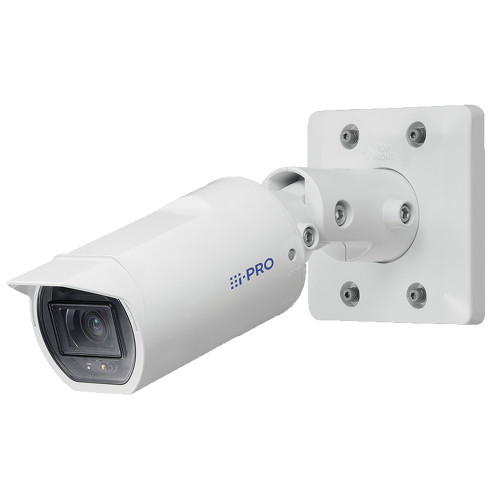
The WV-U1532LA uses an approx. 1/3" CMOS sensor with a 2.9–7.3mm motorized varifocal lens (2.5× optical zoom), offering an adjustable horizontal field of view between 43° and 100°. Minimum illumination is 0.1 lux in color and 0.04 lux in B&W — numerically higher (less sensitive) than the XNO-6010R in color mode. IR range is 30m (98.4ft), extending 10m beyond the Hanwha. Dynamic range is rated at 120dB maximum with Super Dynamic enabled. Maximum frame rate is 30fps. The motorized varifocal lens allows remote focus and zoom adjustment without a site revisit, a significant installation advantage over the XNO-6010R's fixed optic.
What about installation and environment?
Both cameras are IP66-rated and IK10-rated (IEC 62262 impact resistance), and both carry NEMA 4X compliance. The XNO-6010R adds an IP67 rating per its spec sheet. Operating temperature ranges are similar: -30°C to +55°C for the XNO-6010R versus -30°C to +50°C for the WV-U1532LA — a 5°C advantage at the high end for the Hanwha. The i-PRO unit includes an anti-condensation system (Temish element), which is not specified for the XNO-6010R.
Power draw differs notably: the XNO-6010R draws up to 9.7W via PoE (IEEE 802.3af, Class 3), while the WV-U1532LA draws only 6.7W (PoE 802.3af, Class 0). The lower power budget of the i-PRO unit can matter on switches with per-port PoE budget constraints. The XNO-6010R also accepts 12VDC (max 8.8W) as an alternative power input, which the WV-U1532LA does not list. The Hanwha body is aluminum and weighs 1,220g; the i-PRO uses aluminum die cast/PC construction and weighs 860g, making it lighter for pole or parapet mounts. The WV-U1532LA also specifies wind resistance up to 40m/s (~89mph); no equivalent spec is listed for the XNO-6010R.
Which fits your VMS and analytics better?
Both cameras support ONVIF Profile S, G, and T, providing broad VMS compatibility. The XNO-6010R supports Hanwha's SUNAPI (HTTP API) and the Wisenet open platform in addition to ONVIF, which is relevant to Wisenet WAVE/SSM deployments. The WV-U1532LA adds MQTT protocol support and mobile compatibility with iOS and Android terminals, not explicitly listed for the XNO-6010R. Simultaneous users are capped at 20 unicast for the Hanwha (up to 10 streaming profiles) versus 14 users for the i-PRO.
Analytics depth is a significant differentiator. The XNO-6010R lists a broad suite including directional detection, virtual line, loitering, appear/disappear, enter/exit, face detection, digital auto tracking, audio detection, sound classification, defocus detection, fog detection, and tampering — plus business intelligence functions (people counting, queue management, heatmap). The WV-U1532LA specifies VMD (4 areas) and scene change detection (1 area); no advanced analytics beyond those are listed in the provided specifications. Both cameras support microSD/SDHC/SDXC edge storage up to 512GB. Audio is supported on the XNO-6010R (mic/line in, line out); the WV-U1532LA lists no audio input or output in its specifications. The XNO-6010R also provides 2 microSD slots versus a single slot on the WV-U1532LA.
Which should you choose: the XNO-6010R or the U1532LA?
Our take: The XNO-6010R is the stronger choice when on-camera analytics depth, audio capture, and wide fixed coverage at lower cost-of-ownership are priorities. Its 150dB WDR outrates the WV-U1532LA's 120dB, its analytics suite — including loitering, virtual line, people counting, and audio classification — is substantially broader than the i-PRO's VMD-only spec, and its dual microSD slots and 60fps capability add operational flexibility. Conversely, the WV-U1532LA is the better fit when lens flexibility is critical: its 2.9–7.3mm motorized varifocal lens allows remote focus adjustment that the XNO-6010R's fixed 2.4mm optic cannot provide, and its 30m IR range extends 10m beyond the Hanwha's 20m. The i-PRO also draws 3W less PoE power (6.7W vs 9.7W) and carries a 5-year warranty versus 3 years on the Hanwha. Choose the XNO-6010R for analytics-driven or audio-integrated deployments with fixed wide-angle coverage; choose the WV-U1532LA where remote lens tuning, extended IR throw, or longer warranty terms are the deciding factors.
Side-by-Side Comparison
Spec-for-spec, from manufacturer data.
| Specification | Hanwha XNO-6010R | i-PRO U1532LA |
|---|---|---|
| Resolution | 2MP | 2MP |
| Image Sensor | 1/2.8" CMOS | Approx. 1/3" CMOS |
| Lens / Focal Length | 2.4mm fixed | 2.9–7.3mm motorized varifocal (2.5× optical zoom) |
| Horizontal Field of View | 139° (fixed) | 43°–100° (adjustable) |
| Min. Illumination (Color) | 0.055 lux | 0.1 lux |
| Min. Illumination (B&W / IR) | 0 lux (IR active) | 0.04 lux (B&W) |
| IR Range | 20m (65.6ft) | 30m (98.4ft) |
| Wide Dynamic Range | 150dB | 120dB (Super Dynamic On, Level 31) |
| Max Frame Rate | 60fps | 30fps |
| Video Compression | H.265 / H.264 / MJPEG | H.265 / H.264 / MJPEG |
| IP Rating | IP67 / IP66 / NEMA 4X | IP66 / NEMA 4X |
| Impact Rating | IK10 | IK10 |
| Operating Temperature | -30°C to +55°C | -30°C to +50°C |
| Power Input / PoE Class | PoE 802.3af Class 3 / 12VDC; max 9.7W | PoE 802.3af Class 0; 6.7W |
| Edge Storage | Dual microSD/SDHC/SDXC up to 512GB (2 slots) | microSD/SDHC/SDXC up to 512GB (1 slot) |
| Audio | In: mic/line in; Out: line out | — |
| On-Camera Analytics | Loitering, virtual line, enter/exit, people counting, heatmap, and more | VMD (4 areas), scene change detection (1 area) |
| ONVIF Profiles | S / G / T | S / G / T |
| Dimensions | Ø70 × 296mm (Ø2.76" × 11.65") | 112.5 × 112.5 × 262mm (4-7/16" × 4-7/16" × 10-5/16") |
| Weight | 1,220g (2.69 lb) | 860g (1.90 lb) |
| Warranty | 3 years | 5 years |
Frequently Asked Questions
Which should you choose: the XNO-6010R or the U1532LA?
The XNO-6010R is the stronger choice when on-camera analytics depth, audio capture, and wide fixed coverage at lower cost-of-ownership are priorities. Its 150dB WDR outrates the WV-U1532LA's 120dB, its analytics suite — including loitering, virtual line, people counting, and audio classification — is substantially broader than the i-PRO's VMD-only spec, and its dual microSD slots and 60fps capability add operational flexibility. Conversely, the WV-U1532LA is the better fit when lens flexibility is critical: its 2.9–7.3mm motorized varifocal lens allows remote focus adjustment that the XNO-6010R's fixed 2.4mm optic cannot provide, and its 30m IR range extends 10m beyond the Hanwha's 20m. The i-PRO also draws 3W less PoE power (6.7W vs 9.7W) and carries a 5-year warranty versus 3 years on the Hanwha. Choose the XNO-6010R for analytics-driven or audio-integrated deployments with fixed wide-angle coverage; choose the WV-U1532LA where remote lens tuning, extended IR throw, or longer warranty terms are the deciding factors.
Is the XNO-6010R or WV-U1532LA better for low-light performance?
Based on the provided specifications, the XNO-6010R reaches 0.055 lux in color mode and 0 lux with IR active, while the WV-U1532LA is rated at 0.1 lux in color and 0.04 lux in B&W. The XNO-6010R has a lower color-mode illumination threshold. However, the WV-U1532LA's IR range is 30m versus 20m for the XNO-6010R, so it can illuminate subjects at greater distance in darkness. Neither camera's spec sheet provides a standardized scene illumination test result beyond these figures.
Which camera is easier to aim and focus after installation?
The WV-U1532LA has a clear advantage here. Its 2.9–7.3mm motorized varifocal lens supports remote zoom and focus adjustment, so the field of view can be changed from the VMS or browser interface without physically accessing the camera. The XNO-6010R has a fixed 2.4mm lens with no zoom; the field of view is set at installation and cannot be remotely adjusted.
Does either camera support on-camera analytics like loitering or people counting?
Yes, but only the XNO-6010R lists those capabilities in its specifications. Its analytics include loitering detection, virtual line, enter/exit, directional detection, people counting, queue management, and heatmap, among others. The WV-U1532LA's specification lists VMD (video motion detection across 4 areas) and scene change detection (1 area); no advanced behavioral analytics or business intelligence features are listed in the provided spec data.
Get a Second Opinion on Your Camera Choice
Share your site layout, coverage goals, and budget. Our team will validate the camera selection, flag anything we would change, and recommend products that match the use case.