
Hanwha XNO-6010R vs i-PRO S1536LA-B: Specification Comparison
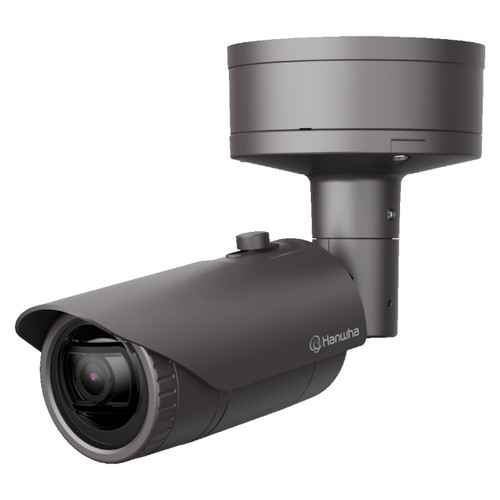
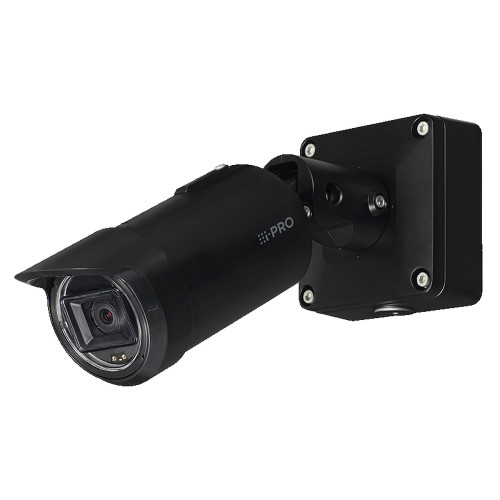
Both the Hanwha XNO-6010R and the i-PRO WV-S1536LA-B are 2MP outdoor bullet IP cameras targeting perimeter and general surveillance applications. The comparison covers sensor and optics, IR range and dynamic range, environmental and power specs, and integration capabilities including analytics, VMS compatibility, and edge storage. The two models share resolution class and form factor but differ meaningfully in lens type, IR reach, dynamic range, analytics depth, and PoE class — factors that directly affect deployment scenarios and total cost of integration.
In This Guide
How do the imaging specs compare?
Both cameras use a 1/2.8" 2MP CMOS sensor and support up to 60fps. The XNO-6010R is fitted with a fixed 2.4mm lens at F2.0, delivering a wide 139° horizontal field of view — suited for close-range, wide-area coverage. The WV-S1536LA-B carries a motorized 2.9–9mm varifocal lens (3.1× optical zoom, auto-focus) with a horizontal FOV of 37–117°, giving installers remote focal adjustment without physical lens access. Minimum object distance is 0.5m on the Hanwha and 0.3m on the i-PRO.
On low-light and dynamic range, the gap is significant. The XNO-6010R specifies 0.055 lux in color mode with 150dB WDR and 20m IR range. The WV-S1536LA-B specifies 0.007 lux at 30IRE in color and 0.005 lux in B&W, with IR illumination rated at 70m at 30IRE (50m at 50IRE) and a maximum dynamic range of 144dB (Super Dynamic On, Level 31). The i-PRO holds the advantage in IR reach and color sensitivity; the Hanwha claims a higher WDR ceiling of 150dB versus 144dB, though measurement methodology may differ between manufacturers.
What about installation and environment?
Both cameras are rated IP66 and IK10, and both carry NEMA 4X certification. The XNO-6010R adds IP67 per its certification listing. Operating temperature for the XNO-6010R is -30°C to +55°C; the WV-S1536LA-B operates from -40°C to +60°C (power-on range -30°C to +60°C) and includes an active anti-condensation system (Temish element, heater, and moisture absorption gel). The i-PRO also specifies wind resistance up to 40 m/s (~89 mph), which the Hanwha spec sheet does not address.
The XNO-6010R is powered by PoE IEEE 802.3af Class 3 (max 9.7W) or 12VDC (max 8.8W). The WV-S1536LA-B is powered by PoE 802.3af (8.5–9.1W) or DC12V at 710mA and is listed as PoE Class 0 — meaning the switch cannot pre-negotiate power class, which may affect managed PoE budgeting. Physically, the Hanwha (Ø70×296mm, 1,220g) is notably more compact and lighter than the i-PRO (Ø133×133×383mm, approx. 2.4kg). The i-PRO supports ceiling and wall mounting with defined pan/tilt/yaw ranges; the Hanwha spec sheet does not list discrete mounting angle specs.
Which fits your VMS and analytics better?
Both cameras support ONVIF Profile S, G, and T. The i-PRO additionally supports ONVIF Profile M. Protocol coverage is broad on both units; the i-PRO adds SFTP and MQTT to its listed IPv4/IPv6 stacks, which the Hanwha spec sheet does not list. The i-PRO also carries FIPS 140-2 Level 3 certification and device certificate support, plus brute-force protection — security posture specs that are absent from the Hanwha listing. The Hanwha lists 802.1X (EAP-TLS, EAP-LEAP); the i-PRO lists 802.1X without specifying EAP sub-types.
On analytics, the XNO-6010R lists a broader named set — including directional detection, appear/disappear, enter/exit, loitering, tampering, virtual line, audio detection, sound classification, defocus detection, fog detection, face detection, and digital auto tracking — plus business intelligence functions (people counting, queue management, heatmap). The WV-S1536LA-B specifies AI Video Analytics (8 types), AI sound classification (gunshot, yell, vehicle horn, glass break), scene change detection, and VMD across 4 areas; specific analytic type names beyond those listed are not enumerated in the provided spec. Both cameras support single-slot microSD/SDHC/SDXC up to 512GB for edge recording; the XNO-6010R provides two microSD slots versus one on the i-PRO. Both support audio in and out with line-level connectivity.
Which should you choose: the XNO-6010R or the S1536LA-B?
Our take: The WV-S1536LA-B is the stronger choice when IR reach, low-light sensitivity, and lens flexibility are the primary requirements. Its 70m IR range (versus 20m on the XNO-6010R), 0.007 lux color sensitivity (versus 0.055 lux), and 3.1× motorized varifocal lens provide substantially greater coverage depth and remote focus adjustment — advantages that matter on long driveways, parking lots, and perimeter fence lines where the camera-to-subject distance varies. The XNO-6010R's 139° fixed wide-angle coverage, dual microSD edge storage slots, a broader named analytics library including business intelligence functions, and more compact/lighter form factor make it better suited for close-range wide-area scenes, retail environments, or budget-constrained deployments. The i-PRO's wider operating temperature range (-40°C vs -30°C cold start), wind-resistance spec, and FIPS 140-2 Level 3 security certification favor deployments in harsh climates or high-security environments. Platform teams standardized on ONVIF Profile M should note only the i-PRO carries that profile.
Side-by-Side Comparison
Spec-for-spec, from manufacturer data.
| Specification | Hanwha XNO-6010R | i-PRO S1536LA-B |
|---|---|---|
| Resolution | 2MP (1920×1080) | 2MP (1920×1080) |
| Image Sensor | 1/2.8" 2MP CMOS | Approx. 1/2.8" type CMOS |
| Lens / Focal Length | 2.4mm fixed, F2.0 | 2.9–9mm motorized varifocal, F1.3–F2.5 |
| Optical Zoom | None (fixed) | 3.1× motorized |
| Horizontal Field of View | 139° (fixed) | 37–117° (zoom-dependent) |
| Min. Illumination (Color) | 0.055 lux | 0.007 lux @ 30IRE |
| Min. Illumination (B&W / IR) | 0 lux (IR on) | 0.005 lux B&W; 0 lux (IR on) |
| IR Range | 20m (65.6ft) | 70m @ 30IRE / 50m @ 50IRE |
| Wide Dynamic Range | 150dB | Max. 144dB (Super Dynamic On, Level 31) |
| Max Frame Rate | 60fps | 60fps |
| Video Compression | H.265 / H.264 / MJPEG | H.265 / H.264 / MJPEG |
| IP Rating | IP67 / IP66 / NEMA 4X | IP66 / NEMA 4X |
| Vandal / Impact Rating | IK10 | IK10 |
| Operating Temperature | -30°C to +55°C | -40°C to +60°C (Power On: -30°C to +60°C) |
| Power Input / PoE Class | PoE 802.3af Class 3 / 12VDC; max 9.7W | PoE 802.3af Class 0 / DC12V 710mA; 8.5–9.1W |
| Edge Storage | Dual microSD/SDHC/SDXC up to 512GB | Single microSD/SDHC/SDXC up to 512GB |
| ONVIF Profiles | S / G / T | G / M / S / T |
| Alarm I/O | 1 input / 1 output | 3 inputs / 1 output / 1 AUX output |
| Audio | Mic/Line in; Line out | 3.5mm Mic/Line in; 3.5mm Line out |
| Dimensions | Ø70 × 296mm (Ø2.76" × 11.65") | Ø133 × 133 × 383mm (Ø5.25" × 5.25" × 15.09") |
| Weight | 1,220g (2.69 lb) | Approx. 2.4kg (5.3 lb) |
| Warranty | 3 years | 5 years |
Frequently Asked Questions
Which should you choose: the XNO-6010R or the S1536LA-B?
The WV-S1536LA-B is the stronger choice when IR reach, low-light sensitivity, and lens flexibility are the primary requirements. Its 70m IR range (versus 20m on the XNO-6010R), 0.007 lux color sensitivity (versus 0.055 lux), and 3.1× motorized varifocal lens provide substantially greater coverage depth and remote focus adjustment — advantages that matter on long driveways, parking lots, and perimeter fence lines where the camera-to-subject distance varies. The XNO-6010R's 139° fixed wide-angle coverage, dual microSD edge storage slots, a broader named analytics library including business intelligence functions, and more compact/lighter form factor make it better suited for close-range wide-area scenes, retail environments, or budget-constrained deployments. The i-PRO's wider operating temperature range (-40°C vs -30°C cold start), wind-resistance spec, and FIPS 140-2 Level 3 security certification favor deployments in harsh climates or high-security environments. Platform teams standardized on ONVIF Profile M should note only the i-PRO carries that profile.
Is the XNO-6010R or WV-S1536LA-B better for low-light performance?
Based on specified minimum illumination, the WV-S1536LA-B has a significant advantage: 0.007 lux at 30IRE in color and 0.005 lux in B&W, compared to 0.055 lux in color for the XNO-6010R. Both reach 0 lux with IR active. The i-PRO also provides 70m IR range versus 20m on the Hanwha, which extends usable night-time coverage distance considerably.
Can I remotely adjust the zoom or focus on either of these cameras?
Only the WV-S1536LA-B supports remote lens adjustment. It uses a motorized 2.9–9mm varifocal lens with 3.1× optical zoom and auto-focus, allowing focal length and focus to be set from the VMS or browser interface after installation. The XNO-6010R has a fixed 2.4mm lens with fixed focus — no remote or mechanical zoom adjustment is available.
Which camera is easier to budget for PoE switch ports?
The XNO-6010R is explicitly rated PoE IEEE 802.3af Class 3 (max 9.7W), allowing a managed PoE switch to allocate power by class negotiation. The WV-S1536LA-B is listed as PoE Class 0 in the provided specifications, which means the switch cannot pre-negotiate a power class and will typically reserve the full 802.3af budget (15.4W) per port, potentially reducing the number of cameras per switch. Actual draw on the i-PRO is 8.5–9.1W.
Get a Second Opinion on Your Camera Choice
Share your site layout, coverage goals, and budget. Our team will validate the camera selection, flag anything we would change, and recommend products that match the use case.