
Hanwha XND-9083RV vs i-PRO U85402-V2L1: Specification Comparison
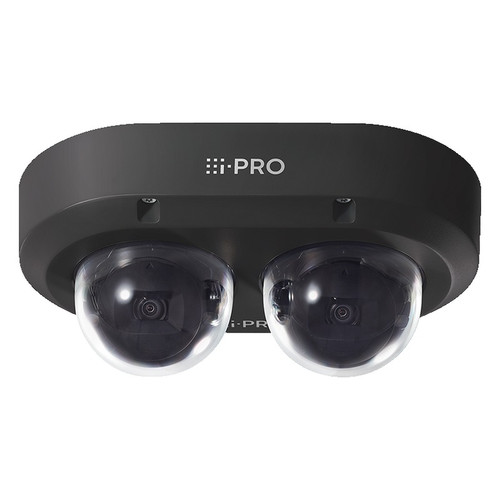
Both the Hanwha XND-9083RV and the i-PRO WV-U85402-V2L1 are fixed-lens motorized-varifocal dome cameras with IK10 vandal resistance, PoE+ power, and onboard IR — but they diverge sharply in resolution (8MP vs. 4MP per sensor), environmental rating, and sensor architecture. This comparison examines imaging performance, installation suitability, and VMS/analytics integration to help installers and IT buyers choose the right unit for their deployment context.

In This Guide
How do the imaging specs compare?
The Hanwha XND-9083RV uses a single 1/1.8" progressive CMOS sensor delivering 3840×2160 (8MP/4K) at 30fps, while the i-PRO WV-U85402-V2L1 employs dual 1/2.7" CMOS sensors each producing up to 2688×1520 (4MP) at 30fps. The Hanwha's larger sensor format generally supports better light-gathering capability, and its specified minimum illumination is 0.04 lux (color) versus the i-PRO's 0.12 lux (B&W at 50IRE) — a meaningful advantage in poorly lit scenes. The Hanwha's IR extends to 50m (WiseIR adaptive), while the i-PRO tops out at 40m in high mode. On dynamic range, the Hanwha claims 120dB (extremeWDR), whereas the i-PRO specifies 108dB maximum (Super Dynamic On, Level 31).
Optically, the Hanwha offers a 4.4–9.3mm motorized varifocal lens (2.1x optical zoom, F1.3 wide), yielding a horizontal field of view from 113° down to approximately 47°. The i-PRO provides a 2.9–7.3mm motorized lens (2.5x optical zoom, F2.0 wide), with a horizontal FoV of 43°–100°. The i-PRO's wider maximum FoV (100° vs. 113° for Hanwha) is comparable, but its tighter telephoto end narrows detection range: Hanwha detects at up to 176.6m (tele) vs. the i-PRO's 136.5m (tele) at 25ppm. For pixel density at distance, the Hanwha's 4K resolution delivers a clear advantage in forensic detail.
What about installation and environment?
The i-PRO WV-U85402-V2L1 carries an IP67 rating (full dust-tight and temporary immersion protection), IK10 impact resistance, NEMA 4X and Type 4X compliance, and wind resistance rated to 40m/s (~89mph) — making it substantially more ruggedized for exposed outdoor environments. It also features an anti-condensation system (Temish element) and operates from –40°C to +60°C. The Hanwha XND-9083RV is rated IP52 (protected against dust ingress and low-pressure water jets from any direction) and IK10, operating from –25°C to +50°C. The IP52 rating limits the Hanwha to sheltered or semi-exposed installations, whereas the i-PRO is field-deployable in direct weather.
Both cameras are PoE+ (IEEE 802.3at, Class 4). The Hanwha draws up to 22.5W; the i-PRO draws 18.9W — a 3.6W difference relevant in high-port-count switch deployments. The Hanwha also accepts 12VDC directly. The Hanwha weighs approximately 1,600g with dimensions of ø160×125mm. The i-PRO weighs approximately 1,800g at 250×150×105mm using the attachment plate. The Hanwha specifies conduit compatibility (1/2" / M20) and a dedicated hanging mount (SBP-167HMW); the i-PRO mounting accessory specifications are not listed in the provided data.
Which fits your VMS and analytics better?
The Hanwha XND-9083RV supports ONVIF Profile S/G/T/M plus Hanwha's own SUNAPI and Wisenet API. It includes on-board AI analytics — object detection with classification (Person, Face, Vehicle, License Plate), vehicle type sub-classification, virtual line crossing with direction, virtual area (loitering), business intelligence (people counting, queue management, heatmap), and DetectionShot. Motion detection supports 8 polygonal zones (8-point). Privacy masking extends to 32 zones with color and mosaic options. The Hanwha also incorporates TPM 2.0 (FIPS 140-2 Level 2) for hardware-rooted security. Edge storage is dual microSD/SDHC/SDXC slots, max 1TB (512GB×2).
The i-PRO WV-U85402-V2L1 supports ONVIF Profile G/S/T. Its analytics are listed as VMD (4 areas) and Scene Change Detection (1 area); the 'AI Analytics' and 'AI Sound Classification' fields are explicitly marked with a dash, indicating those features are not present in this model. It does offer Audio Detection On/Off. Security is rated FIPS 140-2 Level 3 — one level higher than the Hanwha's Level 2. The i-PRO supports up to 24 simultaneous users (vs. Hanwha's 20 unicast). Edge storage is single microSD/SDHC/SDXC slot up to 512GB. Both cameras support G.711 and G.726 audio compression; both include audio input and output. The Hanwha supports MQTT natively in both alarm triggers and protocol stack; the i-PRO also lists MQTT in its IPv6 protocol table.
Which should you choose: the XND-9083RV or the U85402-V2L1?
Our take: The XND-9083RV is the stronger choice when image resolution, low-light performance, on-board AI analytics, and dual-card edge storage are the primary decision criteria. Its 8MP/4K sensor produces roughly twice the pixel count of each i-PRO 4MP sensor, its minimum illumination of 0.04 lux color outperforms the i-PRO's 0.12 lux (B&W), its IR extends 10m further (50m vs. 40m), and it delivers 120dB WDR versus 108dB. However, the WV-U85402-V2L1 is the correct selection for fully exposed outdoor installations: its IP67/NEMA 4X/Type 4X rating and –40°C lower operating limit far exceed the Hanwha's IP52/–25°C envelope. The i-PRO also achieves FIPS 140-2 Level 3 versus the Hanwha's Level 2 if elevated cryptographic assurance is a compliance requirement. Choose the Hanwha for indoor or weather-protected outdoor surveillance requiring high-resolution AI analytics; choose the i-PRO for harsh outdoor or extreme-temperature deployments where ingress and condensation protection are non-negotiable.
Side-by-Side Comparison
Spec-for-spec, from manufacturer data.
| Specification | Hanwha XND-9083RV | i-PRO U85402-V2L1 |
|---|---|---|
| Resolution | 3840×2160 (8MP / 4K) | 2688×1520 per sensor (4MP); dual sensor |
| Image Sensor | 1/1.8" progressive CMOS (single) | 2× 1/2.7" CMOS (dual) |
| Focal Length / Optical Zoom | 4.4–9.3mm, 2.1x motorized varifocal | 2.9–7.3mm, 2.5x motorized varifocal |
| Max Aperture | F1.3 (Wide) / F2.15 (Tele) | F2.0 (Wide) / F3.0 (Tele) |
| Horizontal FoV | 113° (Wide) – ~47° (Tele) | 100° (Wide) – 43° (Tele) |
| Min. Illumination | 0.04 lux color / 0 lux IR | 0.12 lux (B&W, 50IRE) |
| IR Range | 50m (WiseIR adaptive) | 40m (High mode) |
| WDR / Dynamic Range | 120dB (extremeWDR) | 108dB max (Super Dynamic On, Level 31) |
| Max Frame Rate | 30fps @ 8MP | 30fps |
| Video Compression | H.265, H.264, MJPEG | H.265, H.264, MJPEG |
| IP Rating | IP52 | IP67 / IP66 / NEMA 4X / Type 4X |
| IK / Impact Rating | IK10 | IK10 |
| Operating Temperature | –25°C to +50°C | –40°C to +60°C |
| Power Input / PoE Class | PoE+ (802.3at, Class 4) or 12VDC; 22.5W max | PoE+ (802.3at, Class 4); 18.9W |
| Edge Storage | Dual microSD/SDHC/SDXC, max 1TB (512GB×2) | Single microSD/SDHC/SDXC, max 512GB |
| AI Analytics | Object detection: Person, Face, Vehicle, LPR; line/area/loitering; people counting; heatmap | VMD (4 areas), SCD (1 area), Audio Detection; AI Analytics: not specified |
| Security / Cryptographic | TPM 2.0, FIPS 140-2 Level 2, 802.1X | FIPS 140-2 Level 3, HTTPS, 802.1X |
| ONVIF Profiles | S / G / T / M | G / S / T |
| Audio | Built-in mic; mic/line in; line out | 3.5mm mic/line in; 3.5mm mono out |
| Alarm I/O | 2 configurable I/O ports | 3× alarm I/O terminals (IN1/IN2/IN3) |
| Dimensions | ø160×125mm | 250×150×105mm (with attachment plate) |
| Weight | 1,600g (3.53 lb) | ~1,800g |
| Warranty | 3-year | 3-year |
Frequently Asked Questions
Which should you choose: the XND-9083RV or the U85402-V2L1?
The XND-9083RV is the stronger choice when image resolution, low-light performance, on-board AI analytics, and dual-card edge storage are the primary decision criteria. Its 8MP/4K sensor produces roughly twice the pixel count of each i-PRO 4MP sensor, its minimum illumination of 0.04 lux color outperforms the i-PRO's 0.12 lux (B&W), its IR extends 10m further (50m vs. 40m), and it delivers 120dB WDR versus 108dB. However, the WV-U85402-V2L1 is the correct selection for fully exposed outdoor installations: its IP67/NEMA 4X/Type 4X rating and –40°C lower operating limit far exceed the Hanwha's IP52/–25°C envelope. The i-PRO also achieves FIPS 140-2 Level 3 versus the Hanwha's Level 2 if elevated cryptographic assurance is a compliance requirement. Choose the Hanwha for indoor or weather-protected outdoor surveillance requiring high-resolution AI analytics; choose the i-PRO for harsh outdoor or extreme-temperature deployments where ingress and condensation protection are non-negotiable.
Is the XND-9083RV or WV-U85402-V2L1 better for low-light performance?
Based on the provided specifications, the XND-9083RV has a lower minimum illumination figure: 0.04 lux (color) with 0 lux in IR mode, compared to the WV-U85402-V2L1's 0.12 lux (B&W, 50IRE). The Hanwha also uses a larger 1/1.8" sensor versus the i-PRO's 1/2.7" sensors, which typically supports greater light sensitivity. The Hanwha's IR range is also longer at 50m versus 40m for the i-PRO.
Can I mount the WV-U85402-V2L1 outdoors in freezing temperatures or heavy rain?
Yes. The WV-U85402-V2L1 is rated IP67 (dust-tight and protected against temporary immersion), NEMA 4X, Type 4X, and operates down to –40°C. It also includes an anti-condensation system. The XND-9083RV is rated IP52 — protected against dust ingress and water jets from any direction — and operates only to –25°C, making it unsuitable for directly exposed outdoor installations or extreme cold environments.
Does the WV-U85402-V2L1 include AI object classification like the XND-9083RV?
No. The provided specifications for the WV-U85402-V2L1 explicitly show 'AI Analytics' and 'AI Sound Classification' fields as not populated (marked with a dash). It supports VMD (4 areas), Scene Change Detection (1 area), and Audio Detection. The XND-9083RV includes AI-engine-based object detection with classification of Person, Face, Vehicle, and License Plate, vehicle type sub-classification, virtual line crossing, virtual area (loitering), people counting, queue management, and heatmap analytics.
Get a Second Opinion on Your Camera Choice
Share your site layout, coverage goals, and budget. Our team will validate the camera selection, flag anything we would change, and recommend products that match the use case.