
Hanwha C4950TD vs i-PRO S85402-V2L1: Specification Comparison
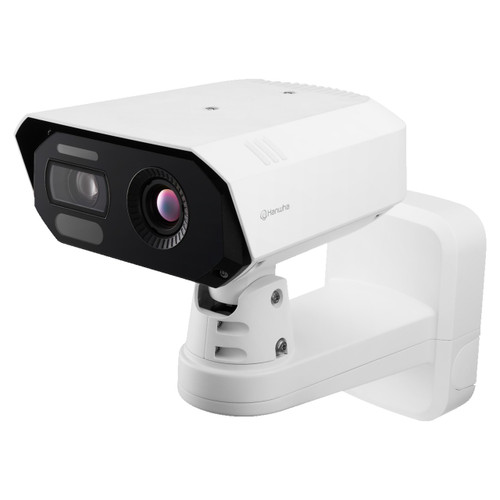
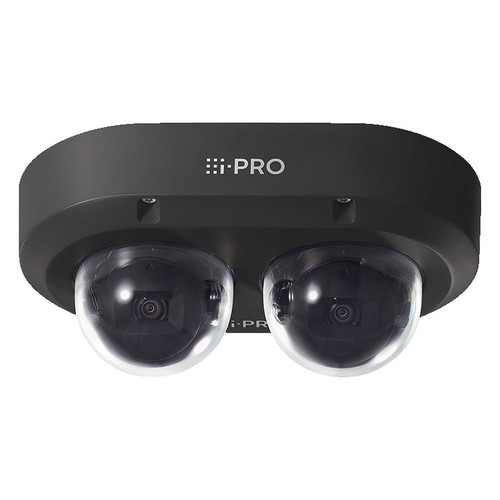
Both the Hanwha TNM-C4950TD and i-PRO WV-S85402-V2L1 are outdoor dome IP cameras rated at a combined 8MP output, support PoE+, carry IK10 impact ratings, and target perimeter and general-area surveillance. However, they differ fundamentally in sensor philosophy: the Hanwha pairs an 8MP visible sensor with an uncooled thermal (VGA) imager for bi-spectrum AI analytics, while the i-PRO uses twin 4MP visible CMOS sensors with active IR illumination. Buyers choosing between them are trading thermal detection capability against conventional IR low-light performance.
In This Guide
How do the imaging specs compare?
The Hanwha TNM-C4950TD fields a 1/1.8" CMOS visible sensor at 8MP (30 fps) paired with an uncooled microbolometer thermal sensor at VGA resolution, 12µm pixel pitch, and a specified NETD of <60mK. The visible channel uses a 10.9–29mm motorized varifocal lens (2.6x zoom, F1.7–F1.73) with 120dB WDR (SSDR) and a minimum illumination of 0.06 lux color / 0.005 lux B/W; the thermal channel uses a 13.5mm fixed lens (F1.0) with an angular FOV of H:31.9°/V:24.2°. DORI detection ranges on the thermal channel reach 200.1m wide / 583.4m tele at 25PPM.
The i-PRO WV-S85402-V2L1 deploys two independent 1/2.7" CMOS sensors, each at 4MP (2688×1520), also at 30 fps. Its motorized varifocal lens spans 2.9–7.3mm (2.5x zoom, F2.0–F3.0 wide-to-tele) with 108dB Super Dynamic WDR (level 31) and a minimum illumination of 0.12 lux B/W (50IRE, F2.0, 1/30s). Built-in IR illumination covers 40m (high mode). DORI detection in the visible channel reaches only 45.1m wide / 136.5m tele at 25PPM—substantially shorter than the Hanwha's thermal detection range. The i-PRO offers no thermal sensing; low-light performance depends entirely on IR LEDs and sensor sensitivity.
What about installation and environment?
Both cameras share a -40°C to +60°C operating temperature range and carry IP66, IP67, IK10, and NEMA 4X ratings, making them suitable for the same harsh outdoor environments. The i-PRO adds a wind resistance specification of up to 40 m/s (~89 mph) and an anti-condensation Temish element—neither of which appears in the Hanwha's published specs. The i-PRO also lists UL 62368-1 / c-UL / CE / IEC 62368-1 safety certifications and FCC Part 15 Class A / ICES-003 / EN55032 EMC marks; the Hanwha lists IP66/IP67, IK10, NEMA 4X, and NEMA TS 2 (2.2.8, 2.2.9) but UL/FCC certifications are not listed in the provided spec data.
The Hanwha is substantially larger and heavier: 353.4 × 287.5 × 191.2mm and 4.533kg versus the i-PRO's 250 × 150 × 105mm and approximately 1.8kg. Both are powered by PoE+ (IEEE 802.3at, Class 4). Maximum draw is 23.5W for the Hanwha and 22.2W for the i-PRO—close enough that either works on the same PoE+ switch port. The Hanwha additionally accepts 12VDC. Both use a shielded RJ-45 Gigabit Ethernet interface.
Which fits your VMS and analytics better?
The Hanwha supports ONVIF Profile S/T, Wisenet SUNAPI, and Wisenet Open API, and lists 6 simultaneous unicast streams (up to 3 profiles). Edge storage is dual Micro SD/SDHC/SDXC slots supporting up to 512GB total. Analytics are AI-thermal: fire detection, perimeter breach, temperature anomaly, and vehicle counting—capabilities absent from conventional visible-only cameras. Security is anchored by TPM 2.0 (FIPS 140-2 Level 2), 802.1X (EAP-TLS/LEAP/PEAP), and device certificate pre-installation. RAM is 4GB with 512MB Flash. Audio I/O includes selectable mic/line input (2.5VDC, 2KΩ) and line output (1Vrms max), and 4 configurable I/O alarm ports.
The i-PRO WV-S85402-V2L1 supports ONVIF Profiles G, M, S, and T—adding Profile G (on-camera recording management) and Profile M (metadata/analytics) not confirmed in the Hanwha spec data. It supports up to 24 simultaneous users versus Hanwha's 6. Edge storage is a single microSD/SDHC/SDXC slot (up to 512GB). AI analytics include motion, scene-change detection, audio detection, and AI sound classification (gunshot, yell, vehicle horn, glass break)—plus 6 AI video analytic types; face recognition is listed in summary specs. Security is FIPS 140-2 Level 3 (one level above the Hanwha's Level 2), HTTPS, and 802.1X. Audio connections are three 3.5mm stereo jacks (input) and one 3.5mm stereo output, with 3 alarm I/O terminals.
Which should you choose: the C4950TD or the S85402-V2L1?
Our take: The TNM-C4950TD is the stronger choice when the deployment requires thermal detection—fire, temperature anomaly, or perimeter breach in total darkness or through obscurants—because the i-PRO WV-S85402-V2L1 carries no thermal sensor whatsoever. Concretely: the Hanwha's uncooled microbolometer achieves a DORI detection range of 200.1m (wide) versus the i-PRO's IR-limited 45.1m (wide); its NETD of <60mK enables temperature-anomaly analytics that the i-PRO cannot replicate; and its dual SD slot provides redundant edge storage versus the i-PRO's single slot. Conversely, the i-PRO is the better fit when the priority is FIPS 140-2 Level 3 cybersecurity compliance, ONVIF Profile G/M coverage for on-camera recording management and metadata, support for 24 concurrent VMS streams, or a compact, lightweight form factor (1.8kg vs 4.533kg). Neither replaces the other; the decision pivots on whether thermal detection capability is required.
Side-by-Side Comparison
Spec-for-spec, from manufacturer data.
| Specification | Hanwha C4950TD | i-PRO S85402-V2L1 |
|---|---|---|
| Total Resolution | 8MP visible + VGA thermal | 2× 4MP visible (8MP combined) |
| Image Sensor | 1/1.8" CMOS (visible) + uncooled microbolometer (thermal) | 2× 1/2.7" CMOS (visible only) |
| Thermal Sensor | Yes — VGA, 12µm, <60mK NETD | — |
| Lens / Focal Length | 10.9–29mm varifocal (visible); 13.5mm fixed (thermal) | 2.9–7.3mm motorized varifocal (visible) |
| Optical Zoom | 2.6× (visible) | 2.5× motorized |
| Min. Illumination | 0.06 lux color / 0.005 lux B/W (visible); 0 lux (thermal) | 0.12 lux B/W (50IRE, F2.0, 1/30s) |
| IR Illumination / Range | — (thermal replaces IR) | Built-in IR LED, 40m (high mode) |
| WDR | 120dB (SSDR) | 108dB (Super Dynamic, level 31) |
| Max Frame Rate | 30 fps | 30 fps |
| Video Compression | H.265 / H.264 / MJPEG | H.265 / H.264 / MJPEG |
| ONVIF Profiles | Profile S / T | Profile G / M / S / T |
| AI Analytics | Fire detection, perimeter breach, temp anomaly, vehicle counting (thermal-based) | Motion, scene-change, face, people, vehicle, occupancy; AI sound classification |
| Cybersecurity | TPM 2.0, FIPS 140-2 Level 2, 802.1X (EAP-TLS/LEAP/PEAP) | FIPS 140-2 Level 3, HTTPS, 802.1X, signed firmware |
| Edge Storage | Dual microSD/SDHC/SDXC slots, up to 512GB total | Single microSD/SDHC/SDXC, up to 512GB |
| Power Input / PoE Class | PoE+ IEEE 802.3at Class 4; 12VDC — max 23.5W | PoE+ IEEE 802.3at Class 4 — max 22.2W |
| IP / Impact Rating | IP66 / IP67 / IK10 / NEMA 4X | IP66 / IP67 / IK10 / NEMA 4X |
| Operating Temperature | -40°C to +60°C | -40°C to +60°C |
| Dimensions (D×W×H) | 353.4 × 287.5 × 191.2mm | 250 × 150 × 105mm |
| Weight | 4.533 kg | Approx. 1.8 kg |
| Warranty | 3 years | 3 years |
Frequently Asked Questions
Which should you choose: the C4950TD or the S85402-V2L1?
The TNM-C4950TD is the stronger choice when the deployment requires thermal detection—fire, temperature anomaly, or perimeter breach in total darkness or through obscurants—because the i-PRO WV-S85402-V2L1 carries no thermal sensor whatsoever. Concretely: the Hanwha's uncooled microbolometer achieves a DORI detection range of 200.1m (wide) versus the i-PRO's IR-limited 45.1m (wide); its NETD of <60mK enables temperature-anomaly analytics that the i-PRO cannot replicate; and its dual SD slot provides redundant edge storage versus the i-PRO's single slot. Conversely, the i-PRO is the better fit when the priority is FIPS 140-2 Level 3 cybersecurity compliance, ONVIF Profile G/M coverage for on-camera recording management and metadata, support for 24 concurrent VMS streams, or a compact, lightweight form factor (1.8kg vs 4.533kg). Neither replaces the other; the decision pivots on whether thermal detection capability is required.
Is the TNM-C4950TD or WV-S85402-V2L1 better for complete-darkness low-light surveillance?
They solve darkness differently. The TNM-C4950TD uses its thermal sensor, which requires zero visible light and detects heat signatures at up to 200.1m (wide) regardless of illumination. The WV-S85402-V2L1 uses built-in IR LEDs rated to 40m at high power with a minimum illumination of 0.12 lux B/W. If the detection range exceeds roughly 40m or the scene involves obscurants (smoke, fog), the thermal channel of the Hanwha has a decisive advantage. For short-range IR-lit corridors or parking areas, the i-PRO is a proven, lower-cost approach.
Which camera is easier to mount and install on a standard junction box?
The i-PRO WV-S85402-V2L1 is substantially more compact—250 × 150 × 105mm and approximately 1.8kg—making it compatible with typical pendant or surface-mount junction boxes used for standard dome cameras. The Hanwha TNM-C4950TD is 353.4 × 287.5 × 191.2mm and weighs 4.533kg; its bi-spectrum dual-lens housing requires heavier mounting hardware and more surface area. Plan for a dedicated pole or parapet mount with the Hanwha.
Does either camera meet cybersecurity hardening requirements for government or critical-infrastructure projects?
Both cameras support HTTPS, 802.1X authentication, and hardware-backed security. The i-PRO WV-S85402-V2L1 specifies FIPS 140-2 Level 3 compliance plus signed firmware, which satisfies stricter federal and critical-infrastructure mandates. The Hanwha TNM-C4950TD specifies FIPS 140-2 Level 2 via an onboard TPM 2.0 chip, which meets most commercial and municipal requirements but falls one level below the i-PRO's certification. Verify your project's specific compliance document against each vendor's FIPS certificate before specifying.
Get a Second Opinion on Your Camera Choice
Share your site layout, coverage goals, and budget. Our team will validate the camera selection, flag anything we would change, and recommend products that match the use case.