
Hanwha XNV-9082R vs i-PRO S85402-V2L1: Specification Comparison
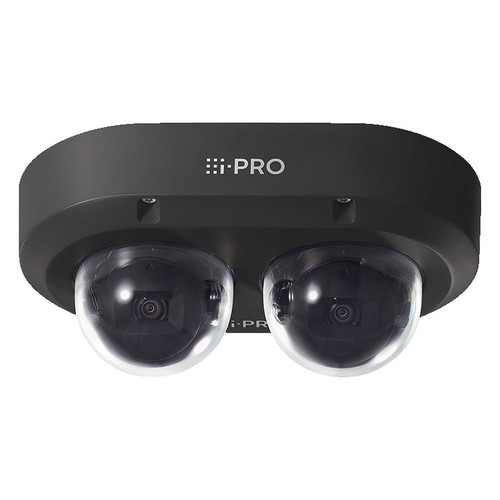
The Hanwha XNV-9082R and i-PRO WV-S85402-V2L1 are both 8MP outdoor vandal domes with motorized varifocal lenses, IR illumination, IK10 impact resistance, IP67/NEMA4X ingress protection, and H.265 compression. The key structural difference: the XNV-9082R uses a single 1/2.8" 8MP sensor producing one 3840×2160 stream, while the S85402-V2L1 pairs two 1/2.7" 4MP sensors to deliver two simultaneous 2688×1520 fields of view. Installers must weigh single-sensor pixel density against dual-sensor scene coverage, and compare each manufacturer's analytics depth and VMS ecosystem fit.
In This Guide
How do the imaging specs compare?
The XNV-9082R captures a single 3840×2160 (8MP) stream from one 1/2.8" progressive CMOS sensor at F1.2 wide aperture, with minimum illumination rated at 0.05 Lux color and 0 Lux with IR active. Its extremeWDR is rated at 120 dB. The S85402-V2L1 uses two 1/2.7" CMOS sensors, each producing 2688×1520 (4MP), with a wider F2.0 aperture and minimum illumination of 0.12 Lux (BW, 50IRE). Its Super Dynamic range peaks at 108 dB. On raw low-light sensitivity and WDR headroom, the XNV-9082R holds a measurable advantage.
IR reach is rated identically at 40 m for both cameras, but the detection-distance figures from standardized DORI calculations differ. At telephoto, the XNV-9082R identifies faces at 21.1 m versus the S85402-V2L1's 13.6 m, and detects at 211 m versus 136.5 m — a consistent 50–55% advantage at tele across all DORI tiers. At wide angle, the XNV-9082R also leads: 49.9 m detect versus 45.1 m. The S85402-V2L1's dual-sensor architecture compensates by covering two independent fields of view simultaneously, which a single-sensor camera cannot replicate without adding a second unit.
What about installation and environment?
Both cameras share IP66/IP67 and NEMA4X ratings and IK10 vandal resistance, making them equally qualified for outdoor exposed mounting. Operating temperature range is nearly identical: XNV-9082R at -50°C to +60°C versus S85402-V2L1 at -40°C to +60°C, with the Hanwha offering a 10°C lower cold-weather floor. The S85402-V2L1 adds a Temish anti-condensation element and a stated wind resistance specification of up to 40 m/s (~89 mph), neither of which appears in the XNV-9082R spec sheet. The S85402-V2L1 also carries NEMA TS 2 traffic-standard compliance, relevant for roadway or intersection deployments.
Power requirements differ significantly. The XNV-9082R draws up to 12.95 W and is satisfied by PoE Class 3 (IEEE 802.3af), meaning standard PoE switches power it without upgrade. The S85402-V2L1 requires PoE+ at 22.2 W (IEEE 802.3at, Class 4), which demands PoE+ capable switches or injectors — a real infrastructure cost consideration when retrofitting existing closets. Physical size also differs: the XNV-9082R is ø180×125 mm at 1,900 g; the S85402-V2L1 is 250×150×105 mm at approximately 1,800 g. The Hanwha includes dual microSD slots supporting up to 1 TB (512 GB × 2) on-camera storage; the i-PRO provides a single microSD/SDHC/SDXC slot up to 512 GB.
Which fits your VMS and analytics better?
Both cameras support ONVIF Profile S, G, and T, providing baseline compatibility with any compliant VMS. The XNV-9082R adds ONVIF Profile M (not listed for the S85402-V2L1 from provided specs) and exposes Wisenet SUNAPI for deeper integration with Hanwha's Wisenet WAVE and partner VMS platforms. The S85402-V2L1 supports ONVIF Profile M and is built on the Ambarella CV2 SoC, integrating tightly with i-PRO's Video Insight and third-party VMS systems. Security posture differs: the S85402-V2L1 carries FIPS 140-2 Level 3 certification, a requirement for many federal, government, and critical-infrastructure projects; the XNV-9082R lists 802.1X, device certificates, and Hanwha Techwin Root CA but does not cite FIPS 140-2 in the provided specifications.
Analytics depth favors the XNV-9082R on breadth: it lists defocus detection, directional detection, digital auto tracking, appear/disappear, enter/exit, loitering, tampering, fog detection, virtual line, audio detection, sound classification, shock detection, face and upper-body detection, plus business intelligence functions including people counting, queue management, and heatmap — all on-camera. The S85402-V2L1 specifies six AI Video Analytics types and AI sound classification (gunshot, yell, vehicle horn, glass break) but does not enumerate all six analytic types in the provided specifications. Motion detection zones are 8 polygonal areas on the XNV-9082R versus 4 rectangular areas on the S85402-V2L1. Privacy masking is 32 zones (Hanwha) versus 8 zones (i-PRO).
Which should you choose: the XNV-9082R or the S85402-V2L1?
Our take: The XNV-9082R is the stronger choice when the installation demands the highest single-sensor pixel density, lowest light performance, and the broadest on-camera analytics suite at standard PoE Class 3 power. It delivers a DORI tele-identify range of 21.1 m versus 13.6 m for the S85402-V2L1 — a 55% advantage — and its 120 dB extremeWDR exceeds the S85402-V2L1's 108 dB Super Dynamic rating. Minimum illumination is 0.05 Lux color versus 0.12 Lux, meaningful in dimly lit parking structures or corridors. The S85402-V2L1 is the stronger choice for dual-scene coverage from one cable drop, FIPS 140-2 Level 3 government-compliance requirements, roadway/traffic deployments requiring NEMA TS 2, or sites already running PoE+ infrastructure. Platform qualifier: confirm VMS native driver support for Wisenet SUNAPI (Hanwha) or Ambarella CV2 AI pipeline (i-PRO) before specifying either.
Side-by-Side Comparison
Spec-for-spec, from manufacturer data.
| Specification | Hanwha XNV-9082R | i-PRO S85402-V2L1 |
|---|---|---|
| Resolution | 3840×2160 (8MP, single sensor) | 2×2688×1520 (2×4MP dual sensor, 8MP total) |
| Image Sensor | 1/2.8" progressive CMOS | 2× 1/2.7" CMOS (dual) |
| Lens / Focal Length | 2.8–8.4mm motorized varifocal (3× zoom) | 2.9–7.3mm motorized zoom / motorized focus (2.5× zoom) |
| Max Aperture (Wide) | F1.2 | F2.0 |
| Min. Illumination | 0.05 Lux color / 0 Lux IR | 0.12 Lux (BW, 50IRE, F2.0, 1/30s) |
| IR Range | WiseIR 40m (131ft) | 40m (High); 30m (50IRE) |
| Wide Dynamic Range | 120 dB (extremeWDR) | 108 dB (Super Dynamic, Level 31) |
| Max Frame Rate | 30fps @ 8MP | 30fps per sensor |
| Video Compression | H.265, H.264 (Main/Baseline/High), MJPEG | H.265, H.264, JPEG |
| IP / Impact Rating | IP66/IP67/IP6K9K, IK10+, NEMA4X | IP67/IP66, IK10, NEMA4X, Type 4X |
| Operating Temperature | -50°C to +60°C | -40°C to +60°C |
| Power Input / PoE Class | PoE IEEE 802.3af Class 3 (12.95W max); 12VDC; 24VAC (accessory) | PoE+ IEEE 802.3at Class 4 (22.2W) |
| Edge Storage | Dual microSD/SDHC/SDXC slots; max 1TB (512GB×2) | Single microSD/SDHC/SDXC slot; 64GB–512GB microSDXC |
| Concurrent Streams / Users | Unicast up to 20 users; multicast; up to 10 profiles | Up to 24 simultaneous users; unicast/multicast |
Frequently Asked Questions
Which should you choose: the XNV-9082R or the S85402-V2L1?
The XNV-9082R is the stronger choice when the installation demands the highest single-sensor pixel density, lowest light performance, and the broadest on-camera analytics suite at standard PoE Class 3 power. It delivers a DORI tele-identify range of 21.1 m versus 13.6 m for the S85402-V2L1 — a 55% advantage — and its 120 dB extremeWDR exceeds the S85402-V2L1's 108 dB Super Dynamic rating. Minimum illumination is 0.05 Lux color versus 0.12 Lux, meaningful in dimly lit parking structures or corridors. The S85402-V2L1 is the stronger choice for dual-scene coverage from one cable drop, FIPS 140-2 Level 3 government-compliance requirements, roadway/traffic deployments requiring NEMA TS 2, or sites already running PoE+ infrastructure. Platform qualifier: confirm VMS native driver support for Wisenet SUNAPI (Hanwha) or Ambarella CV2 AI pipeline (i-PRO) before specifying either.
Does the i-PRO S85402-V2L1 require a PoE+ switch?
Yes. The S85402-V2L1 is rated at 22.2 W and requires IEEE 802.3at PoE+ (Class 4). Standard 802.3af PoE switches deliver a maximum of 15.4 W and will not power this camera. The XNV-9082R draws up to 12.95 W and operates on standard PoE Class 3 (802.3af).
Can either camera record locally without a server?
Both support edge recording to microSD cards. The XNV-9082R has dual microSD slots supporting up to 512 GB each (1 TB total). The S85402-V2L1 provides one microSD/SDHC/SDXC slot supporting up to 512 GB. For sites requiring extended local retention without NVR infrastructure, the XNV-9082R's dual-slot design offers a significant capacity advantage.
Which camera is suitable for a federal or government project requiring FIPS compliance?
The i-PRO WV-S85402-V2L1 lists FIPS 140-2 Level 3 certification in its specifications, which is a common procurement requirement for U.S. federal and certain state/local government installations. FIPS 140-2 Level 3 compliance is not listed in the provided XNV-9082R specifications.
Get a Second Opinion on Your Camera Choice
Share your site layout, coverage goals, and budget. Our team will validate the camera selection, flag anything we would change, and recommend products that match the use case.