
Hanwha C9083R vs i-PRO S85402-V2L: Specification Comparison
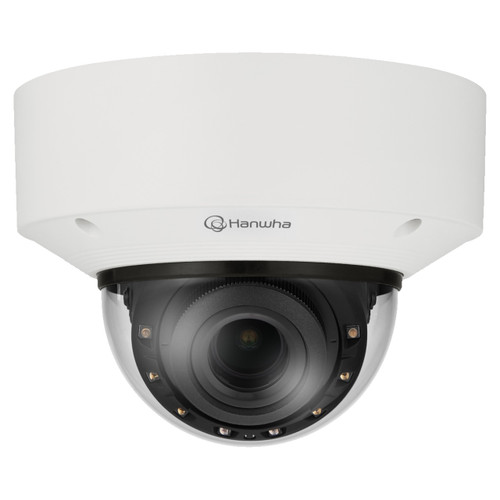
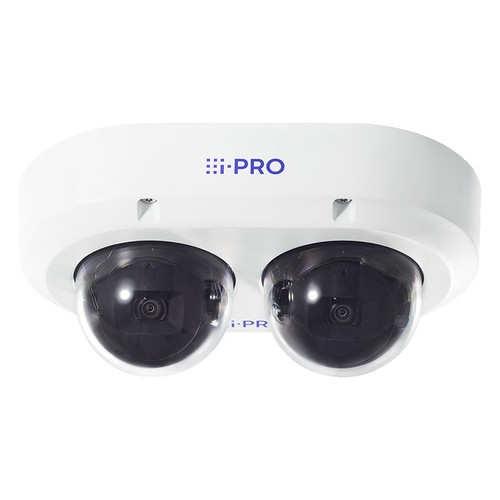
Both the Hanwha XNV-C9083R and the i-PRO WV-S85402-V2L are outdoor fixed dome cameras with built-in IR, motorized varifocal lenses, IK10 vandal resistance, and AI analytics — positioning them squarely in the 8MP-class outdoor dome segment. The Hanwha delivers its 8MP via a single 1/1.8" sensor, while the i-PRO achieves a combined 8MP through two independent 4MP sensors in a dual-dome configuration. This comparison evaluates imaging performance, installation requirements, and integration fit to help integrators determine which camera best suits a given deployment.
In This Guide
How do the imaging specs compare?
The Hanwha XNV-C9083R uses a single 1/1.8" progressive CMOS sensor delivering a native 3840×2160 (4K) resolution at 30fps, with a 4.4–9.3mm motorized varifocal lens providing 2.1× optical zoom and a maximum aperture of F1.3 at wide. Minimum illumination is rated at 0.04 Lux in color and 0 Lux with IR active. The WiseIR LED reaches 40m (131ft). Wide Dynamic Range is specified at 120dB (extremeWDR). DORI detection in wide mode reaches 50.8m and tele reaches 176.6m. The i-PRO WV-S85402-V2L pairs two 1/2.7" CMOS sensors, each outputting up to 2688×1520 (4MP), for a combined 8MP dual-field view. Its motorized lens spans 2.9–7.3mm with 2.5× optical zoom and a maximum aperture of F2.0 at wide. Minimum illumination is specified at 0.12 Lux (B/W with IR). IR range is also rated at 40m. Dynamic range is specified at 108dB maximum (Super Dynamic on, Level 31). DORI detection in wide reaches 45.1m and tele reaches 136.5m.
The Hanwha's larger 1/1.8" single sensor and wider aperture (F1.3 vs F2.0) provide a tangible low-light advantage, with a minimum illumination of 0.04 Lux versus the i-PRO's 0.12 Lux — a 3× difference per spec. The Hanwha also leads on WDR at 120dB versus 108dB. The i-PRO's dual-sensor architecture trades individual sensor size for simultaneous wide-angle and telephoto coverage from a single mounting point, with each channel independently adjustable across its 43°–100° horizontal FOV. The Hanwha covers a wider single-channel horizontal FOV of up to 113° at wide. Both cameras offer Digital Noise Reduction, defog/fog compensation, and Day/Night ICR switching.
What about installation and environment?
Both cameras are rated IP66, IP67, IK10, and NEMA 4X, making them equivalently suited for outdoor vandal-resistant deployments. The i-PRO adds NEMA TS 2 (2.2.7–2.2.9) compliance and a wind resistance rating of up to 40 m/s (approximately 89 mph), which are not listed for the Hanwha. The i-PRO also includes an anti-condensation Temish element, which is not specified for the Hanwha. Operating temperature ranges differ slightly: the Hanwha is rated –40°C to +55°C, while the i-PRO is rated –40°C to +60°C (with a power-on floor of –20°C). The Hanwha operates from 0–95% RH non-condensing; the i-PRO is rated 10%–100% (no condensation).
Power requirements diverge meaningfully. The Hanwha XNV-C9083R draws a maximum of 12.95W and is powered by PoE (IEEE 802.3af, Class 3) or 12VDC. The i-PRO WV-S85402-V2L requires PoE+ (IEEE 802.3at) at 22.2W — nearly double the power draw — which mandates a PoE+ capable switch or injector. The Hanwha's footprint is ø160×118mm at 1,450g. The i-PRO measures 250mm(D)×150mm(W)×105mm(H) at approximately 1,800g, reflecting the dual-sensor housing. Both cameras support conduit entry and standard dome mounting; specific mount accessory compatibility (e.g., Hanwha SBP-167HMW pendant) is listed only for the Hanwha in the provided specs.
Which fits your VMS and analytics better?
Both cameras support ONVIF Profile G/M/S/T and H.265/H.264/MJPEG compression with CBR/VBR bitrate control. The Hanwha supports unicast streaming to up to 20 simultaneous users across up to 10 configurable profiles (including 3 virtual channels), while the i-PRO supports up to 24 simultaneous users. The Hanwha also exposes SUNAPI and Wisenet SDK integration in addition to ONVIF, which is relevant for Wisenet WAVE/SSM VMS environments. The i-PRO's H.265 resolution tops out at 2688×1520 per channel; the Hanwha streams full 3840×2160 in H.265. The Hanwha lists WiseStream II/III smart codec; the i-PRO offers GOP control-based smart coding. Network interface differs: the Hanwha provides 10/100BASE-T only, while the i-PRO provides 10/100/1000BASE-T (Gigabit Ethernet). Both support SNMPv1/v2/v3, MQTT, 802.1X, HTTPS, and microSD up to 512GB.
AI analytics differ in scope and classification. The Hanwha classifies Person, Face, Vehicle (type: car/bus/truck/motorcycle/bicycle), and License Plate, and adds business intelligence features including people counting, queue management, and heatmap — not listed for the i-PRO. The Hanwha provides 8 configurable motion detection zones (8-point polygonal) and 32 privacy masking zones; the i-PRO provides 4 VMD areas, 8 privacy zones, and Scene Change Detection (SCD). The i-PRO adds AI Sound Classification (gunshot, yell, vehicle horn, glass break) and has 3 alarm I/O terminals versus the Hanwha's 2 configurable I/O ports. The i-PRO also carries a FIPS 140-2 Level 3 security certification not listed for the Hanwha, which may be relevant for government or regulated deployments. Both support audio input and output with comparable codec support (G.711, G.726). The i-PRO lists 3 audio input jacks (3.5mm stereo) versus the Hanwha's single selectable mic/line input.
Which should you choose: the C9083R or the S85402-V2L?
Our take: The XNV-C9083R is the stronger choice when single-sensor 4K resolution, lower-light performance, and a broader AI business-intelligence feature set are the primary drivers. Its 1/1.8" sensor and F1.3 aperture yield a minimum illumination of 0.04 Lux — three times more sensitive than the i-PRO's 0.12 Lux — and its 120dB extremeWDR exceeds the i-PRO's 108dB maximum. The Hanwha also supports full 3840×2160 streaming and includes people counting, queue management, and heatmap analytics not listed for the i-PRO. The WV-S85402-V2L is the better fit when dual-field simultaneous coverage from one mounting point is required, when the installation demands Gigabit Ethernet, FIPS 140-2 Level 3 security compliance, or NEMA TS 2 certification, or when the broader +60°C operating ceiling and wind-resistance rating matter. Note that the i-PRO requires PoE+ (22.2W) versus the Hanwha's PoE 802.3af (12.95W), which has infrastructure cost implications. Both carry a 3-year warranty.
Side-by-Side Comparison
Spec-for-spec, from manufacturer data.
| Specification | Hanwha C9083R | i-PRO S85402-V2L |
|---|---|---|
| Resolution | 3840×2160 (8MP, single sensor) | 2688×1520 per channel (4MP × 2 sensors, 8MP combined) |
| Image Sensor | 1/1.8" progressive CMOS | 2× 1/2.7" CMOS |
| Lens / Focal Length | 4.4–9.3mm motorized varifocal, 2.1× zoom | 2.9–7.3mm motorized varifocal, 2.5× zoom |
| Maximum Aperture (Wide) | F1.3 | F2.0 |
| Min. Illumination | 0.04 Lux (color) / 0 Lux (IR) | 0.12 Lux (B/W, IR LED) |
| IR Range | 40m (131ft) WiseIR | 40m (131ft) |
| Wide Dynamic Range | 120dB (extremeWDR) | 108dB max (Super Dynamic On, Level 31) |
| Max Frame Rate | 30fps @ 8MP | 30fps |
| Video Compression | H.265, H.264, MJPEG | H.265, H.264, MJPEG |
| IP / Impact Rating | IP66 / IP67 / NEMA 4X / IK10 | IP66 / IP67 / NEMA 4X / IK10 |
| Operating Temperature | –40°C to +55°C | –40°C to +60°C (power-on: –20°C to +60°C) |
| Power Input / PoE Class | PoE 802.3af Class 3 / 12VDC, 12.95W max | PoE+ 802.3at, 22.2W |
| Network Interface | 10/100BASE-T (RJ-45) | 10/100/1000BASE-T (RJ-45) |
| Edge Storage | microSD/SDHC/SDXC up to 512GB | microSD 2GB–512GB (SDXC/SDHC/SD) |
| Alarm I/O | 2 configurable I/O ports | 3 alarm I/O terminals (input/output configurable) |
| Audio | 1× mic/line input selectable; 1× line out | 3× 3.5mm stereo mic input; 1× 3.5mm stereo output |
| Security Certification | Not listed | FIPS 140-2 Level 3 |
| Warranty | 3 years | 3 years |
Frequently Asked Questions
Which should you choose: the C9083R or the S85402-V2L?
The XNV-C9083R is the stronger choice when single-sensor 4K resolution, lower-light performance, and a broader AI business-intelligence feature set are the primary drivers. Its 1/1.8" sensor and F1.3 aperture yield a minimum illumination of 0.04 Lux — three times more sensitive than the i-PRO's 0.12 Lux — and its 120dB extremeWDR exceeds the i-PRO's 108dB maximum. The Hanwha also supports full 3840×2160 streaming and includes people counting, queue management, and heatmap analytics not listed for the i-PRO. The WV-S85402-V2L is the better fit when dual-field simultaneous coverage from one mounting point is required, when the installation demands Gigabit Ethernet, FIPS 140-2 Level 3 security compliance, or NEMA TS 2 certification, or when the broader +60°C operating ceiling and wind-resistance rating matter. Note that the i-PRO requires PoE+ (22.2W) versus the Hanwha's PoE 802.3af (12.95W), which has infrastructure cost implications. Both carry a 3-year warranty.
Is the XNV-C9083R or WV-S85402-V2L better for low-light performance?
Based on the provided specs, the XNV-C9083R has a lower minimum illumination rating — 0.04 Lux in color and 0 Lux with IR active — compared to the WV-S85402-V2L's 0.12 Lux (B/W with IR). The Hanwha also has a wider maximum aperture (F1.3 vs F2.0 at wide) and a higher WDR rating (120dB vs 108dB), all of which favor low-light and high-contrast scene performance per the specifications.
Can I power both cameras from a standard PoE switch?
No — not both. The Hanwha XNV-C9083R draws a maximum of 12.95W and is specified for PoE (IEEE 802.3af, Class 3), which standard PoE switches support. The i-PRO WV-S85402-V2L requires PoE+ (IEEE 802.3at) at 22.2W. A switch port that delivers only 802.3af (up to 15.4W) is insufficient for the i-PRO; a PoE+ (802.3at, up to 30W) port or dedicated injector is required.
Which camera is better suited for a government or high-security network environment?
Based on the provided specifications, the i-PRO WV-S85402-V2L lists FIPS 140-2 Level 3 security certification, which is a federal standard relevant to regulated and government deployments. This certification is not listed in the Hanwha XNV-C9083R specifications. The i-PRO also lists NEMA TS 2 compliance, relevant for traffic and transportation infrastructure applications. Both cameras support 802.1X, HTTPS, and SNMPv3.
Get a Second Opinion on Your Camera Choice
Share your site layout, coverage goals, and budget. Our team will validate the camera selection, flag anything we would change, and recommend products that match the use case.