
Hanwha XNV-9082R vs i-PRO S85402-V2L: Specification Comparison
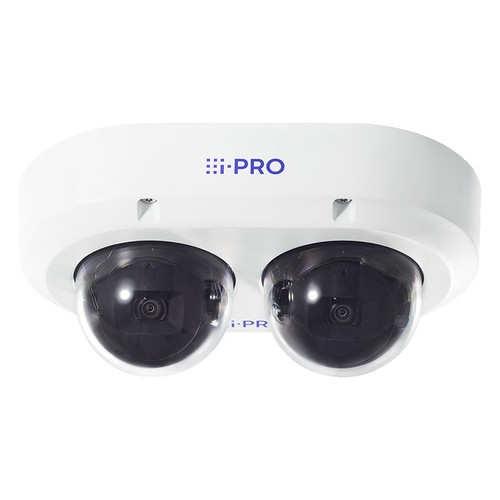
Both the Hanwha XNV-9082R and the i-PRO WV-S85402-V2L are outdoor, vandal-rated, IP67/IK10-class dome cameras positioned at the 8MP system tier with 40m IR and ONVIF compliance. The Hanwha delivers its 8MP via a single 1/2.8" sensor at 3840×2160, while the i-PRO uses two independent 1/2.7" sensors each producing 4MP (2688×1520 max per channel). This architectural split drives most of the practical differences an integrator will encounter in coverage geometry, power draw, analytics depth, and VMS channel licensing.
In This Guide
How do the imaging specs compare?
The XNV-9082R uses a single 1/2.8" progressive CMOS sensor at 3840×2160 (8MP) running 30fps, with a 2.8–8.4mm 3× motorized varifocal lens delivering a horizontal field of view of 114° at wide and narrowing toward tele, a maximum aperture of F1.2 at wide, and a minimum illumination of 0.05 lux color / 0 lux IR. Its extremeWDR is rated at 120dB. IR reach is 40m (WiseIR). The WV-S85402-V2L carries two 1/2.7" CMOS sensors, each capped at 2688×1520 (4MP per channel) at 30fps. Its 2.5× motorized zoom spans 2.9–7.3mm with a horizontal FOV of 43°–100° per head, maximum aperture F2.0 at wide, and minimum illumination of 0.12 lux (BW, IR LED). WDR (Super Dynamic) is rated at 108dB maximum. IR range is also 40m.
On single-channel pixel density the Hanwha leads outright — 3840×2160 versus 2688×1520 per sensor — meaning finer DORI metrics: at wide the XNV-9082R detects to 49.9m versus 45.1m for the i-PRO, and at tele the Hanwha reaches 211m detect versus 136.5m. The Hanwha's F1.2 wide aperture versus the i-PRO's F2.0 also gives a roughly 1.3-stop light advantage per lens, consistent with the lower lux floor (0.05 vs 0.12). The i-PRO's dual-sensor architecture trades per-channel resolution for simultaneous wide-and-tele coverage from one mounting point without a physical PTZ, which the Hanwha cannot replicate with a single head.
What about installation and environment?
Both cameras are rated IP66/IP67, IK10, and NEMA 4X, and both carry UL 62368-1 and CSA C22.2 No. 62368-1 safety certifications. The Hanwha additionally holds IP6K9K (high-pressure wash per ISO 20653) and EN IEC 63000 environmental certifications, which the i-PRO spec does not list. The i-PRO adds NEMA TS 2 (2.2.7–2.2.9) traffic-cabinet compliance and a Temish anti-condensation element, neither of which appears in the Hanwha spec. Operating temperature ranges are essentially equivalent: XNV-9082R is –50°C to +60°C; WV-S85402-V2L is –40°C to +60°C (power-on minimum –20°C).
Power requirements differ meaningfully. The XNV-9082R draws 12.95W maximum and is powered by PoE IEEE 802.3af (Class 3) or 12VDC/24VAC. The WV-S85402-V2L requires PoE+ IEEE 802.3at at 22.2W — roughly 70% more power — reflecting its dual-sensor, dual-IR-array design. This means the i-PRO mandates an 802.3at-capable switch or injector; an 802.3af-only infrastructure cannot support it. Form factor also differs: the Hanwha is ø180×125mm at 1,900g; the i-PRO is 250mm(D)×150mm(W)×105mm(H) at approximately 1,800g. The i-PRO's adjusting angle range (horizontal –50° to +230°, vertical +10° to +105°) differs from the Hanwha's pan 0°–360° / tilt –45°–85° / rotate 0°–355° — relevant for junction-box and conduit planning.
Which fits your VMS and analytics better?
Both cameras support ONVIF Profile S/G/T. The i-PRO additionally lists ONVIF Profile M (AI metadata); the Hanwha spec does not list Profile M. The Hanwha supports SUNAPI (HTTP API) and Wisenet Open Platform for third-party app embedding. The i-PRO is built on an Ambarella CV2 SoC and declares FIPS 140-2 Level 3 security certification; the Hanwha lists 802.1X (EAP-TLS/LEAP/PEAP), HTTPS, IP filtering, and device certificates but does not cite FIPS 140-2. The i-PRO's AI analytics cover 6 declared types including AI Sound Classification (gunshot, yell, vehicle horn, glass break); the Hanwha lists a broader declared analytics suite: defocus detection, directional detection, digital auto tracking, appear/disappear, enter/exit, loitering, tampering, fog detection, virtual line, audio detection, sound classification, shock detection, face/upper body detection, people counting, queue management, and heatmap.
Edge storage is identical in maximum capacity: both support microSD/SDHC/SDXC up to 512GB per slot; the Hanwha offers two microSD slots (up to 1TB total) while the i-PRO spec lists a single microSD slot up to 512GB. Audio I/O: the Hanwha has a selectable mic/line input (2.5VDC, 2KΩ) and line output (1Vrms); the i-PRO provides three 3.5mm stereo jacks for audio input and one 3.5mm stereo jack for audio output (600Ω), plus three configurable alarm I/O terminals versus the Hanwha's two configurable I/O ports. VMS channel licensing implications differ: the i-PRO's dual sensor typically registers as two video streams, potentially consuming two VMS licenses depending on platform; the Hanwha's single sensor registers as one.
Which should you choose: the XNV-9082R or the S85402-V2L?
Our take: The XNV-9082R is the stronger choice when a single high-resolution channel, lower infrastructure power budget, or richer on-camera analytics depth is the priority. It delivers 3840×2160 versus 2688×1520 per sensor on the i-PRO, a 0.05 lux minimum illumination versus 0.12 lux, and 120dB WDR versus 108dB — all meaningful advantages for challenging lighting. Its two microSD slots provide up to 1TB edge storage versus the i-PRO's 512GB single slot. The WV-S85402-V2L is the stronger choice when simultaneous wide-and-tele dual-sector coverage from one conduit drop is required, when FIPS 140-2 Level 3 compliance is a site mandate, or when the deployment falls under NEMA TS 2 traffic-cabinet requirements. The i-PRO's dual-sensor architecture does demand PoE+ (22.2W) versus the Hanwha's PoE af (12.95W), and its per-channel resolution is lower. Confirm VMS dual-stream licensing costs before specifying the i-PRO.
Side-by-Side Comparison
Spec-for-spec, from manufacturer data.
| Specification | Hanwha XNV-9082R | i-PRO S85402-V2L |
|---|---|---|
| Resolution (max per sensor) | 3840×2160 (8MP) | 2688×1520 (4MP per sensor, dual) |
| System total MP | 8MP | 8MP (2×4MP) |
| Image Sensor | 1/2.8" progressive CMOS (single) | 2× 1/2.7" CMOS (dual) |
| Lens / Focal Length | 2.8–8.4mm, 3× motorized varifocal | 2.9–7.3mm, 2.5× motorized zoom |
| Horizontal FOV | 114° (wide) | 43°–100° per head |
| Max Aperture (Wide) | F1.2 | F2.0 |
| Min. Illumination | 0.05 lux color / 0 lux IR | 0.12 lux (BW, IR LED) |
| IR Range | 40m (WiseIR) | 40m |
| WDR | 120dB (extremeWDR) | 108dB max (Super Dynamic) |
| Max Frame Rate | 30fps @ 8MP | 30fps |
| Video Compression | H.265, H.264, MJPEG | H.265, H.264, MJPEG |
| IP Rating | IP66 / IP67 / IP6K9K / NEMA 4X | IP66 / IP67 / NEMA 4X |
| IK / Impact Rating | IK10+ | IK10 |
| Operating Temperature | –50°C to +60°C | –40°C to +60°C (power-on: –20°C min) |
| Power Input / PoE Class | PoE 802.3af Class 3, 12.95W max; also 12VDC / 24VAC | PoE+ 802.3at, 22.2W |
| Edge Storage | 2× microSD/SDHC/SDXC, max 1TB (512GB×2) | 1× microSD, max 512GB |
| Alarm I/O | 2 configurable I/O ports | 3 alarm I/O terminals (configurable) |
| ONVIF Profiles | S / G / T | G / M / S / T |
| Security Certification | 802.1X, HTTPS, device certificate (no FIPS listed) | FIPS 140-2 Level 3, HTTPS, 802.1X |
| Dimensions | ø180×125mm, 1,900g | 250×150×105mm, approx. 1,800g |
| Warranty | 3-year | 3-year |
Frequently Asked Questions
Which should you choose: the XNV-9082R or the S85402-V2L?
The XNV-9082R is the stronger choice when a single high-resolution channel, lower infrastructure power budget, or richer on-camera analytics depth is the priority. It delivers 3840×2160 versus 2688×1520 per sensor on the i-PRO, a 0.05 lux minimum illumination versus 0.12 lux, and 120dB WDR versus 108dB — all meaningful advantages for challenging lighting. Its two microSD slots provide up to 1TB edge storage versus the i-PRO's 512GB single slot. The WV-S85402-V2L is the stronger choice when simultaneous wide-and-tele dual-sector coverage from one conduit drop is required, when FIPS 140-2 Level 3 compliance is a site mandate, or when the deployment falls under NEMA TS 2 traffic-cabinet requirements. The i-PRO's dual-sensor architecture does demand PoE+ (22.2W) versus the Hanwha's PoE af (12.95W), and its per-channel resolution is lower. Confirm VMS dual-stream licensing costs before specifying the i-PRO.
Is the XNV-9082R or WV-S85402-V2L better for low-light performance?
Based on published specs, the XNV-9082R has the advantage: its minimum illumination is 0.05 lux color / 0 lux IR versus 0.12 lux (BW, IR LED) for the WV-S85402-V2L, and its wide-end aperture is F1.2 versus F2.0 on the i-PRO — approximately 1.3 stops more light collection per lens. Both cameras provide 40m IR range.
Does either camera require a PoE+ switch, or will standard PoE work?
The Hanwha XNV-9082R runs on standard PoE IEEE 802.3af (Class 3, 12.95W maximum) and also accepts 12VDC or 24VAC. The i-PRO WV-S85402-V2L requires PoE+ IEEE 802.3at at 22.2W; a standard 802.3af switch or injector cannot power it. This is a switch infrastructure consideration at the time of specifying.
How does dual-sensor on the i-PRO affect VMS licensing compared to the Hanwha?
The i-PRO WV-S85402-V2L has two independent sensors, each producing a separate video stream. Most VMS platforms license by stream or channel, meaning the i-PRO may consume two VMS licenses versus one for the single-sensor XNV-9082R. Verify with your specific VMS vendor before finalizing the bill of materials, as licensing impact varies by platform.
Get a Second Opinion on Your Camera Choice
Share your site layout, coverage goals, and budget. Our team will validate the camera selection, flag anything we would change, and recommend products that match the use case.