
Hanwha XNB-6000 vs i-PRO U11300-V2: Specification Comparison
Both the Hanwha XNB-6000 and the i-PRO WV-U11300-V2 are 2MP wired box cameras designed for indoor/outdoor and indoor deployments respectively, positioned for installers who need a fixed-lens or varifocal box format with PoE power and ONVIF compatibility. The comparison centers on imaging performance—particularly WDR depth and low-light sensitivity—alongside lens flexibility, edge analytics breadth, environmental ratings, and platform integration, all of which materially affect channel selection and system design decisions.
In This Guide
How do the imaging specs compare?
The Hanwha XNB-6000 uses a 1/2.8" CMOS sensor with a stated WDR of 150 dB, significantly deeper than the i-PRO WV-U11300-V2's maximum 120 dB Super Dynamic range. Minimum illumination favors the XNB-6000 in B/W mode at 0.001 lux versus the U11300-V2's 0.0025 lux (B/W), though in color mode the U11300-V2 (0.006 lux) outperforms the XNB-6000 (0.01 lux). Both sensors share the same 1/2.8" format and deliver 1920×1080 at up to 30 fps for normal operation.
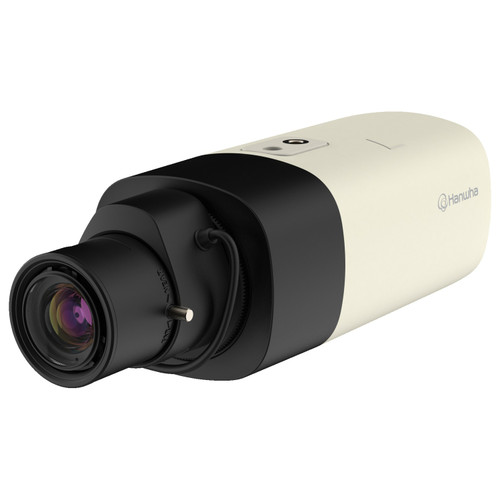
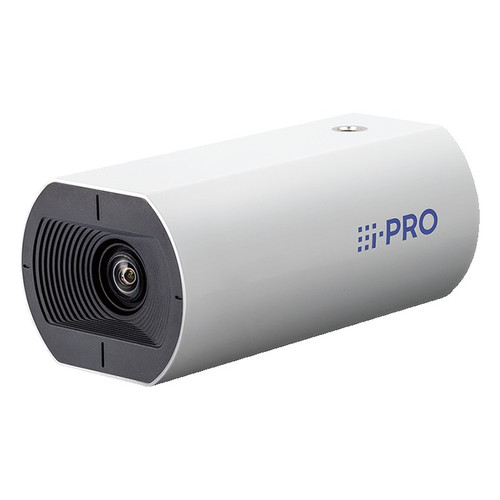
Lens architecture differs fundamentally. The XNB-6000 ships body-only and accepts C/CS-mount lenses—DC auto iris, P-iris, manual, or I-CS—giving integrators broad lens flexibility at the cost of sourcing a separate optic. The U11300-V2 includes an integrated 2.5x motorized zoom varifocal lens (2.9–7.3 mm, f/2.0–3.0), covering 43°–100° horizontal field of view with motorized focus, which simplifies installation but limits lens substitution. The XNB-6000 also supports digital image stabilization via a built-in gyro sensor; no equivalent is listed for the U11300-V2.
What about installation and environment?
The XNB-6000 carries an IP66 weatherproof rating, making it suitable for outdoor exposure to dust and direct water jets. The U11300-V2 is rated for indoor use only; no IP ingress protection rating is stated in its specifications. Operating temperature ranges are similar—XNB-6000: -10°C to +55°C; U11300-V2: -10°C to +50°C—with the Hanwha unit offering a 5°C higher upper limit. IK impact resistance is not specified for either model.
Power requirements differ by PoE class: the XNB-6000 draws up to 7.5 W at PoE Class 3 (IEEE 802.3af) and also accepts 12 VDC or 24 VAC, giving three power input options. The U11300-V2 operates at PoE Class 2 drawing 4.3 W (802.3af only), with no alternate power input stated. The U11300-V2 is notably lighter and more compact (approx. 165 g / 59×49×116 mm) than the XNB-6000 (420 g / 73.1×66.6×147.8 mm), relevant for ceiling-tile or plenum installations. The XNB-6000 includes an RS-485/422 serial interface and one alarm input/one alarm output; the U11300-V2's alarm I/O specifics beyond alarm source/action descriptions are not listed in the provided specifications.
Which fits your VMS and analytics better?
Both cameras support ONVIF Profiles G, S, and T, providing broad VMS compatibility. The XNB-6000 additionally exposes Hanwha's SUNAPI (HTTP API) and the Wisenet open platform for deeper integration with Wisenet Wave/WAVE VMS environments. The U11300-V2 lists ONVIF as its primary integration path; no manufacturer-proprietary API is stated in the provided specifications. Protocol depth is comparable, with both supporting HTTPS, SNMPv1/v2/v3, NTP, SMTP, and IEEE 802.1X; the U11300-V2 adds SFTP and MQTT to its listed IPv4/IPv6 protocol stacks—neither is listed for the XNB-6000.
Analytics breadth heavily favors the XNB-6000, which lists defocus detection, directional detection, fog detection, face detection, motion detection, digital auto tracking, appear/disappear, enter/exit, loitering, tampering, virtual line, audio detection, and sound classification as on-camera analytics events, with up to 32 privacy mask zones (4-point quadrangle with color/mosaic options) and 8 motion detection zones (8-point polygonal). The U11300-V2 provides VMD (4 areas), scene change detection (1 area), audio detection, and up to 8 privacy zones. Both support microSD edge storage up to 512 GB. Audio input is selectable mic/line/built-in on the XNB-6000; the U11300-V2 supports full-duplex audio with mic input and audio output. The XNB-6000 streams to up to 20 unicast users across 10 configurable profiles; the U11300-V2 supports up to 14 simultaneous users.
Which should you choose: the XNB-6000 or the U11300-V2?
Our take: The XNB-6000 is the stronger choice when the installation is outdoors, demands maximum WDR performance, or requires a rich on-camera analytics suite without a server-side license. Its 150 dB WDR exceeds the U11300-V2's 120 dB by 30 dB, its IP66 rating covers outdoor exposure where the U11300-V2 (indoor-only, no IP rating stated) cannot be used, and its analytics library—14 event types including loitering, enter/exit, and face detection—is substantially broader than the U11300-V2's VMD plus scene change detection. The U11300-V2 is the better fit for compact indoor box installations where a self-contained motorized varifocal lens (2.5x, 2.9–7.3 mm, motorized focus) simplifies aiming, where lower power draw (4.3 W Class 2 vs. 7.5 W Class 3) matters to switch budgets, and where a 5-year warranty outweighs the Hanwha 3-year term. Select the XNB-6000 for outdoor perimeter or mixed-light scenes; select the U11300-V2 for controlled indoor environments where lens flexibility at installation outweighs analytics depth.
Side-by-Side Comparison
Spec-for-spec, from manufacturer data.
| Specification | Hanwha XNB-6000 | i-PRO U11300-V2 |
|---|---|---|
| Resolution | 2MP (1920×1080) | 2MP (1920×1080) |
| Image Sensor | 1/2.8" CMOS | Approx. 1/2.8" CMOS |
| Lens Type | C/CS-mount; DC auto iris, P-iris, Manual, I-CS (lens sold separately) | Integrated motorized varifocal 2.9–7.3 mm (2.5× zoom), f/2.0–3.0 |
| Min. Illumination (Color) | 0.01 lux | 0.006 lux (color) / 0.1 lux (standard color) |
| Min. Illumination (B/W) | 0.001 lux | 0.0025 lux (B/W) / 0.04 lux (standard B/W) |
| Wide Dynamic Range | 150 dB | Max. 120 dB (Super Dynamic On, Level 31) |
| Max. Frame Rate | 60 fps | 30 fps |
| Video Compression | H.265 / H.264 (Main/Baseline/High) / MJPEG | H.265 / H.264 / MJPEG (JPEG) |
| IP / Ingress Rating | IP66 | Not stated (indoor only) |
| Operating Temperature | -10°C to +55°C | -10°C to +50°C |
| Power Input / PoE Class | PoE 802.3af Class 3 / 12 VDC / 24 VAC; max 7.5 W | PoE 802.3af Class 2; 4.3 W |
| Edge Storage | microSD/SDHC/SDXC 2-slot, max 512 GB (256 GB × 2) | microSD up to 512 GB (microSDXC 64–512 GB) |
| Audio | Mic in / Line in / Built-in mic (selectable); Line out | Mic input / Audio output; Half/Full duplex; AAC-LC, G.711, G.726 |
| On-Camera Analytics | 14 event types incl. loitering, enter/exit, face detection, sound classification, +more | VMD (4 areas), Scene Change Detection (1 area), Audio Detection |
| ONVIF Profiles | G / S / T | G / S / T |
| Dimensions (W×H×D) | 73.1 × 66.6 × 147.8 mm (2.88" × 2.62" × 5.82") | 59 × 49 × 116 mm (with base bracket) |
| Weight | 420 g (0.93 lb) | Approx. 165 g (0.36 lb) |
| Warranty | 3-year | 5-year |
Frequently Asked Questions
Which should you choose: the XNB-6000 or the U11300-V2?
The XNB-6000 is the stronger choice when the installation is outdoors, demands maximum WDR performance, or requires a rich on-camera analytics suite without a server-side license. Its 150 dB WDR exceeds the U11300-V2's 120 dB by 30 dB, its IP66 rating covers outdoor exposure where the U11300-V2 (indoor-only, no IP rating stated) cannot be used, and its analytics library—14 event types including loitering, enter/exit, and face detection—is substantially broader than the U11300-V2's VMD plus scene change detection. The U11300-V2 is the better fit for compact indoor box installations where a self-contained motorized varifocal lens (2.5x, 2.9–7.3 mm, motorized focus) simplifies aiming, where lower power draw (4.3 W Class 2 vs. 7.5 W Class 3) matters to switch budgets, and where a 5-year warranty outweighs the Hanwha 3-year term. Select the XNB-6000 for outdoor perimeter or mixed-light scenes; select the U11300-V2 for controlled indoor environments where lens flexibility at installation outweighs analytics depth.
Is the XNB-6000 or U11300-V2 better for low-light performance?
It depends on the mode. In B/W (night) mode the XNB-6000 reaches 0.001 lux versus the U11300-V2's 0.0025 lux, giving the Hanwha an edge at absolute minimum illumination. In color mode the U11300-V2 (0.006 lux) outperforms the XNB-6000 (0.01 lux), meaning the i-PRO unit sees color at lower light levels before switching to B/W. Choose based on whether twilight color retention or ultimate night sensitivity is the priority.
Can I use the XNB-6000 outdoors but not the U11300-V2?
Yes, based on the provided specifications. The XNB-6000 carries an IP66 rating, qualifying it for outdoor use with dust and water-jet exposure. The U11300-V2 is specified as an indoor camera and no IP ingress protection rating is listed in its specifications, so it should not be installed in outdoor or wet environments without a separately rated housing.
Which camera supports more on-camera analytics without a separate VMS license?
The XNB-6000 lists significantly more built-in analytics: 14 event types including directional detection, loitering, enter/exit, face detection, digital auto tracking, tampering, virtual line, and sound classification. The U11300-V2 lists VMD (4 areas), scene change detection (1 area), and audio detection. If on-camera intelligence without additional licensing is a project requirement, the XNB-6000 has the broader specification.
Get a Second Opinion on Your Camera Choice
Share your site layout, coverage goals, and budget. Our team will validate the camera selection, flag anything we would change, and recommend products that match the use case.