
Hanwha XNB-6000 vs Hanwha XNB-6005: Specification Comparison
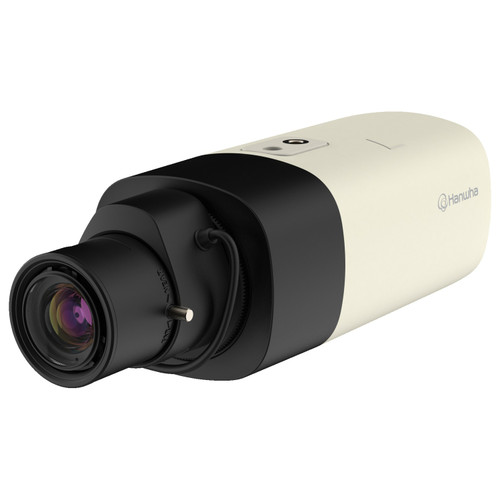
The Hanwha XNB-6000 and XNB-6005 are both 2MP wired box cameras in Hanwha's Wisenet lineup, sharing the same physical housing, C/CS-mount compatibility, PoE Class 3 power, and ONVIF Profile S/G/T support. Both target installers who need a lensless platform camera for indoor or outdoor applications. The key differentiators are sensor size and low-light sensitivity, serial interface breadth, alarm trigger options, and environmental rating—making this a genuine cross-shop decision for integrators specifying fixed-lens box cameras in the 2MP class.
In This Guide
How do the imaging specs compare?
The XNB-6000 uses a 1/2.8" CMOS sensor while the XNB-6005 steps up to a larger 1/2" CMOS. That larger photosensitive area translates directly into better low-light performance: the XNB-6005 reaches 0.006 Lux in color mode and 0.0006 Lux in B/W, whereas the XNB-6000 requires 0.01 Lux color and 0.001 Lux B/W. In practical terms the XNB-6005 is roughly 1.7× more sensitive in both modes. Both cameras deliver the same 150 dB WDR and share the SSNR V digital noise reduction engine.
Both models resolve 2MP (1920×1080) at up to 60 fps and support H.265/H.264 Main/Baseline/High plus MJPEG, with WiseStream II smart codec and CBR/VBR bitrate control. The XNB-6000 specifies lens compatibility with DC auto iris, P-iris, Manual, and I-CS types; the XNB-6005 lists DC auto iris and P-iris but does not list Manual or I-CS types in its specs. The XNB-6000 also explicitly lists optional SLA-M2890DN and SLA-M2890PN Hanwha lenses; no optional lens part numbers are provided for the XNB-6005.
What about installation and environment?
Both cameras share an identical physical footprint—73.1 × 66.6 × 147.8 mm, 420 g—and use C-mount or CS-mount lens adapters. Power inputs are equivalent: PoE IEEE 802.3af Class 3, 12 VDC, and 24 VAC. The XNB-6000 draws a maximum of 7.5 W; the XNB-6005 draws up to 8.5 W, a 1 W increase likely attributable to the larger sensor. Operating temperature range is identical for both: −10 °C to +55 °C at less than 90% RH.
Storage temperature diverges: the XNB-6000 is rated to −50 °C minimum storage, while the XNB-6005 is rated only to −30 °C minimum storage—a relevant consideration for cold-climate warehousing or shipping. The XNB-6000 carries an IP66 environmental rating and Hanwha's product data lists it as suitable for outdoor environments. The XNB-6005 specs do not list an IP rating, and its environment rating is listed as Indoor only—making it unsuitable for direct outdoor exposure without an additional housing.
Which fits your VMS and analytics better?
Both cameras implement ONVIF Profile S/G/T, SUNAPI (HTTP API), and the Wisenet open platform, ensuring compatibility with the same broad range of VMS platforms. Analytics suites are effectively identical: defocus detection, directional detection, fog detection, face detection, motion detection (8 zones, 8-point polygonal), digital auto tracking, appear/disappear, enter/exit, loitering, tampering, virtual line, audio detection, and sound classification. Both support 32 privacy masking zones with color and mosaic options, LDC, digital image stabilization via built-in gyro, and defog.
The primary integration difference is in serial and alarm capabilities. The XNB-6000 provides RS-485/422 with multiple protocols, while the XNB-6005 supports RS-485 only—no RS-422. For alarm triggers, the XNB-6000 adds 'App event' and 'Time schedule' trigger types beyond what the XNB-6005 lists. The XNB-6000's alarm events include HTTP/HTTPS/TCP handover and PTZ preset commands; the XNB-6005 lists DPTZ preset but does not list HTTP/HTTPS/TCP handover. Both cameras provide dual micro SD/SDHC/SDXC slots up to 512 GB total, 1024 MB RAM, 256 MB flash, and identical audio I/O (selectable mic/line in with built-in mic, line out). Both carry a 3-year warranty.
Which should you choose: the XNB-6000 or the XNB-6005?
Our take: The XNB-6005 is the stronger choice when maximum low-light sensitivity is the primary requirement and the installation is indoors or within a protective housing. Its 1/2" sensor achieves 0.006 Lux color and 0.0006 Lux B/W versus the XNB-6000's 0.01 Lux color and 0.001 Lux B/W—roughly 1.7× more sensitive. However, the XNB-6000 holds three concrete advantages: it carries a documented IP66 rating and outdoor environment classification (the XNB-6005 specifies no IP rating and is rated indoor only), it supports both RS-485 and RS-422 serial interfaces versus RS-485 only on the XNB-6005, and it extends alarm triggering to App event and Time schedule triggers absent from the XNB-6005 spec. Choose the XNB-6000 for outdoor or harsh-environment deployments, PTZ pan-tilt controller integration requiring RS-422, or sites needing time-based alarm scheduling; choose the XNB-6005 for low-light-critical indoor locations where an IP-rated housing will be added separately.
Side-by-Side Comparison
Spec-for-spec, from manufacturer data.
| Specification | Hanwha XNB-6000 | Hanwha XNB-6005 |
|---|---|---|
| Resolution | 2MP (1920×1080) | 2MP (1920×1080) |
| Image Sensor | 1/2.8" CMOS | 1/2" CMOS |
| Min. Illumination (Color) | 0.01 Lux | 0.006 Lux |
| Min. Illumination (B/W) | 0.001 Lux | 0.0006 Lux |
| Wide Dynamic Range | 150 dB | 150 dB |
| Max Frame Rate | 60 fps | 60 fps |
| Video Compression | H.265 / H.264 / MJPEG | H.265 / H.264 / MJPEG |
| Smart Codec | WiseStream II | WiseStream II |
| IP Rating | IP66 | — |
| Environment Rating | Outdoor | Indoor |
| Operating Temperature | −10 °C to +55 °C | −10 °C to +55 °C |
| Storage Temperature | −50 °C to +60 °C | −30 °C to +60 °C |
| Power Input / PoE Class | PoE 802.3af Class 3 / 12 VDC / 24 VAC | PoE 802.3af Class 3 / 12 VDC / 24 VAC |
| Max Power Draw | 7.5 W | 8.5 W |
| Serial Interface | RS-485 / RS-422 | RS-485 |
| Lens Type Compatibility | DC auto iris / P-iris / Manual / I-CS | DC auto iris / P-iris |
| Mount Type | C-mount / CS-mount | C-mount / CS-mount |
| Edge Storage | 2× micro SD/SDHC/SDXC, max 512 GB | 2× micro SD/SDHC/SDXC, max 512 GB |
| Audio In | Mic in / Line in / Built-in mic (selectable) | Mic in / Line in / Built-in mic (selectable) |
| Audio Out | Line out | Line out |
| Alarm I/O | 1 input / 1 output | 1 input / 1 output |
| ONVIF | Profile S/G/T | Profile S/G/T |
| Dimensions (W×H×D) | 73.1 × 66.6 × 147.8 mm | 73.1 × 66.6 × 147.8 mm |
| Weight | 420 g (0.93 lb) | 420 g (0.93 lb) |
| Warranty | 3 years | 3 years |
Frequently Asked Questions
Which should you choose: the XNB-6000 or the XNB-6005?
The XNB-6005 is the stronger choice when maximum low-light sensitivity is the primary requirement and the installation is indoors or within a protective housing. Its 1/2" sensor achieves 0.006 Lux color and 0.0006 Lux B/W versus the XNB-6000's 0.01 Lux color and 0.001 Lux B/W—roughly 1.7× more sensitive. However, the XNB-6000 holds three concrete advantages: it carries a documented IP66 rating and outdoor environment classification (the XNB-6005 specifies no IP rating and is rated indoor only), it supports both RS-485 and RS-422 serial interfaces versus RS-485 only on the XNB-6005, and it extends alarm triggering to App event and Time schedule triggers absent from the XNB-6005 spec. Choose the XNB-6000 for outdoor or harsh-environment deployments, PTZ pan-tilt controller integration requiring RS-422, or sites needing time-based alarm scheduling; choose the XNB-6005 for low-light-critical indoor locations where an IP-rated housing will be added separately.
Is the XNB-6000 or XNB-6005 better for low-light surveillance?
The XNB-6005 is more sensitive in low light. Its larger 1/2" sensor achieves 0.006 Lux in color mode and 0.0006 Lux in B/W mode, compared to 0.01 Lux color and 0.001 Lux B/W on the XNB-6000—roughly 1.7× better sensitivity in both modes. Both share the same 150 dB WDR and SSNR V noise reduction.
Can the XNB-6000 or XNB-6005 be installed outdoors?
The XNB-6000 carries an IP66 rating and is spec-listed for outdoor environments. The XNB-6005 has no IP rating listed in its specifications and is rated for indoor use only. For outdoor deployment, either use the XNB-6000 directly or house the XNB-6005 in a rated outdoor enclosure—but verify enclosure compatibility separately, as that spec is not provided for the XNB-6005.
Do both cameras support the same lens mounts and lens types?
Both cameras accept C-mount and CS-mount lenses. The XNB-6000 additionally lists compatibility with DC auto iris, P-iris, Manual, and I-CS lens types, and names two optional Hanwha lenses (SLA-M2890DN and SLA-M2890PN). The XNB-6005 lists DC auto iris and P-iris compatibility; Manual and I-CS are not specified, and no optional lens part numbers are provided in its specs.
Get a Second Opinion on Your Camera Choice
Share your site layout, coverage goals, and budget. Our team will validate the camera selection, flag anything we would change, and recommend products that match the use case.