
Hanwha QNV-8010R vs i-PRO U22501-F3L: Specification Comparison
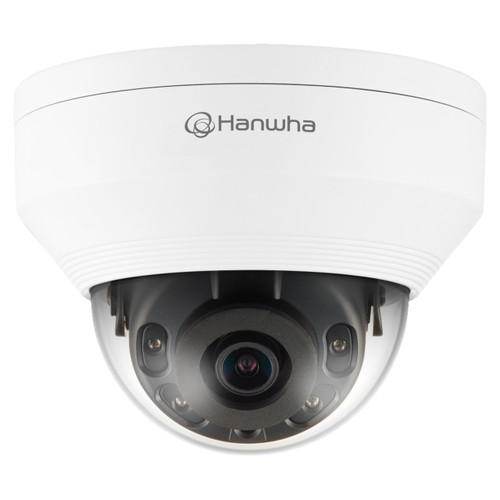
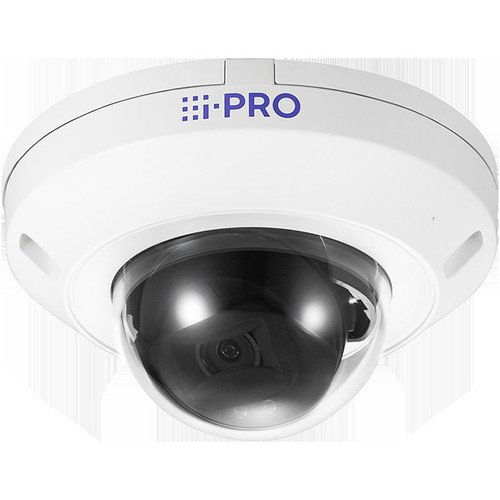
Both the Hanwha QNV-8010R and the i-PRO WV-U22501-F3L are 5MP fixed indoor vandal-resistant dome cameras powered by PoE, sharing the same 1/2.8-inch CMOS sensor class, IK10 impact rating, and H.265/H.264/MJPEG compression support. This comparison is directed at installers and IT buyers evaluating a ceiling-mount indoor vandal dome for access-controlled or high-traffic interior spaces where resolution, low-light performance, cybersecurity posture, and VMS integration are the primary decision drivers.
In This Guide
How do the imaging specs compare?
Both cameras deliver 5MP resolution, but at slightly different native pixel arrays: the QNV-8010R outputs 2592×1944 pixels while the i-PRO WV-U22501-F3L outputs 2560×1920 pixels — a negligible difference in practice. Both achieve 30fps at full resolution, share a 1/2.8-inch CMOS sensor, and include 120dB Super Dynamic WDR. Low-light minimum illumination differs measurably: the QNV-8010R specifies 0.15 lux color / 0 lux IR, whereas the WV-U22501-F3L specifies 0.11 lux color (30IRE) / 0 lux IR — giving the i-PRO a slight edge in color low-light sensitivity per stated specs.
IR illumination range is a more significant delta: the WV-U22501-F3L specifies a 28m (92ft) IR LED range, while the QNV-8010R specifies 20m (65.6ft) — a 40% reach advantage for the i-PRO in IR mode. The QNV-8010R uses an 850nm IR LED and a fixed 2.8mm lens at F2.0 with a 105° horizontal field of view. The i-PRO WV-U22501-F3L lens focal length and aperture are not specified in the provided data. The QNV-8010R includes DORI distances (Detect 40m, Observe 16m, Recognize 8m, Identify 4m); equivalent DORI data is absent for the WV-U22501-F3L.
What about installation and environment?
Both cameras carry IK10 vandal resistance, but their IP ingress ratings differ significantly: the QNV-8010R is rated IP66 (dust-tight, protected against powerful water jets), while the WV-U22501-F3L is rated IP42 (protected against solid objects >1mm and dripping water). The QNV-8010R is therefore suitable for wet or semi-outdoor vestibule environments; the WV-U22501-F3L is rated for dry indoor use only.
Operating temperature range also diverges: the QNV-8010R operates from -30°C to +55°C, supporting installations in unconditioned spaces or cold-climate corridors. The WV-U22501-F3L is rated -10°C to +50°C, limiting it to climate-controlled interiors. Both cameras are PoE 802.3af-powered, but maximum power draw differs — the QNV-8010R draws a maximum of 7.5W (typical 5.8W), while the WV-U22501-F3L draws up to 13W, which affects switch budget planning on dense deployments. Both are dome form-factor ceiling-mount units; the QNV-8010R specifies a pan/tilt/rotate range of 0°–350° / 0°–67° / 0°–355°. Equivalent mechanical adjustment data is not provided for the WV-U22501-F3L.
Which fits your VMS and analytics better?
Both cameras support ONVIF Profile S, G, and T, ensuring broad VMS compatibility. The QNV-8010R additionally supports Hanwha's SUNAPI (HTTP API) and Wisenet open platform, which may be advantageous in Hanwha VMS environments. Edge analytics differ in scope: the QNV-8010R specifies motion detection, tampering, defocus detection, virtual area intrusion/enter/exit, and virtual line crossing/direction. The WV-U22501-F3L specifies VMD, SCD (Scene Change Detection), and AI Sound Classification — the last being a differentiating feature not present on the QNV-8010R.
Audio support is a clear differentiator: the WV-U22501-F3L includes a built-in microphone and audio input; the QNV-8010R provides no audio capability per the supplied specs. On-board storage: the QNV-8010R supports a Micro SD/SDHC/SDXC slot up to 128GB with SD card partition encryption; edge storage capability for the WV-U22501-F3L is not specified in the provided data. Cybersecurity posture is a notable delta — the WV-U22501-F3L holds FIPS 140-3 Level 3 certification via EdgeLock SE052F secure element and carries NDAA compliance certification; the QNV-8010R specifies firmware encryption, 802.1X (EAP-TLS/LEAP/PEAP), HTTPS/SRTP, digest authentication, and a Hanwha Private Root CA device certificate, but does not cite FIPS 140-3 or NDAA in the provided specs.
Which should you choose: the QNV-8010R or the U22501-F3L?
Our take: The QNV-8010R is the stronger choice when the installation environment demands broader environmental resilience, lower power draw, or on-board edge storage. It carries IP66 weatherproofing versus the WV-U22501-F3L's IP42, operates across -30°C to +55°C versus -10°C to +50°C, and draws a maximum of 7.5W versus 13W — meaningful advantages in dense PoE switch budgets and unconditioned spaces. It also provides a rated 128GB microSD edge storage slot and a broader built-in video analytics suite. Conversely, the WV-U22501-F3L is the stronger choice for high-security credentialed environments: its FIPS 140-3 Level 3 and NDAA certifications are absent from the QNV-8010R's spec sheet, its 28m IR range exceeds the QNV-8010R's 20m by 40%, and its built-in microphone enables audio-triggered or AI sound classification workflows not possible with the QNV-8010R. Buyers on federal, defense, or compliance-driven projects should weight the WV-U22501-F3L's certified cybersecurity posture heavily; commercial installers prioritizing environmental flexibility and power efficiency will favor the QNV-8010R.
Side-by-Side Comparison
Spec-for-spec, from manufacturer data.
| Specification | Hanwha QNV-8010R | i-PRO U22501-F3L |
|---|---|---|
| Resolution | 2592×1944 (5MP) | 2560×1920 (5MP) |
| Image Sensor | 1/2.8" CMOS | 1/2.8" CMOS |
| Lens / Focal Length | 2.8mm fixed, F2.0 | — |
| Horizontal FOV | 105° | — |
| Min. Illumination (Color) | 0.15 lux | 0.11 lux (30IRE) |
| Min. Illumination (B/W / IR on) | 0 lux | 0 lux |
| IR Range | 20m (65.6ft), 850nm | 28m (92ft) |
| WDR | 120dB | 120dB Super Dynamic |
| Max Frame Rate | 30fps @ 5MP | 30fps / 25fps |
| Video Compression | H.265, H.264, MJPEG | H.265, H.264, MJPEG |
| IP Rating | IP66 | IP42 |
| IK / Impact Rating | IK10 | IK10 |
| Operating Temperature | -30°C to +55°C | -10°C to +50°C |
| Power Input / PoE | PoE 802.3af, Class 3, max 7.5W | PoE 802.3af, max 13W |
| Edge Storage | MicroSD/SDHC/SDXC, 1 slot, up to 128GB | — |
| Audio | — | Built-in mic; Audio input |
| Analytics | VMD, Tampering, Defocus, Virtual Area/Line | VMD, SCD, AI Sound Classification |
| ONVIF | Profile S, G, T | Profile S, G, T |
| Cybersecurity Certifications | — | FIPS 140-3 Level 3; NDAA |
| Alarm I/O | 1 input / 1 output | — |
| Dimensions | ø120.3×91.7mm (ø4.74×3.61") | — |
| Weight | 510g (1.12 lb) | — |
| Warranty | 3 years | — |
Frequently Asked Questions
Which should you choose: the QNV-8010R or the U22501-F3L?
The QNV-8010R is the stronger choice when the installation environment demands broader environmental resilience, lower power draw, or on-board edge storage. It carries IP66 weatherproofing versus the WV-U22501-F3L's IP42, operates across -30°C to +55°C versus -10°C to +50°C, and draws a maximum of 7.5W versus 13W — meaningful advantages in dense PoE switch budgets and unconditioned spaces. It also provides a rated 128GB microSD edge storage slot and a broader built-in video analytics suite. Conversely, the WV-U22501-F3L is the stronger choice for high-security credentialed environments: its FIPS 140-3 Level 3 and NDAA certifications are absent from the QNV-8010R's spec sheet, its 28m IR range exceeds the QNV-8010R's 20m by 40%, and its built-in microphone enables audio-triggered or AI sound classification workflows not possible with the QNV-8010R. Buyers on federal, defense, or compliance-driven projects should weight the WV-U22501-F3L's certified cybersecurity posture heavily; commercial installers prioritizing environmental flexibility and power efficiency will favor the QNV-8010R.
Is the QNV-8010R or WV-U22501-F3L better for low-light performance?
Both cameras reach 0 lux in IR mode. In color low-light, the WV-U22501-F3L specifies a slightly lower minimum illumination of 0.11 lux (30IRE) versus the QNV-8010R's 0.15 lux. The WV-U22501-F3L also has a longer specified IR range of 28m versus the QNV-8010R's 20m. On both color sensitivity and IR reach, the WV-U22501-F3L has a spec advantage per the provided data.
Can either camera be installed in a lobby entrance or semi-outdoor vestibule?
The QNV-8010R is rated IP66, making it suitable for environments exposed to dust and water jets, including semi-outdoor vestibules or building entrances. The WV-U22501-F3L is rated only IP42, which covers dripping water and solid objects larger than 1mm — it is not appropriate for environments with direct moisture exposure. For wet or transitional entry spaces, the QNV-8010R is the appropriate choice based on rated IP protection.
Which camera is better suited for a government or federally regulated deployment?
The WV-U22501-F3L carries FIPS 140-3 Level 3 certification via its EdgeLock SE052F secure element and is listed with NDAA compliance per the provided specs. These certifications are not cited for the QNV-8010R in the provided data. For federal, defense, or NDAA-sensitive procurements, the WV-U22501-F3L meets documented certification requirements that the QNV-8010R's spec sheet does not reflect.
Get a Second Opinion on Your Camera Choice
Share your site layout, coverage goals, and budget. Our team will validate the camera selection, flag anything we would change, and recommend products that match the use case.