
Hanwha QNV-6012R1 vs i-PRO S2236LA: Specification Comparison
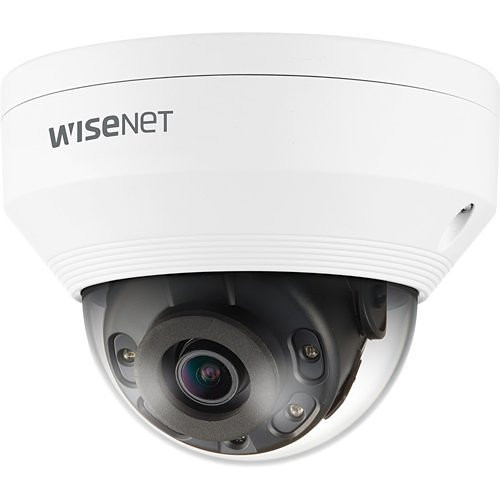
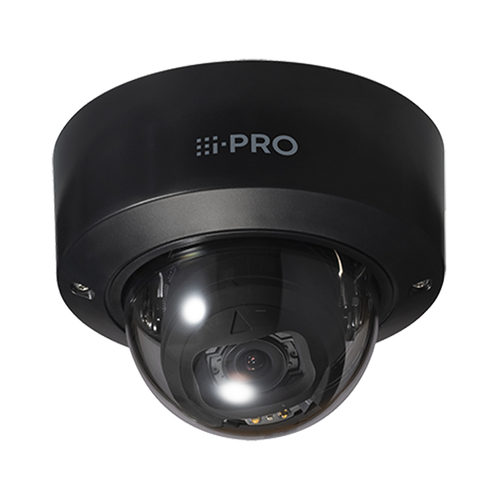
Both the Hanwha QNV-6012R1 and the i-PRO WV-S2236LA are 2MP (1920×1080) vandal-resistant IP dome cameras powered by PoE, making them cross-shoppable within the same resolution and form-factor class. The comparison centers on outdoor-rated fixed-focal budget deployment (QNV-6012R1) versus indoor AI-analytics-equipped varifocal performance (WV-S2236LA). Key differentiators include lens flexibility, IR range, frame rate, dynamic range, AI capability, and environmental rating.
In This Guide
How do the imaging specs compare?
Both cameras use an approximately 1/2.8" 2MP CMOS sensor delivering 1920×1080 resolution. The QNV-6012R1 captures at 30 fps with a fixed 2.8mm lens offering a 113.7° horizontal field of view and a minimum illumination of 0.03 lux (color) / 0 lux (IR), backed by a 20m IR range and 120 dB WDR. The WV-S2236LA doubles the frame rate at 60 fps and features a motorized varifocal 2.9–9mm lens (3.1x optical zoom, auto-focus) with an angular range of 36°–115°, a minimum illumination of 0.007 lux (color) / 0.006 lux (B&W with IR), a substantially longer 70m IR range (30 IRE), and a maximum dynamic range of 144 dB (Super Dynamic level 31).
In low-light terms, the WV-S2236LA's 0.007 lux figure is more than four times more sensitive than the QNV-6012R1's 0.03 lux, and its IR throw of 70m is 3.5× the QNV-6012R1's 20m. The WV-S2236LA's 144 dB dynamic range also exceeds the QNV-6012R1's 120 dB by 24 dB, providing a meaningful advantage in high-contrast scenes. The QNV-6012R1 offers a fixed wide-angle view suited to lobbies or corridors where a set FOV is acceptable, while the WV-S2236LA's motorized varifocal lens allows post-install focus adjustment across a 36°–115° range without a technician physically changing the lens.
What about installation and environment?
The QNV-6012R1 carries an IP66 weatherproof rating and IK10 impact resistance, making it explicitly rated for outdoor deployment. It operates between -10°C and +55°C and accepts either PoE (IEEE 802.3af, Class 3, max 7.4W) or 12VDC. Its compact form factor (Ø110×86mm, 255g) and built-in CVBS analog output aid rough-in alignment during installation. Pan/tilt/rotate ranges are 0°–350° / 0°–67° / 0°–355°.
The WV-S2236LA carries an IK10 impact rating but no external IP ingress rating is specified in the provided data, and its environment rating is listed as Indoor. It operates between -10°C and +50°C and accepts PoE (IEEE 802.3af, PoE Class 0, max 8.7W) or DC12V at 720mA (8.6W). It is larger (Ø129.5×102.5mm) and heavier (570g vs 255g). Its motorized lens supports auto-focus, which simplifies commissioning in difficult-to-access ceiling locations. The WV-S2236LA also provides 3.5mm audio in/out jacks and three external alarm terminals, whereas the QNV-6012R1 has no audio I/O.
Which fits your VMS and analytics better?
Both cameras support ONVIF Profile G/S/T and H.265/H.264/MJPEG compression with microSD edge storage. The QNV-6012R1 adds ONVIF Profile G and supports Wisenet's WiseStream II smart codec for bandwidth reduction, up to 3 simultaneous streams, and 6 unicast users, with edge storage capped at 128GB. Its on-camera analytics include defocus detection, directional detection, enter/exit, virtual line crossing, and tampering — all processed on-device. The WV-S2236LA supports up to 14 simultaneous users, microSD up to 512GB, and ONVIF Profile G/M/S/T (Profile M adds metadata streaming for analytics). Its Ambarella CV25M SoC enables on-camera AI analytics: AI Video Motion Detection, Face Detection, People Detection, Vehicle Detection, and AI Sound Classification (gunshot, yell, vehicle horn, glass break). The WV-S2236LA also provides G.726 and G.711 audio compression with full-duplex audio transmission, SFTP, MQTT, and SRTP protocol support not listed for the QNV-6012R1, and it carries a FIPS 140-2 Level 3 security certification. The QNV-6012R1 uses Wisenet's proprietary SUNAPI/HTTP API alongside ONVIF, which may be advantageous in Wisenet/Wisenet WAVE VMS environments.
Which should you choose: the QNV-6012R1 or the S2236LA?
Our take: The WV-S2236LA is the stronger choice when the deployment is indoors and demands superior low-light performance, flexible lens coverage, or on-camera AI analytics. Concretely: it delivers 0.007 lux minimum illumination versus 0.03 lux, a 70m IR range versus 20m, and 144 dB dynamic range versus 120 dB — all significant operational margins. Its motorized varifocal 2.9–9mm lens eliminates fixed-focal placement constraints, and its Ambarella AI SoC adds face, people, vehicle, and sound classification analytics without external servers. The QNV-6012R1 is the appropriate choice when the installation is outdoor (IP66-rated versus no stated IP rating for the WV-S2236LA), budget is a constraint, the wide 113.7° fixed view fits the scene, and the deployment is anchored to a Wisenet VMS ecosystem. The WV-S2236LA also carries a 5-year warranty versus the QNV-6012R1's 3-year warranty.
Side-by-Side Comparison
Spec-for-spec, from manufacturer data.
| Specification | Hanwha QNV-6012R1 | i-PRO S2236LA |
|---|---|---|
| Resolution | 1920×1080 (2MP) | 1920×1080 (2MP) |
| Image Sensor | 1/2.8" CMOS | Approx. 1/2.8" CMOS |
| Max Frame Rate | 30 fps | 60 fps |
| Lens / Focal Length | 2.8mm fixed | 2.9–9mm motorized varifocal (3.1x) |
| Horizontal FOV | 113.7° | 36°–115° (16:9 mode) |
| Min. Illumination (Color) | 0.03 lux | 0.007 lux @ 30IRE, F1.3 |
| Min. Illumination (B&W / IR) | 0 lux (IR on) | 0.006 lux (B&W with IR) |
| IR Range | 20m (65.6 ft) | 70m @ 30IRE / 50m @ 50IRE |
| Wide Dynamic Range | 120 dB | 144 dB (Super Dynamic level 31) |
| Video Compression | H.265, H.264, MJPEG | H.265, H.264, MJPEG |
| IP Rating | IP66 | — (not specified; indoor-rated) |
| IK / Impact Rating | IK10 | IK10 |
| Operating Temperature | -10°C to +55°C | -10°C to +50°C |
| Power Input / PoE Class | PoE 802.3af Class 3 / 12VDC; max 7.4W | PoE 802.3af Class 0 / DC12V; max 8.7W |
| Edge Storage | microSD/SDHC/SDXC up to 128GB | microSDXC up to 512GB |
| Audio I/O | — (none) | 3.5mm mic in + audio out; full-duplex |
| On-Camera AI Analytics | Motion, tampering, defocus, directional, enter/exit, virtual line | AI VMD, Face/People/Vehicle Detection, AI Sound Classification |
| ONVIF Profiles | Profile S/G/T | Profile G/M/S/T |
| Simultaneous Users | 6 (unicast) | Up to 14 |
| Dimensions | Ø110×86mm | Ø129.5×102.5mm |
| Weight | 255g (0.56 lb) | 570g (1.26 lb) |
| Environment Rating | Outdoor | Indoor |
| Warranty | 3 years | 5 years |
Frequently Asked Questions
Which should you choose: the QNV-6012R1 or the S2236LA?
The WV-S2236LA is the stronger choice when the deployment is indoors and demands superior low-light performance, flexible lens coverage, or on-camera AI analytics. Concretely: it delivers 0.007 lux minimum illumination versus 0.03 lux, a 70m IR range versus 20m, and 144 dB dynamic range versus 120 dB — all significant operational margins. Its motorized varifocal 2.9–9mm lens eliminates fixed-focal placement constraints, and its Ambarella AI SoC adds face, people, vehicle, and sound classification analytics without external servers. The QNV-6012R1 is the appropriate choice when the installation is outdoor (IP66-rated versus no stated IP rating for the WV-S2236LA), budget is a constraint, the wide 113.7° fixed view fits the scene, and the deployment is anchored to a Wisenet VMS ecosystem. The WV-S2236LA also carries a 5-year warranty versus the QNV-6012R1's 3-year warranty.
Is the QNV-6012R1 or WV-S2236LA better for low-light and night coverage?
The WV-S2236LA has a measurable low-light advantage: its minimum illumination is 0.007 lux (color) versus the QNV-6012R1's 0.03 lux, and its built-in IR illuminator reaches 70m (30 IRE) versus 20m. If long-range night detection in a corridor or large indoor space is the priority, the WV-S2236LA's specs are substantially stronger.
Can the QNV-6012R1 be used outdoors while the WV-S2236LA cannot?
Based on the provided specifications, yes. The QNV-6012R1 carries an IP66 ingress protection rating and an operating temperature range of -10°C to +55°C, and is listed as outdoor-rated. The WV-S2236LA is listed as indoor-rated with no IP ingress rating specified in its provided data; its operating range is -10°C to +50°C. Installers should not deploy the WV-S2236LA outdoors without confirming an appropriate housing from the manufacturer.
Which camera offers better on-camera analytics for retail or transit environments?
The WV-S2236LA offers substantially richer on-camera AI analytics, including Face Detection, People Detection, Vehicle Detection, and AI Sound Classification (gunshot, yell, vehicle horn, glass break), powered by its Ambarella CV25M SoC. It also supports ONVIF Profile M for metadata streaming. The QNV-6012R1's analytics cover motion detection (4 polygonal zones), tampering, defocus, directional detection, enter/exit, and virtual line — useful for perimeter and general intrusion use cases but without AI-based subject classification.
Get a Second Opinion on Your Camera Choice
Share your site layout, coverage goals, and budget. Our team will validate the camera selection, flag anything we would change, and recommend products that match the use case.