
Hanwha QNO-8010R vs i-PRO U15501-V3L: Specification Comparison
Both the Hanwha QNO-8010R and the i-PRO WV-U15501-V3L are 5MP outdoor IR bullet cameras designed for fixed perimeter surveillance. They share the same resolution class, 1/2.8" CMOS sensor format, 802.3af PoE power, IP66/IK10-rated housings, and H.265/H.264/MJPEG compression. This comparison addresses the meaningful differences installers and IT buyers will encounter when choosing between the two platforms — imaging performance, deployment environment requirements, and VMS/analytics integration depth.
In This Guide
How do the imaging specs compare?
Both cameras deliver 5MP resolution at 30fps using a 1/2.8" CMOS sensor. The QNO-8010R resolves 2592×1944 pixels with a fixed 2.8mm lens at F2.0, giving a horizontal field of view of 105°. The i-PRO WV-U15501-V3L specifies a 3.2× optical zoom lens — a meaningful operational advantage when scene coverage must be adjusted after mounting — though the specific focal length range and aperture are not stated in the provided specs. The i-PRO's aperture is cited as F1.6 in the minimum illumination note, suggesting a faster lens than the QNO-8010R's F2.0.
On low-light performance, the QNO-8010R's minimum illumination is 0.15 lux (color) with IR off, and 0 lux monochrome with IR on, using 850nm LEDs rated to 20m (65.6ft). The WV-U15501-V3L specifies 0.07 lux color (at F1.6, 1/30s, AGC 11) and 0 lux monochrome with IR on, with IR rated to 28m (92ft). The i-PRO thus provides meaningfully better color sensitivity in low-ambient scenes and extends IR reach by 8m. Both cameras offer 120dB WDR — the QNO-8010R labels it as such outright; the i-PRO describes it as 'Super Dynamic (0–31 levels), max 120dB.'
What about installation and environment?
Both cameras are rated IP66 and IK10, confirming resistance to high-pressure water jets, dust ingress, and vandal impact up to 20J — suitable for exposed exterior mounting. The QNO-8010R has an operating temperature range of -30°C to +55°C; the WV-U15501-V3L is rated -30°C to +50°C, a 5°C narrower upper limit that may matter in enclosed enclosures or direct-sun southern deployments. Both are powered by PoE IEEE 802.3af (Class 3 for the QNO-8010R; class not stated for the i-PRO). The QNO-8010R draws a maximum of 7.5W typical, 6.1W typical. Power consumption figures for the WV-U15501-V3L are not provided in the supplied specs.
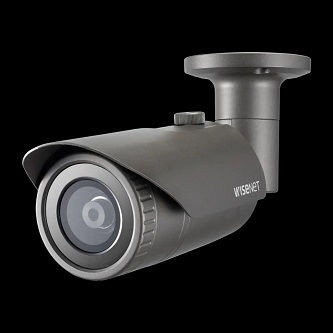
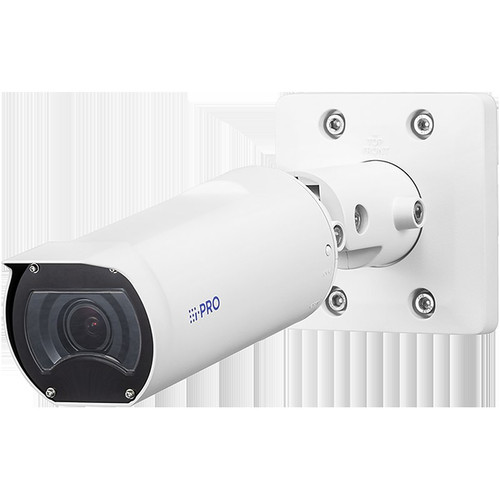
The QNO-8010R ships in a dark-grey aluminum housing measuring ø70.0×246.0mm and weighing 680g (1.50 lb), and supports a back-box accessory (SBO-100B1). The WV-U15501-V3L dimensions are 112.5mm (W) × 112.5mm (H) × 298.5mm (D); weight is not stated in the provided specs. The i-PRO unit is notably wider in cross-section. Pan/tilt/rotate adjustment ranges are specified for the QNO-8010R (0°–360° pan, 0°–100° tilt, 0°–360° rotate); equivalent adjustment ranges for the i-PRO are not provided in the supplied specs.
Which fits your VMS and analytics better?
Both cameras declare ONVIF Profile S, G, and T compliance. The QNO-8010R also exposes Hanwha's SUNAPI (HTTP API) and the Wisenet Open Platform, offering deeper integration hooks for Wisenet-native VMS environments such as Wisenet WAVE or SSM. The i-PRO WV-U15501-V3L does not list a proprietary API in the provided specs. On analytics, the QNO-8010R offers a broader declared edge-analytics set: motion detection with 4 polygonal zones, tampering, defocus detection, virtual line crossing/direction, and virtual area intrusion/enter/exit. The i-PRO lists VMD (Video Motion Detection) and Scene Change Detection; additional analytics beyond those are not specified in the supplied data.
The QNO-8010R includes one alarm input and one alarm output, supports micro SD/SDHC/SDXC up to 128GB for onboard recording, and specifies 512MB RAM / 256MB flash. Audio input is listed for the WV-U15501-V3L; audio capability for the QNO-8010R is not stated in the provided specs. The WV-U15501-V3L's onboard storage capability is not stated in the provided specs. A significant cybersecurity differentiator for the i-PRO is its FIPS 140-3 Level 3 certified SecureElement (EdgeLock® SE052F) and declared NDAA compliance — neither of which is cited for the QNO-8010R in the provided specs. The QNO-8010R details firmware encryption, 802.1X authentication, AES encryption, SRTP, and a device certificate scheme under Hanwha's private root CA.
Which should you choose: the QNO-8010R or the U15501-V3L?
Our take: The QNO-8010R is the stronger choice when analytics depth, wider operating temperature tolerance (+55°C vs +50°C), and edge storage are priorities within a Hanwha/Wisenet VMS ecosystem. It delivers 4 polygonal motion zones plus virtual line and area analytics versus the i-PRO's VMD and scene change only, supports up to 128GB micro SD onboard, and exposes SUNAPI for custom integrations. The WV-U15501-V3L is the stronger choice when low-light color sensitivity (0.07 lux vs 0.15 lux), extended IR reach (28m vs 20m), optical zoom flexibility (3.2× vs fixed 2.8mm), NDAA compliance, and FIPS 140-3 Level 3 hardware-level cybersecurity are the governing requirements. If the deployment is a federal, critical-infrastructure, or zero-trust environment where supply-chain and cryptographic certifications are mandatory, the i-PRO's SecureElement is a decisive specification the QNO-8010R does not match in the provided data.
Side-by-Side Comparison
Spec-for-spec, from manufacturer data.
| Specification | Hanwha QNO-8010R | i-PRO U15501-V3L |
|---|---|---|
| Resolution | 2592×1944 (5MP) | 5MP (pixel dimensions not stated in provided specs) |
| Image Sensor | 1/2.8" CMOS | 1/2.8" |
| Lens / Focal Length | 2.8mm fixed | 3.2× optical zoom (focal length range not stated) |
| Max Aperture | F2.0 | F1.6 (stated in illumination spec; not separately declared) |
| Horizontal FOV | 105° | — |
| Min Illumination (Color) | 0.15 lux | 0.07 lux (F1.6, 1/30s, AGC 11) |
| Min Illumination (B&W / IR) | 0 lux (IR on) | 0 lux (IR on, monochrome) |
| IR Range | 20m (65.6ft) @ 850nm | 28m (92ft) |
| WDR | 120dB | Super Dynamic, max 120dB (0–31 levels) |
| Max Frame Rate | 30fps @ 5MP | 30fps |
| Video Compression | H.265 / H.264 / MJPEG | H.265 / H.264 / MJPEG |
| IP Rating | IP66 | IP66 |
| IK / Impact Rating | IK10 | IK10 |
| Operating Temperature | -30°C to +55°C | -30°C to +50°C |
| Power Input / PoE | PoE IEEE 802.3af, Class 3; max 7.5W | PoE IEEE 802.3af; power consumption not stated |
| ONVIF Profiles | Profile S / G / T | Profile G / S / T |
| Edge Analytics | Motion (4 polygonal zones), tampering, defocus, virtual line/area intrusion | VMD, Scene Change Detection |
| Alarm I/O | 1 input / 1 output | — |
| Audio | — | Audio input |
| Edge Storage | Micro SD/SDHC/SDXC, 1 slot, up to 128GB (encrypted) | — |
| Cybersecurity Certifications | Firmware encryption, AES, 802.1X, SRTP, device certificate | FIPS 140-3 Level 3 SecureElement; NDAA Compliant |
| Dimensions | ø70.0×246.0mm | 112.5mm (W) × 112.5mm (H) × 298.5mm (D) |
| Weight | 680g (1.50 lb) | — |
| Warranty | 3-year | — |
Frequently Asked Questions
Which should you choose: the QNO-8010R or the U15501-V3L?
The QNO-8010R is the stronger choice when analytics depth, wider operating temperature tolerance (+55°C vs +50°C), and edge storage are priorities within a Hanwha/Wisenet VMS ecosystem. It delivers 4 polygonal motion zones plus virtual line and area analytics versus the i-PRO's VMD and scene change only, supports up to 128GB micro SD onboard, and exposes SUNAPI for custom integrations. The WV-U15501-V3L is the stronger choice when low-light color sensitivity (0.07 lux vs 0.15 lux), extended IR reach (28m vs 20m), optical zoom flexibility (3.2× vs fixed 2.8mm), NDAA compliance, and FIPS 140-3 Level 3 hardware-level cybersecurity are the governing requirements. If the deployment is a federal, critical-infrastructure, or zero-trust environment where supply-chain and cryptographic certifications are mandatory, the i-PRO's SecureElement is a decisive specification the QNO-8010R does not match in the provided data.
Is the QNO-8010R or WV-U15501-V3L better for low-light performance?
The WV-U15501-V3L has an edge in low-light color sensitivity, rated at 0.07 lux color (F1.6) versus the QNO-8010R's 0.15 lux color. Its IR illumination also reaches 28m compared to 20m on the QNO-8010R. Both cameras achieve 0 lux monochrome with IR active. The i-PRO's faster F1.6 aperture (inferred from its illumination spec) contributes to its color low-light advantage.
Which camera is better suited for a federal or NDAA-compliant deployment?
The i-PRO WV-U15501-V3L specifies NDAA compliance and carries a FIPS 140-3 Level 3 certified SecureElement (EdgeLock® SE052F). Neither NDAA compliance nor FIPS certification is listed for the QNO-8010R in the provided specifications. For procurements governed by NDAA Section 889 or federal cybersecurity standards, the WV-U15501-V3L satisfies requirements the QNO-8010R cannot be confirmed to meet based on available data.
Does the QNO-8010R or WV-U15501-V3L support onboard SD card storage?
The QNO-8010R explicitly supports a single micro SD/SDHC/SDXC card slot up to 128GB with SD card partition encryption. Onboard storage capability for the WV-U15501-V3L is not stated in the provided specifications, so that feature cannot be confirmed for the i-PRO model based on available data.
Get a Second Opinion on Your Camera Choice
Share your site layout, coverage goals, and budget. Our team will validate the camera selection, flag anything we would change, and recommend products that match the use case.