
Hanwha QND-6082R1 vs Hanwha QNV-6082R1: Specification Comparison
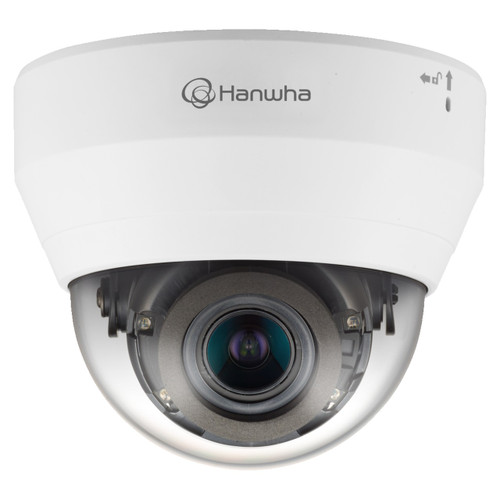
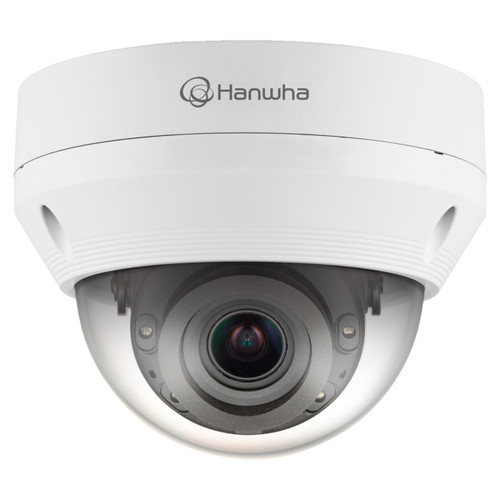
The Hanwha QND-6082R1 and QNV-6082R1 are both 2MP (1920×1080) fixed motorized-varifocal dome cameras from the Wisenet Q series, sharing the same imaging core, lens, codec stack, and PoE power scheme. The key differentiator is deployment environment: the QND-6082R1 is an indoor dome in a plastic housing, while the QNV-6082R1 is a vandal-resistant outdoor dome in an aluminum housing with IP66 and IK10 ratings. Installers and IT buyers choosing between them are effectively deciding whether the deployment site demands weatherproof, impact-rated protection.
In This Guide
How do the imaging specs compare?
Both cameras use an identical 1/2.8-inch 2MP CMOS sensor delivering 1920×1080 at up to 30fps. The lens is the same 3.2–10mm (3.1×) motorized varifocal with DC auto iris, aperture F1.6 (Wide) to F2.9 (Tele), and identical angular field of view (H: 109.0°, V: 57.4°). Minimum illumination is identical at 0.03 Lux color and 0 Lux in IR mode. Both support 120dB WDR, SSNR digital noise reduction, BLC, SSDR, Auto ICR day/night switching, and WiseStream II smart codec.
The one imaging-tier difference is IR range: the QND-6082R1 is rated at 20m (65.62ft), while the QNV-6082R1 is rated at 30m (98.42ft). DORI performance (Detect/Observe/Recognize/Identify distances at Wide and Tele) is listed identically for both models in the provided specs. Neither model lists audio input or output, digital image stabilization, or defog in the supplied specifications.
What about installation and environment?
The QNV-6082R1 is IP66-rated (dust-tight, protected against powerful water jets) and IK10-rated (impact-resistant to 20J), housed in aluminum, and specified for an operating temperature range of -30°C to +55°C. The QND-6082R1 carries no IP or IK rating per its provided specifications, is housed in plastic, and is rated for -10°C to +55°C operation — a 20-degree Celsius narrower cold-side range. The QNV-6082R1 is explicitly categorized as outdoor-ready; the QND-6082R1 is categorized as indoor only.
Both cameras draw PoE (IEEE 802.3af, Class 3) or 12VDC at a maximum of 7.70W, and both use RJ-45 (10/100BASE-T) Ethernet. The QNV-6082R1 is larger and heavier (Ø137.0×106.1mm, 710g / 1.57 lb) versus the QND-6082R1 (Ø119.8×98.8mm, 320g / 0.71 lb), and lists conduit-hole compatibility (Single, Double, 4" Octagon), a hanging mount accessory (SBP-301HMW2), and a backbox (SBV-136BW). The QND-6082R1 does not list conduit, hanging mount, or backbox options in the provided specifications.
Which fits your VMS and analytics better?
Both cameras are functionally identical at the integration layer. Each supports ONVIF Profile S/G/T, SUNAPI (HTTP API), and the Wisenet open platform. Video compression covers H.265/H.264 (Main/High) and MJPEG with CBR/VBR bitrate control. Streaming supports unicast (up to 6 users), multicast, and up to 3 simultaneous profiles. The protocol stack is identical: IPv4/IPv6, RTSP, HTTPS/SSL, SNMPv1/v2c/v3, 802.1X (EAP-TLS, EAP-LEAP), UPnP, Bonjour, LLDP, and others.
Edge analytics are the same on both: defocus detection, directional detection, motion detection (4 polygonal zones), Enter/Exit, tampering, and virtual line. Privacy masking supports 6 rectangular zones on each. On-board storage is Micro SD/SDHC/SDXC up to 128GB (1 slot) on both. Neither model lists audio input or audio output in the provided specifications. Alarm I/O is 1 input / 1 output on each, with identical trigger and event options. Warranty is 3 years for both.
Which should you choose: the QND-6082R1 or the QNV-6082R1?
Our take: The QND-6082R1 is the stronger choice when the deployment is strictly indoor, weight and housing size are constraints, or the installation budget does not require weatherproofing. The QNV-6082R1 is the required choice for any outdoor or harsh-environment deployment. Three concrete spec deltas drive the decision: (1) IR range — QNV-6082R1 reaches 30m versus the QND-6082R1's 20m, a 50% increase relevant in parking lots or perimeter corridors; (2) environmental protection — QNV-6082R1 is rated IP66 and IK10 while the QND-6082R1 has no listed IP or IK rating; (3) cold-temperature tolerance — QNV-6082R1 operates to -30°C versus the QND-6082R1's -10°C lower limit, a critical delta in unheated exterior enclosures. Imaging core, lens, codec, analytics, and VMS integration are otherwise identical, so platform compatibility is a non-factor in the selection.
Side-by-Side Comparison
Spec-for-spec, from manufacturer data.
| Specification | Hanwha QND-6082R1 | Hanwha QNV-6082R1 |
|---|---|---|
| Resolution | 1920×1080 | 1920×1080 |
| Image Sensor | 1/2.8" 2MP CMOS | 1/2.8" 2MP CMOS |
| Lens / Focal Length | 3.2–10mm (3.1×) motorized varifocal | 3.2–10mm (3.1×) motorized varifocal |
| Max Aperture | F1.6 (Wide) / F2.9 (Tele) | F1.6 (Wide) / F2.9 (Tele) |
| Min Illumination | 0.03 Lux color / 0 Lux IR | 0.03 Lux color / 0 Lux IR |
| IR Range | 20m (65.62ft) | 30m (98.42ft) |
| Wide Dynamic Range | 120dB | 120dB |
| Max Frame Rate | 30fps | 30fps |
| Video Compression | H.265 / H.264 / MJPEG | H.265 / H.264 / MJPEG |
| IP Rating | — | IP66 |
| IK / Impact Rating | — | IK10 |
| Operating Temperature | -10°C ~ +55°C | -30°C ~ +55°C |
| Power Input / PoE Class | PoE 802.3af Class 3 / 12VDC | PoE 802.3af Class 3 / 12VDC |
| Max Power | 7.70W | 7.70W |
| Housing Material | Plastic | Aluminum |
| Edge Storage | MicroSD/SDHC/SDXC up to 128GB | MicroSD/SDHC/SDXC up to 128GB |
| Dimensions | Ø119.8×98.8mm (Ø4.72×3.89") | Ø137.0×106.1mm (Ø5.39×4.18") |
| Weight | 320g (0.71 lb) | 710g (1.57 lb) |
| Warranty | 3 years | 3 years |
Frequently Asked Questions
Which should you choose: the QND-6082R1 or the QNV-6082R1?
The QND-6082R1 is the stronger choice when the deployment is strictly indoor, weight and housing size are constraints, or the installation budget does not require weatherproofing. The QNV-6082R1 is the required choice for any outdoor or harsh-environment deployment. Three concrete spec deltas drive the decision: (1) IR range — QNV-6082R1 reaches 30m versus the QND-6082R1's 20m, a 50% increase relevant in parking lots or perimeter corridors; (2) environmental protection — QNV-6082R1 is rated IP66 and IK10 while the QND-6082R1 has no listed IP or IK rating; (3) cold-temperature tolerance — QNV-6082R1 operates to -30°C versus the QND-6082R1's -10°C lower limit, a critical delta in unheated exterior enclosures. Imaging core, lens, codec, analytics, and VMS integration are otherwise identical, so platform compatibility is a non-factor in the selection.
Is the QND-6082R1 or QNV-6082R1 better for low-light performance?
Both cameras are identical in low-light imaging: the same 1/2.8-inch sensor, 0.03 Lux color minimum illumination, and 0 Lux in IR mode with Auto ICR. The QNV-6082R1 does have a longer IR illuminator range (30m vs 20m), so it can reveal subjects at greater distances in darkness, but the sensitivity floor of the sensor is the same on both.
Can the QND-6082R1 be used outdoors?
Based on the provided specifications, no. The QND-6082R1 carries no IP or IK rating in its spec sheet and is categorized as an indoor camera. The QNV-6082R1, by contrast, is rated IP66 (weatherproof) and IK10 (vandal-resistant) in an aluminum housing, and is explicitly listed as outdoor-ready.
Do the QND-6082R1 and QNV-6082R1 work with the same VMS platforms?
Yes — both cameras support ONVIF Profile S/G/T, SUNAPI (HTTP API), and the Wisenet open platform, and share an identical protocol and security stack. Any VMS or NVR compatible with one will be compatible with the other at the integration level.
Get a Second Opinion on Your Camera Choice
Share your site layout, coverage goals, and budget. Our team will validate the camera selection, flag anything we would change, and recommend products that match the use case.