
Hanwha PRN-3200B2 vs Hanwha XRN-3220B4: Specification Comparison
The Hanwha PRN-3200B2 and XRN-3220B4 are both 32-channel, Linux-based enterprise NVRs from Hanwha's Wisenet lineup, supporting up to 32MP camera inputs with H.265/H.264/MJPEG compression, dual HDMI output, RAID 5/6 redundancy, N+1 failover, and ARB. A buyer evaluating either unit is looking at a rack-mount recorder for medium-to-large IP camera deployments. The key differentiators lie in recording bandwidth, raw storage capacity, HDD bay count, chassis size, and power draw — all of which are covered in the sections below.

In This Guide
- Which NVR delivers higher recording bandwidth and storage capacity for growing deployments?
- How do the two units compare in physical footprint, power consumption, and operating environment?
- Which unit offers broader integration, AI analytics, and remote management capabilities?
- Which should you choose: the PRN-3200B2 or the XRN-3220B4?
- Side-by-Side Specs
- FAQ
Which NVR delivers higher recording bandwidth and storage capacity for growing deployments?
Recording bandwidth is one of the most critical specs for multi-camera, high-resolution deployments. The XRN-3220B4 is rated at up to 520 Mbps, versus 400 Mbps for the PRN-3200B2 — a 30% advantage that directly translates to more headroom for high-bitrate 4K/8K streams, analytics overlays, or dual-stream configurations without throttling.
Storage capacity diverges even more sharply. The XRN-3220B4 ships with 16 SATA bays supporting up to 160TB in non-RAID mode with hot-swap capability, while the PRN-3200B2 provides 8 SATA bays for a maximum of 80TB. Both units cap individual drives at 10TB and support iSCSI external expansion. RAID implementation also differs: the XRN-3220B4 supports two independent 8-HDD arrays (RAID 5/6), whereas the PRN-3200B2 is limited to a single array. The PRN-3200B2 specifies RAID-mode playback bandwidth at 64 Mbps and non-RAID at 32 Mbps; the XRN-3220B4 specifies playback bandwidth at up to 200 Mbps across 32 simultaneous channels — a significant operational difference for large-scale retrieval.
Playback concurrency is identical at 80 channels maximum (local 32CH, remote 16CH per user, up to 3 remote users). Both units support simultaneous fisheye dewarping on 1 local channel and via CMS.
How do the two units compare in physical footprint, power consumption, and operating environment?
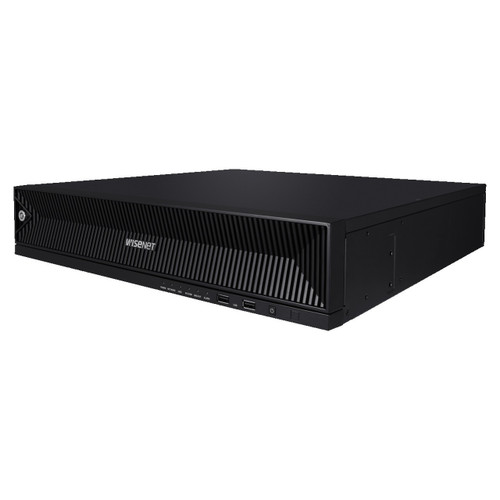
The XRN-3220B4 is a physically larger and heavier unit: 440.0 × 132.0 × 571.1 mm and approximately 14 kg (30.9 lb) without HDDs. The PRN-3200B2 measures 438 × 86 × 434.9 mm and weighs approximately 9.1 kg (20.1 lb) without HDDs. The XRN-3220B4 occupies roughly 3U of rack space based on its 132 mm height, while the PRN-3200B2 fits in approximately 2U at 86 mm — a meaningful difference in constrained rack environments.
Power draw follows suit. The XRN-3220B4 is rated at a maximum of 265W with 16 HDDs installed (904.2 BTU), powered by a single SMPS at 100–240 VAC, 2.7A. The PRN-3200B2 draws a maximum of 205W with 8 HDDs at 100–240 VAC, 2.1A. Both operate across identical environmental ranges: 0°C to +40°C and 20%–85% RH non-condensing. Both chassis are black metal construction.
The PRN-3200B2 spec includes an HDD key lock feature on the front panel, which is not listed in the XRN-3220B4 spec. The XRN-3220B4 specifies hot-swap HDD capability; the PRN-3200B2 does not list hot-swap in its provided specifications.
Which unit offers broader integration, AI analytics, and remote management capabilities?
Both NVRs share a common Wisenet protocol foundation — SUNAPI and ONVIF Profile-S — and support the same remote access stack: Webviewer (Chrome, Edge, Safari), Wisenet mobile (iOS/Android), RTP/RTSP/SUNAPI for smartphone clients, and P2P via QR code. Maximum remote user counts are identical: 3 search, 10 live unicast, 20 multicast. Security features on both include IP filtering, user access logging, 802.1x, and encryption; the PRN-3200B2 spec additionally lists a Hanwha Techwin Root CA device certificate and signed firmware — these are not enumerated in the XRN-3220B4 provided spec.
AI search is explicitly detailed for the PRN-3200B2: object attributes cover human, face, vehicle, and license plate, with LPR support for English and numeric plates via Wisenet AI/P/X cameras. The XRN-3220B4 spec states only 'Compatible for Hanwha AI Camera' without enumerating specific object attributes or LPR capability — this does not confirm absence, but the detail is absent from the provided specification.
Web viewer OS support differs slightly: the PRN-3200B2 lists Windows 10 and macOS 10.13; the XRN-3220B4 specifies Windows 10 or higher and macOS 13.5.2 or higher, indicating a more current minimum macOS baseline. The PRN-3200B2 camera setup menu includes Hallway View configuration, which is not listed in the XRN-3220B4 spec. PTZ control via the SPC-2000 hardware controller is listed for the PRN-3200B2; this is not specified for the XRN-3220B4. Both support 300 PTZ presets and N+1 failover with ARB.
Which should you choose: the PRN-3200B2 or the XRN-3220B4?
Our take: The PRN-3200B2 is the stronger choice when rack space is constrained, AI search detail matters, and 80TB of on-board storage is sufficient. For deployments that need maximum on-board capacity and recording throughput headroom, the XRN-3220B4 is the appropriate selection. Three concrete spec deltas define the trade-off: (1) recording bandwidth — 520 Mbps (XRN-3220B4) versus 400 Mbps (PRN-3200B2), a 30% margin that matters in dense 4K/8K multi-stream environments; (2) storage — 16 SATA bays and 160TB max (XRN-3220B4) versus 8 bays and 80TB (PRN-3200B2), with hot-swap available only on the XRN-3220B4; (3) playback bandwidth — 200 Mbps on the XRN-3220B4 versus 64 Mbps RAID / 32 Mbps non-RAID on the PRN-3200B2. The PRN-3200B2 offsets those gaps with a documented 2U footprint, 60W lower peak power draw, explicitly detailed AI/LPR search attributes, and SPC-2000 controller support. Buyers on an existing Wisenet AI camera platform who have confirmed AI search requirements should verify XRN-3220B4 AI attribute support with Hanwha before committing.
Side-by-Side Comparison
Spec-for-spec, from manufacturer data.
| Specification | Hanwha PRN-3200B2 | Hanwha XRN-3220B4 |
|---|---|---|
| Camera Channels | 32CH max | 32CH max |
| Max Input Resolution | 32MP | 32MP |
| Recording Bandwidth | 400 Mbps | 520 Mbps |
| Playback Bandwidth | 64 Mbps (RAID) / 32 Mbps (non-RAID) | 200 Mbps (32CH simultaneous) |
| HDD Bays | 8 x SATA | 16 x SATA |
| Max On-Board Storage | 80TB (non-RAID) | 160TB (non-RAID) |
| Hot-Swap HDD | — | Yes |
| RAID Support | RAID 5/6 (1 array, 8 HDDs) | RAID 5/6 (2 arrays, 8 HDDs each) |
| External Storage | iSCSI | iSCSI |
| Display Output | 2x HDMI: 4K@30Hz + 1080p@60Hz | 2x HDMI: 4K@30Hz + 1080p@60Hz |
| Max Display Divisions | 36 | 32 |
| AI Search Attributes | Human, Face, Vehicle, License Plate + LPR | Compatible with Hanwha AI Camera (detail not specified in provided spec) |
| Video Compression | H.265, H.264, MJPEG | H.265, H.264, MJPEG |
| Peak Power (full HDDs) | 205W (8x 10TB) | 265W (16x 10TB) |
| Chassis Size (WxHxD mm) | 438 x 86 x 434.9 | 440.0 x 132.0 x 571.1 |
| Weight (no HDDs) | 9.1 kg (20.1 lb) | 14.0 kg (30.9 lb) |
Frequently Asked Questions
Which should you choose: the PRN-3200B2 or the XRN-3220B4?
The PRN-3200B2 is the stronger choice when rack space is constrained, AI search detail matters, and 80TB of on-board storage is sufficient. For deployments that need maximum on-board capacity and recording throughput headroom, the XRN-3220B4 is the appropriate selection. Three concrete spec deltas define the trade-off: (1) recording bandwidth — 520 Mbps (XRN-3220B4) versus 400 Mbps (PRN-3200B2), a 30% margin that matters in dense 4K/8K multi-stream environments; (2) storage — 16 SATA bays and 160TB max (XRN-3220B4) versus 8 bays and 80TB (PRN-3200B2), with hot-swap available only on the XRN-3220B4; (3) playback bandwidth — 200 Mbps on the XRN-3220B4 versus 64 Mbps RAID / 32 Mbps non-RAID on the PRN-3200B2. The PRN-3200B2 offsets those gaps with a documented 2U footprint, 60W lower peak power draw, explicitly detailed AI/LPR search attributes, and SPC-2000 controller support. Buyers on an existing Wisenet AI camera platform who have confirmed AI search requirements should verify XRN-3220B4 AI attribute support with Hanwha before committing.
Is the PRN-3200B2 or XRN-3220B4 better for larger deployments with more cameras and longer retention?
For maximum on-board retention, the XRN-3220B4 is the clear choice: 16 SATA bays support up to 160TB versus the PRN-3200B2's 8 bays and 80TB ceiling. The XRN-3220B4 also supports two independent RAID 5/6 arrays (8 HDDs each), providing greater redundancy flexibility. Both units accept up to 32 camera channels and expand via iSCSI, so channel count is not a differentiator — storage volume is.
Which NVR handles high-bitrate 4K and 8K camera streams better without dropping frames?
The XRN-3220B4 is rated at 520 Mbps recording bandwidth, compared to 400 Mbps on the PRN-3200B2. In a fully loaded 32-channel deployment with high-bitrate 4K or 8K cameras, the additional 120 Mbps headroom on the XRN-3220B4 reduces the risk of bandwidth saturation. Both units decode to 32MP at 15fps and 12MP at 30fps, so decoding capability at the display layer is equivalent based on the provided specs.
Does the PRN-3200B2 or XRN-3220B4 include AI video analytics for searching recorded footage?
The PRN-3200B2 specification explicitly lists AI search attributes — human, face, vehicle, and license plate — with LPR support for English and numeric plates on Wisenet AI, P, and X series cameras. The XRN-3220B4 specification states compatibility with Hanwha AI cameras but does not enumerate specific searchable object attributes or LPR capability in the provided spec sheet. Buyers requiring confirmed AI search functionality should request the full XRN-3220B4 AI feature list from Hanwha before selecting that unit.
Get a Second Opinion on Your Camera Choice
Share your site layout, coverage goals, and budget. Our team will validate the camera selection, flag anything we would change, and recommend products that match the use case.