
Hanwha PNM-12082RVD vs Hanwha XNV-8083R: Specification Comparison
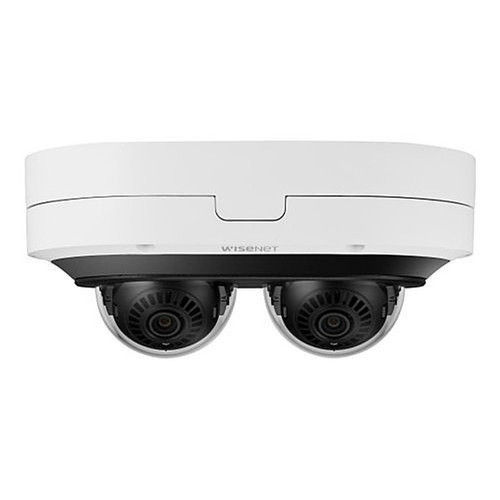
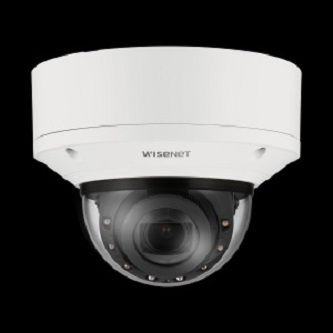
Both the Hanwha PNM-12082RVD and XNV-8083R are 6MP outdoor vandal dome cameras sharing PoE+ power, IK10 impact resistance, IP66 weatherproofing, motorized varifocal lenses, and 120dB extremeWDR — a pairing installers will genuinely cross-shop for perimeter and general-surveillance applications. The key differentiators are the PNM-12082RVD's dual-channel architecture and shorter IR throw versus the XNV-8083R's single-channel design with a longer IR range, higher frame rate, deeper operating temperature envelope, built-in AI analytics, and native audio I/O.
In This Guide
How do the imaging specs compare?
Both cameras deliver 6MP resolution at 3328×1872. The PNM-12082RVD uses a 1/2.8" sensor and is rated at 15 fps maximum at full resolution, while the XNV-8083R uses a larger 1/1.8" progressive CMOS sensor and achieves 30 fps at the same resolution — a 2× frame-rate advantage that matters for moving-target capture. Minimum illumination also favors the XNV-8083R: 0.04 lux color / 0 lux IR versus the PNM-12082RVD's 0.16 lux color / 0.016 lux B/W / 0 lux IR. Lenses differ meaningfully: the PNM-12082RVD covers 3.54–6.69mm (1.9× optical zoom) while the XNV-8083R spans 4.4–9.3mm (2.1× optical zoom) with a P-iris design for tighter aperture control. Both cameras are rated for 120dB extremeWDR.
IR performance is a major split: the XNV-8083R specifies WiseIR at 50m (164 ft), whereas the PNM-12082RVD lists 25m (82 ft) IR range per specs — and separately notes a 1.5m value under the IR Distance field, which appears to be a minimum object distance or mounting offset rather than throw. Buyers requiring long-range night coverage should weight the XNV-8083R's 50m WiseIR specification. The PNM-12082RVD's primary differentiator is its dual-channel (2-channel) architecture, which allows two independent 6MP streams simultaneously from a single PoE+ drop — a meaningful advantage for coverage density in multi-zone installations.
What about installation and environment?
Both cameras share IP66 and NEMA 4X ratings; the XNV-8083R adds IP67 and IP6K9K certifications, and its IK rating is listed as IK10+ versus the PNM-12082RVD's IK10. Both ship in white aluminum housings. The XNV-8083R measures Ø180×125mm and weighs 1,900g; the PNM-12082RVD's physical dimensions and weight are not specified in the provided data.
Operating temperature is a significant differentiator: the XNV-8083R is rated −50°C to +55°C, versus the PNM-12082RVD's −10°C to +50°C. For installations in cold climates (below −10°C), only the XNV-8083R is rated. Both cameras accept PoE+ (IEEE 802.3at, Class 4); the XNV-8083R also accepts 12VDC as an alternative input. Maximum power draw is specified at 22.5W for the XNV-8083R; the PNM-12082RVD's maximum wattage is not stated in the provided specs. The PNM-12082RVD supports ceiling, wall, and pendant mounting per specs; the XNV-8083R's mounting options are not enumerated in the provided data.
Which fits your VMS and analytics better?
Both cameras support ONVIF Profile S and T and H.265/H.264/MJPEG compression. The XNV-8083R additionally declares ONVIF Profile G, SUNAPI (HTTP API), and the Wisenet open platform. The XNV-8083R carries an AI-engine analytics suite covering object detection (person, face, vehicle types, license plate), IVA (virtual line, area, enter/exit, loitering, intrusion, appear/disappear), defocus detection, people counting, queue management, and heatmap — none of these analytics functions are listed in the PNM-12082RVD's provided specs. The XNV-8083R supports WiseStream II/III smart codec and up to 10 streaming profiles with 3 virtual channels; the PNM-12082RVD provides dual-channel (2-channel) streaming.
Audio is native on the XNV-8083R with selectable mic/line input (2.5VDC supply), line output (1Vrms max), and G.711/G.726 compression; the PNM-12082RVD routes audio only via an optional external I/O box. Edge storage also differs: the XNV-8083R provides two microSD/SDHC/SDXC slots supporting up to 1TB (512GB×2), while the PNM-12082RVD provides a single microSD slot. Both cameras include TPM 2.0 (FIPS 140-2) cybersecurity, encrypted firmware, secure boot, and signed firmware. The XNV-8083R specifies 2 configurable alarm I/O ports with 12VDC output; the PNM-12082RVD's alarm I/O is not stated in the provided specs.
Which should you choose: the PNM-12082RVD or the XNV-8083R?
Our take: The XNV-8083R is the stronger single-channel choice when frame rate, IR range, cold-weather deployment, or on-board analytics are priorities. It delivers 30 fps versus the PNM-12082RVD's 15 fps at the same 6MP resolution, extends IR coverage to 50m versus 25m, and operates from −50°C versus −10°C — a critical gap for unheated outdoor enclosures in cold climates. Its built-in AI analytics engine (object detection, IVA, people counting) and dual microSD slot (up to 1TB) add capability the PNM-12082RVD's provided specs do not match, and it carries a native audio path. The PNM-12082RVD is the stronger choice where coverage density is the constraint: its dual-channel architecture delivers two independent 6MP streams over a single PoE+ cable, halving cabling cost in multi-zone applications. Choose the PNM-12082RVD for dual-zone single-drop efficiency; choose the XNV-8083R for superior low-light performance, AI-driven event detection, extreme-temperature resilience, and deeper VMS integration. Note the PNM-12082RVD carries a 5-year warranty versus the XNV-8083R's 3-year warranty.
Side-by-Side Comparison
Spec-for-spec, from manufacturer data.
| Specification | Hanwha PNM-12082RVD | Hanwha XNV-8083R |
|---|---|---|
| Resolution | 6MP (3328×1872) | 6MP (3328×1872) |
| Image Sensor | 1/2.8" CMOS | 1/1.8" progressive CMOS |
| Max Frame Rate | 15 fps @ 6MP | 30 fps @ 6MP |
| Lens / Focal Length | Motorized varifocal 3.54–6.69mm (1.9× zoom) | Motorized varifocal 4.4–9.3mm (2.1× zoom), P-iris |
| Min. Illumination | 0.16 lux (color); 0.016 lux (B/W); 0 lux (IR on) | 0.04 lux (color); 0 lux (IR on) |
| IR Range | 25m (82 ft) | WiseIR 50m (164 ft) |
| WDR | extremeWDR 120dB | extremeWDR 120dB |
| Channels | 2 (dual-channel) | 1 |
| Video Compression | H.265, H.264, MJPEG | H.265, H.264, MJPEG |
| IP Rating | IP66 / IP67 / NEMA 4X | IP66 / IP67 / IP6K9K / NEMA 4X |
| IK / Impact Rating | IK10 | IK10+ |
| Operating Temperature | −10°C to +50°C | −50°C to +55°C |
| Power Input / PoE Class | PoE+ (802.3at), Class 4 | PoE+ (802.3at), Class 4; also 12VDC |
| Max Power Draw | Not specified | 22.5W |
| Edge Storage | 1× microSD slot | 2× microSD/SDHC/SDXC slots, up to 1TB |
| Audio | Via optional external I/O box only | Built-in mic/line input; line output; G.711/G.726 |
| AI / Analytics | Not specified in provided specs | Object detection, IVA, people counting, queue mgmt, heatmap |
| ONVIF Profiles | Profile S, T | Profile S, G, T |
| Alarm I/O | Not specified in provided specs | 2 configurable I/O ports, 12VDC output (max 50mA) |
| Cybersecurity | TPM 2.0 (FIPS 140-2); Secure boot; Signed firmware | TPM 2.0 (FIPS 140-2 level 2); Secure boot; 802.1X; Device Certificate |
| RAM / Flash | 4GB RAM; 512MB Flash | 4GB RAM; 512MB Flash |
| Housing Material | Aluminum, White | Aluminum, Hard-coated dome bubble, White (RAL9003) |
| Dimensions | Not specified | Ø180×125mm (7.09×4.92") |
| Weight | Not specified | 1,900g (4.19 lb) |
| Warranty | 5-year | 3-year |
Frequently Asked Questions
Which should you choose: the PNM-12082RVD or the XNV-8083R?
The XNV-8083R is the stronger single-channel choice when frame rate, IR range, cold-weather deployment, or on-board analytics are priorities. It delivers 30 fps versus the PNM-12082RVD's 15 fps at the same 6MP resolution, extends IR coverage to 50m versus 25m, and operates from −50°C versus −10°C — a critical gap for unheated outdoor enclosures in cold climates. Its built-in AI analytics engine (object detection, IVA, people counting) and dual microSD slot (up to 1TB) add capability the PNM-12082RVD's provided specs do not match, and it carries a native audio path. The PNM-12082RVD is the stronger choice where coverage density is the constraint: its dual-channel architecture delivers two independent 6MP streams over a single PoE+ cable, halving cabling cost in multi-zone applications. Choose the PNM-12082RVD for dual-zone single-drop efficiency; choose the XNV-8083R for superior low-light performance, AI-driven event detection, extreme-temperature resilience, and deeper VMS integration. Note the PNM-12082RVD carries a 5-year warranty versus the XNV-8083R's 3-year warranty.
Is the PNM-12082RVD or XNV-8083R better for low-light performance?
Based on the provided specifications, the XNV-8083R has a lower minimum illumination rating (0.04 lux color / 0 lux IR) compared to the PNM-12082RVD (0.16 lux color / 0.016 lux B/W / 0 lux IR), and it uses a larger 1/1.8" sensor versus the PNM-12082RVD's 1/2.8" sensor. The XNV-8083R also specifies a longer IR throw of 50m (164 ft) versus 25m (82 ft) for the PNM-12082RVD. For low-light and long-range night applications, the XNV-8083R's specs indicate an advantage.
Can I use the PNM-12082RVD to cover two separate zones with one camera?
Yes. The PNM-12082RVD is specified as a dual-channel camera supporting up to 2 simultaneous independent 6MP streams from a single PoE+ connection. This allows it to serve two monitoring zones from one installation point, which can reduce cabling and switch-port costs compared to deploying two separate single-channel cameras. The XNV-8083R is a single-channel camera.
Which camera works in colder environments — the PNM-12082RVD or XNV-8083R?
The XNV-8083R is rated for operation from −50°C to +55°C per its specifications. The PNM-12082RVD is rated from −10°C to +50°C. If the installation site experiences temperatures below −10°C (14°F) — such as unheated outdoor enclosures in northern climates — only the XNV-8083R meets the operating temperature requirement based on the specs provided.
Get a Second Opinion on Your Camera Choice
Share your site layout, coverage goals, and budget. Our team will validate the camera selection, flag anything we would change, and recommend products that match the use case.