
Hanwha L7022R vs Pelco SRXE4-4V9-EBT-IR1: Specification Comparison
Both the Hanwha ANO-L7022R and the Pelco SRXE4-4V9-EBT-IR1 are 4MP (2560×1440) fixed outdoor bullet IP cameras with IR illumination and IP66 weatherproofing, making them directly cross-shoppable for perimeter and exterior surveillance applications. The comparison covers sensor size, lens flexibility, low-light performance, environmental hardening, power requirements, analytics depth, and cybersecurity posture — all derived strictly from the specifications provided for each model.
In This Guide
How do the imaging specs compare?
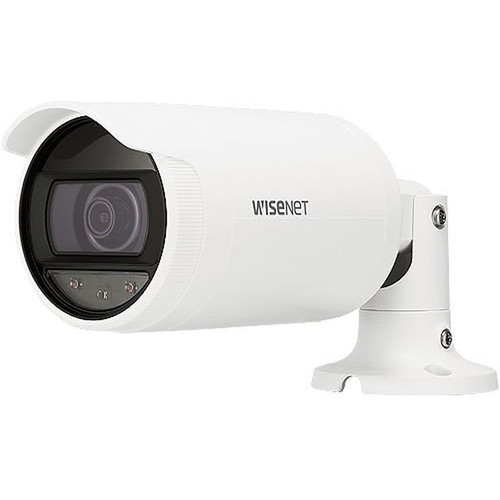
The ANO-L7022R uses a 1/3" CMOS sensor with a fixed 4mm lens at F1.6, delivering a horizontal FOV of 79° and a minimum color illumination of 0.13 Lux, dropping to 0 Lux with its 850nm IR LEDs rated to 25m (82ft). Its 120dB WDR (SSDR) and SSNR digital noise reduction handle mixed-light scenes. The camera streams at up to 30fps at full 4MP resolution. DORI detection range is 62.9m at 25PPM, with identification at 6.3m.
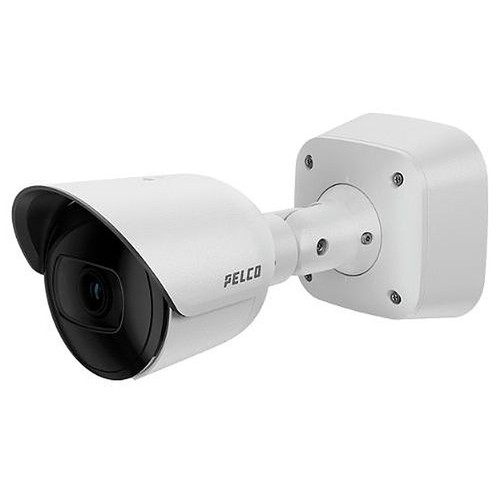
The SRXE4-4V9-EBT-IR1 uses a larger 1/1.8" progressive scan CMOS sensor — note that the provided specs also reference a 1/2.8" figure, a conflict in the source data — with a motorized varifocal lens spanning 4.4–9.3mm (a secondary spec field cites 2.8–12mm, also conflicting; the primary field value of 4.4–9.3mm is used here) at F1.4. That wider aperture and larger sensor contribute to a dramatically lower minimum color illumination of 0.003 Lux versus the Hanwha's 0.13 Lux, both reaching 0 Lux with 850nm IR. The Pelco supports up to 60fps at 4MP — double the Hanwha's maximum — and its SureVision WDR is rated at 130dB, 10dB higher than the ANO-L7022R's 120dB. DORI distances are not specified in the provided Pelco specs.
What about installation and environment?
The ANO-L7022R is rated IP66 and operates from -30°C to +55°C. It runs on standard PoE (IEEE 802.3af, Class 3) at a maximum of 7.5W, making it compatible with any 802.3af-capable switch without budget for PoE+. Its compact cylindrical form (ø78×262mm, 390g) and pan/tilt/rotate adjustability (360°/100°/360°) cover most fixed-mount orientations. Storage temperature matches operating temperature at -30°C to +55°C.
The SRXE4-4V9-EBT-IR1 offers substantially broader environmental hardening: IP66, IP67, IP68 (2m submersion for 2 hours), IPX9K high-pressure washdown, and NEMA 4X. Its impact rating is IK11 per the primary spec field (secondary fields cite IK10 and IK09 — the discrepancy exists in the source data). Operating temperature extends from -50°C to +65°C, a significantly wider range than the Hanwha's -30°C to +55°C, suited to arctic or industrial environments. Power requires PoE+ (802.3at) or 12/24 Vdc external supply — the PoE class field in the source data says Class 3, which conflicts with PoE+ (802.3at = Class 4); buyers should verify injector/switch compatibility before installation. The camera is larger at 309×133×133mm and supports wall, pole, and corner mounting. Weight is not specified in the provided Pelco specs.
Which fits your VMS and analytics better?
Both cameras support ONVIF Profile S, T, and G. The Pelco additionally carries ONVIF Profile M, which covers metadata streaming for analytics events — relevant if your VMS or PSIM platform consumes standardized analytics metadata. The ANO-L7022R exposes Hanwha's SUNAPI (HTTP API) alongside ONVIF, which integrates directly with Wisenet Wave and broader ONVIF-compliant VMS platforms. The Pelco uses Pelco's proprietary analytics engine and is presumed to integrate most deeply with VideoXpert and Pelco-ecosystem NVRs, though ONVIF Profile M extends its reach.
On analytics, the ANO-L7022R provides motion detection (4 polygonal zones), tampering, defocus detection, virtual area (intrusion/enter/exit), and virtual line (crossing/direction). The SRXE4-4V9-EBT-IR1's Smart Analytics layer adds classified object detection — Person and Vehicle — plus Direction Violation, Loitering, Beam Crossing, Crowd Detection, Audio Analytics, and Tamper Alert, representing a materially broader on-camera intelligence set. Audio is supported on the Pelco (microphone input; audio analytics listed); audio capability is not specified in the provided Hanwha specs. Both support microSD edge storage. The Pelco carries 4GB RAM and 4GB Flash versus the Hanwha's 512MB RAM and 256MB Flash, which underpins the deeper on-camera analytics processing.
Which should you choose: the L7022R or the SRXE4-4V9-EBT-IR1?
Our take: The ANO-L7022R is the stronger choice when budget, standard PoE infrastructure, and Hanwha/ONVIF VMS ecosystems are the primary constraints. The SRXE4-4V9-EBT-IR1 outperforms it in three concrete spec categories: low-light sensitivity (0.003 Lux color vs. 0.13 Lux), WDR range (130dB vs. 120dB), and maximum frame rate (60fps vs. 30fps). The Pelco also extends environmental coverage to -50°C operating temperature, IP68/IPX9K/IK11 ratings, and NDAA Section 889 / TAA compliance — critical for federal or high-abuse deployments. Its broader on-camera analytics (Person/Vehicle classification, Loitering, Crowd Detection) and ONVIF Profile M metadata streaming reduce server-side processing load. Choose the ANO-L7022R for cost-sensitive commercial installs on standard PoE switches; choose the SRXE4-4V9-EBT-IR1 for government, industrial, or high-security sites where environmental hardening, compliance certifications, and advanced analytics justify the premium.
Side-by-Side Comparison
Spec-for-spec, from manufacturer data.
| Specification | Hanwha L7022R | Pelco SRXE4-4V9-EBT-IR1 |
|---|---|---|
| Resolution | 4MP (2560×1440) | 4MP (2560×1440) |
| Sensor Size | 1/3" CMOS | 1/1.8" progressive scan CMOS (1/2.8" also listed — conflict in source) |
| Max Frame Rate | 30fps | 60fps |
| Min Illumination (Color) | 0.13 Lux | 0.003 Lux |
| Min Illumination (IR) | 0 Lux | 0 Lux |
| WDR | 120dB | 130dB SureVision |
| Lens | 4mm fixed focal | 4.4–9.3mm motorized varifocal (2.8–12mm also listed — conflict in source) |
| Aperture | F1.6 | F1.4 |
| IR Range | 25m (82ft) | Not specified in provided specs |
| IP Rating | IP66 | IP66 / IP67 / IP68 / IPX9K / NEMA 4X |
| Impact Rating | Not specified | IK11 (IK10 and IK09 also listed — conflict in source) |
| Operating Temp | -30°C to +55°C | -50°C to +65°C |
| Power | PoE 802.3af (Class 3, 7.5W max) | PoE+ 802.3at or 12/24 Vdc (PoE class field says 3 — conflict in source) |
| ONVIF Profiles | S, G, T | S, T, G, M |
| Person/Vehicle Detection | No | Yes |
| NDAA / TAA Compliant | Not specified | Yes |
| Warranty | 3 years | 5 years |
| RAM / Flash | 512MB / 256MB | 4GB / 4GB |
| Audio | Not specified | Microphone supported; Audio Analytics |
Frequently Asked Questions
Which should you choose: the L7022R or the SRXE4-4V9-EBT-IR1?
The ANO-L7022R is the stronger choice when budget, standard PoE infrastructure, and Hanwha/ONVIF VMS ecosystems are the primary constraints. The SRXE4-4V9-EBT-IR1 outperforms it in three concrete spec categories: low-light sensitivity (0.003 Lux color vs. 0.13 Lux), WDR range (130dB vs. 120dB), and maximum frame rate (60fps vs. 30fps). The Pelco also extends environmental coverage to -50°C operating temperature, IP68/IPX9K/IK11 ratings, and NDAA Section 889 / TAA compliance — critical for federal or high-abuse deployments. Its broader on-camera analytics (Person/Vehicle classification, Loitering, Crowd Detection) and ONVIF Profile M metadata streaming reduce server-side processing load. Choose the ANO-L7022R for cost-sensitive commercial installs on standard PoE switches; choose the SRXE4-4V9-EBT-IR1 for government, industrial, or high-security sites where environmental hardening, compliance certifications, and advanced analytics justify the premium.
Is the ANO-L7022R or SRXE4-4V9-EBT-IR1 better for low-light performance?
The SRXE4-4V9-EBT-IR1 is measurably better in low light. Its minimum color illumination is 0.003 Lux versus the ANO-L7022R's 0.13 Lux — a difference of roughly 43× in light sensitivity. Both reach 0 Lux with active 850nm IR illumination. The Pelco's larger 1/1.8" sensor and F1.4 aperture (vs. the Hanwha's 1/3" sensor and F1.6) directly support that advantage.
Does the ANO-L7022R work on a standard PoE switch, or do I need PoE+?
The ANO-L7022R runs on standard 802.3af PoE (Class 3, max 7.5W), so any 802.3af-capable switch port will power it. The SRXE4-4V9-EBT-IR1 requires PoE+ (802.3at), though the source spec also lists a PoE class field of 3 — a conflict in the provided data — so buyers should confirm switch compatibility with Pelco before deployment.
Which camera meets NDAA Section 889 compliance requirements?
The SRXE4-4V9-EBT-IR1 explicitly lists NDAA Section 889 and TAA compliance among its certifications, making it suitable for federal and government-funded projects subject to those procurement rules. The ANO-L7022R's provided specifications do not reference NDAA or TAA compliance.
Get a Second Opinion on Your Camera Choice
Share your site layout, coverage goals, and budget. Our team will validate the camera selection, flag anything we would change, and recommend products that match the use case.