
Hanwha HRX-434 vs Speco Technologies D4WVN8TB: Specification Comparison
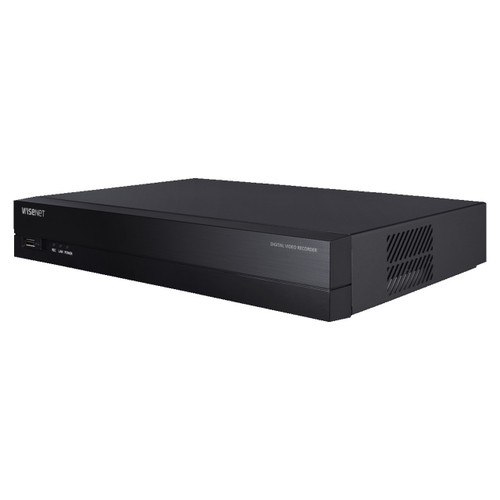
Both the Hanwha HRX-434 and the Speco D4WVN8TB are 4-channel hybrid DVRs designed to record analog coaxial camera signals in small-to-medium surveillance deployments. The HRX-434 is a rack-mount pentabrid unit supporting AHD, HDTVI, HDCVI, and CVBS alongside up to 6 IP channels, while the D4WVN8TB is a wall-mount 4K TVI-focused unit with 8TB onboard storage. This comparison examines how each product addresses channel flexibility, storage and recording performance, and remote management for installers evaluating 4-channel hybrid DVR options.
In This Guide
Which DVR offers more channel capacity and input flexibility?
The HRX-434 accepts 4 analog channels via BNC (75-ohm, 1Vp-p) and auto-detects AHD, HDTVI, HDCVI, and CVBS signal types on the same connectors — no manual per-port configuration required. Beyond analog, it extends to a maximum of 6 IP camera channels (8MP down to CIF resolution), yielding up to 10 total concurrent sources. Analog record rates scale with resolution: 8MP at 8fps, 5MP at 12fps, 4MP at 15fps, and 2MP at 30fps. Coaxial control covers Pelco-C (CVBS), AHD, CVI, and TVI, with RS-485 PTZ support for Pelco-D/P and Samsung-T protocols.
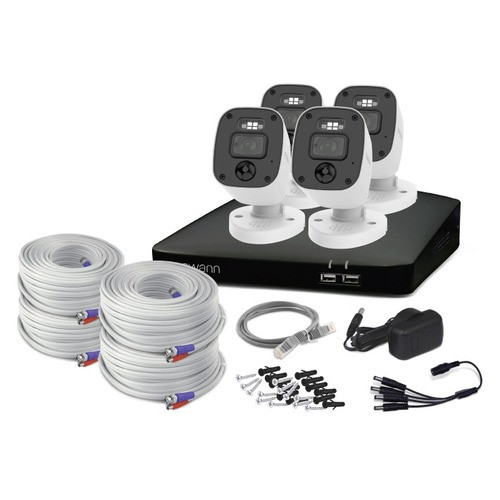
The D4WVN8TB is specified as a 4-channel 4K TVI DVR. The spec block does not detail analog signal type auto-detection beyond TVI, nor does it enumerate IP camera channel expansion, remote PTZ protocol support, or per-resolution frame rates. The product is ONVIF-compliant and H.265/H.264 capable, which implies some IP camera compatibility, but the maximum IP channel count and supported analog formats beyond TVI are not specified in available specs. The IK10, IP67, and PoE+ fields present in the spec block appear inconsistent with a DVR device class and likely belong to a bundled camera product.
How do the two units compare on storage capacity and recording performance?
The HRX-434 provides a single internal SATA slot with a maximum supported HDD size of 6TB. Recording bandwidth peaks at 30Mbps (main stream) and 32Mbps during simultaneous 6-channel playback. Compression options are H.265, H.264, and MJPEG. The unit supports manual, schedule, event, and dual-track recording modes. Event triggers include video loss, motion detection, tampering, and face detection. File backup is available in BU, EXE (with embedded player), and AVI (web viewer only) formats.
The D4WVN8TB ships with an 8TB hard drive — a meaningful storage advantage over the HRX-434's 6TB ceiling. It supports H.265 and H.264 compression. Recording bandwidth, frame rates per resolution tier, maximum HDD slot count, recording modes, and event trigger types are not specified in available specs. The built-in microphone noted in the spec block suggests onboard audio capture, though DVR-level audio channel count and mixing are not detailed.
Which unit provides stronger remote access and system integration options?
The HRX-434 supports up to 10 simultaneous live unicast remote viewers, 20 multicast, and 3 concurrent search sessions. Remote access is available via web browser (HTTPS, CGI/SUNAPI), Wisenet Mobile (iOS and Android), Smart Viewer CMS, and SDK/CGI. The unit implements 802.1x authentication, IP address filtering, user access logging, and end-to-end encryption covering ID/PW, recording, transmission, and backup data. A Hanwha Techwin Root CA device certificate is included. Network protocols span TCP/IP, UDP/IP, RTP (UDP and TCP), RTSP, NTP, HTTP, DHCP (server and client), PPPoE, SMTP, IGMP, ARP, DNS, DDNS (Wisenet DDNS), uPnP, HTTPS, SNMP, and ONVIF Profile-S. P2P setup via QR code and ARB redundancy are supported. Maximum concurrent local users: 1; remote: 3 authenticated accounts.
The D4WVN8TB is ONVIF-compliant and supports H.265/H.264, confirming NVR/IP integration capability, but remote viewer limits, supported mobile platforms, CMS software, network protocol stack, security feature set, and user account maximums are not specified in available specs. NDAA and TAA compliance are confirmed certifications, which are relevant for federal and regulated commercial installations — a compliance posture the HRX-434 spec block does not address.
Which should you choose: the HRX-434 or the D4WVN8TB?
Our take: The HRX-434 is the stronger choice when detailed integration, multi-format analog flexibility, and documented remote management are the primary requirements. It supports four distinct analog signal types (AHD/HDTVI/HDCVI/CVBS) on the same BNC ports plus 6 additional IP channels versus the D4WVN8TB's unspecified IP expansion beyond 4K TVI. The HRX-434 caps storage at 6TB versus the D4WVN8TB's shipped 8TB — a meaningful gap for continuous high-resolution recording without external archiving. Remote access on the HRX-434 is documented at 10 unicast live streams and a full security stack (802.1x, encryption at rest and in transit); equivalent D4WVN8TB figures are absent from available specs. Choose the D4WVN8TB when NDAA/TAA compliance is a contractual requirement, wall-mount form factor is necessary, or 8TB onboard capacity is the deciding constraint and detailed protocol specs can be confirmed with Speco directly before purchase.
Side-by-Side Comparison
Spec-for-spec, from manufacturer data.
| Specification | Hanwha HRX-434 | Speco Technologies D4WVN8TB |
|---|---|---|
| Analog Input Channels | 4 (BNC, 1Vp-p 75Ω) | 4 (TVI) |
| Supported Analog Formats | AHD, HDTVI, HDCVI, CVBS | TVI (others not specified) |
| Max IP Camera Channels | 6 CH (up to 10 total) | — |
| Max Analog Resolution | 8MP | 4K (implied by product name) |
| Video Compression | H.265, H.264, MJPEG | H.265, H.264 |
| Max Record Bandwidth | 30 Mbps | — |
| Max Playback Bandwidth | 32 Mbps (6CH simultaneous) | — |
| Internal Storage | 1× SATA, 6TB max | 8TB (shipped) |
| Form Factor / Mount | Rack mount | Wall mount |
| Display Outputs | 1× HDMI, 1× VGA (4K/1080p) | — |
| Audio | 1× line in, 1× line out (RCA), 2-way | 2-way, built-in mic |
| ONVIF | Yes (Profile-S) | Yes |
| Remote Viewer Limit | 10 unicast live / 20 multicast | — |
| Mobile App Support | iOS, Android (Wisenet Mobile) | — |
| NDAA / TAA Compliant | Not specified | Yes (both) |
| Warranty | Not specified in available specs | 3 years |
Frequently Asked Questions
Which should you choose: the HRX-434 or the D4WVN8TB?
The HRX-434 is the stronger choice when detailed integration, multi-format analog flexibility, and documented remote management are the primary requirements. It supports four distinct analog signal types (AHD/HDTVI/HDCVI/CVBS) on the same BNC ports plus 6 additional IP channels versus the D4WVN8TB's unspecified IP expansion beyond 4K TVI. The HRX-434 caps storage at 6TB versus the D4WVN8TB's shipped 8TB — a meaningful gap for continuous high-resolution recording without external archiving. Remote access on the HRX-434 is documented at 10 unicast live streams and a full security stack (802.1x, encryption at rest and in transit); equivalent D4WVN8TB figures are absent from available specs. Choose the D4WVN8TB when NDAA/TAA compliance is a contractual requirement, wall-mount form factor is necessary, or 8TB onboard capacity is the deciding constraint and detailed protocol specs can be confirmed with Speco directly before purchase.
Can the HRX-434 record from both my old analog cameras and new IP cameras at the same time?
Yes. The HRX-434 accepts up to 4 analog channels (auto-detecting AHD, HDTVI, HDCVI, or CVBS on each BNC port) and simultaneously connects up to 6 IP cameras (8MP down to CIF), for a maximum of 10 total sources recording concurrently.
Is the D4WVN8TB approved for government or federally funded projects?
Yes. The D4WVN8TB carries both NDAA and TAA compliance certifications, making it eligible for federal, state, and local government procurements that prohibit certain foreign-manufactured equipment. The HRX-434 spec block does not list NDAA or TAA compliance.
Which unit gives me more storage, and can I expand it later?
The D4WVN8TB ships with an 8TB hard drive. The HRX-434 supports up to 6TB via a single internal SATA slot. Whether the D4WVN8TB supports HDD replacement or upgrade, and the maximum supported drive size, are not specified in available specs for that model.
Get a Second Opinion on Your Camera Choice
Share your site layout, coverage goals, and budget. Our team will validate the camera selection, flag anything we would change, and recommend products that match the use case.