
Hanwha HRX-1635 vs Vivotek ND9442P: Specification Comparison
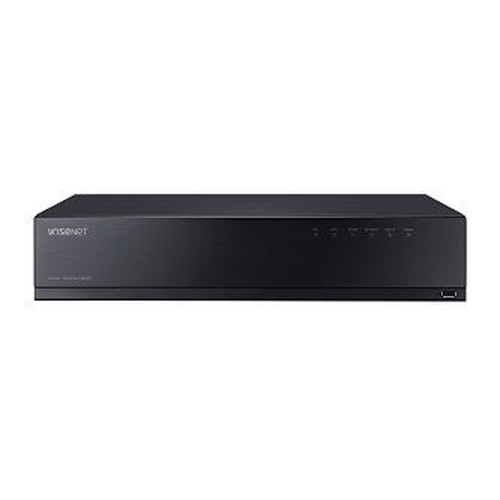
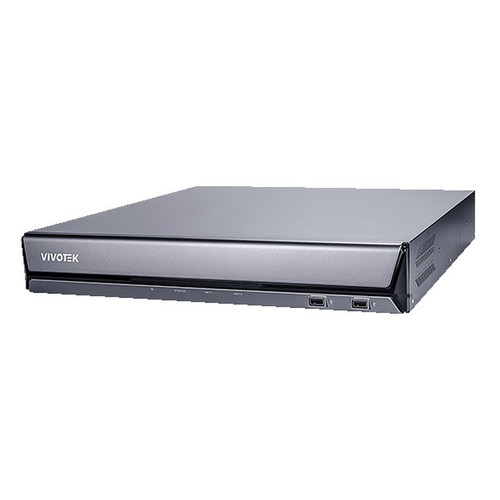
The Hanwha HRX-1635 and Vivotek ND9442P are both 16-channel recorders aimed at mid-size surveillance deployments, but they represent fundamentally different recording architectures. The HRX-1635 is a Pentabrid DVR supporting analog coaxial cameras (AHD, TVI, CVI, CVBS) alongside IP channels, while the ND9442P is a pure NVR with built-in PoE+ ports. Installers choosing between them are weighing analog-legacy compatibility and hybrid expansion against a clean IP-only PoE infrastructure with RAID storage redundancy.
In This Guide
- How do channel capacity, recording throughput, and storage scale compare?
- What are the PoE power delivery, operating environment, and physical build differences?
- How do camera protocol support, analytics, and management software ecosystems differ?
- Which should you choose: the HRX-1635 or the ND9442P?
- Side-by-Side Specs
- FAQ
How do channel capacity, recording throughput, and storage scale compare?
The HRX-1635 supports 16 analog channels (BNC, 1Vp-p 75Ω) plus 2 native IP channels expandable to 18 IP channels total, yielding a maximum combined channel count of 18 when analog inputs are displaced. Recording bandwidth peaks at 128 Mbps, with playback bandwidth capped at 32 Mbps across 18 simultaneous channels. Storage is handled by 8 internal SATA bays supporting drives up to 6 TB each, for a maximum raw capacity of 48 TB. Analog record rates top out at 8MP@8fps or 4MP@15fps.
The ND9442P is a dedicated 16-channel IP NVR with a recording throughput of 192 Mbps — 50% higher than the HRX-1635's 128 Mbps ceiling. Network throughput (input/output combined) reaches 224 Mbps via dual 10/100/1000 Mbps Ethernet ports. Storage is limited to 4 internal 3.5" HDD bays; Vivotek does not publish a per-drive capacity ceiling in the provided specs, instead referring buyers to a recommended HDD list. RAID 0, 1, and 5 are supported, adding redundancy options absent on the Hanwha. Simultaneous playback is specified at 4 channels versus 18 channels local on the HRX-1635.
What are the PoE power delivery, operating environment, and physical build differences?
The ND9442P integrates PoE+ (802.3at) power delivery with PoE management, allowing cameras to receive both data and power over a single Ethernet cable — a significant cabling simplification in new IP deployments. Its maximum power draw is 300 W. Operating temperature range is -10°C to 55°C (14°F to 131°F), and humidity tolerance is 0–95%, giving it a notably wider environmental envelope. It weighs 4.6 kg without HDDs and measures 432 × 421 × 66 mm.
The HRX-1635 has no PoE capability; analog and IP cameras require separate power runs. Maximum power draw is 200 W with eight 6TB drives installed. Its operating temperature range is narrower: 0°C to +40°C (32°F to 104°F), and humidity is rated 20–85% RH. At approximately 7.70 kg (with one 4TB HDD) and 440 × 88 × 384.8 mm, it is physically heavier and taller (2U) compared to the ND9442P's 1.5U-class chassis. Both units ship in white metal housings.
How do camera protocol support, analytics, and management software ecosystems differ?
The HRX-1635 is built around the Hanwha/Wisenet ecosystem: it natively supports SUNAPI (Wisenet) and ONVIF Profile S for IP cameras, and coaxial control via CVBS (Pelco-C), AHD, CVI, and TVI for analog. Event triggers cover motion detection, video loss, tampering, and defocus; actions include email, FTP, PTZ preset, alarm output, and SUNAPI commands. Remote management uses SmartViewer CMS, Wisenet Mobile Viewer (iOS/Android), and web viewer. ARB (Automatic Recovery Backup) is supported. PTZ serial control runs over RS-485/422 with Pelco-D/P and Samsung-T protocols. Maximum remote users are 10 live unicast and 20 multicast.
The ND9442P supports ONVIF Profile S for camera integration. Its analytics capabilities are substantially broader per spec: Smart VCA events, object search (people and vehicles), scene search (line crossing, intrusion, loitering), attribute search (gender, age, clothing color, vehicle type and color), VCA counting, and Trend Micro IoT Security integration are all listed. Cybersecurity Management and watermarking are also specified. Management software includes Vivotek's Shepherd, VAST Security Station (VSS), iViewer, VIVOCloud, and VORTEX mobile apps. The web browser interface is Chrome-based. RS-485 is present but marked reserved. There is no coaxial camera support.
Which should you choose: the HRX-1635 or the ND9442P?
Our take: The ND9442P is the stronger choice when deploying or expanding a pure IP camera infrastructure that demands built-in PoE+, higher recording throughput, RAID storage redundancy, and advanced video analytics. Its 192 Mbps recording bandwidth exceeds the HRX-1635's 128 Mbps by 50%, its operating temperature range (-10°C to 55°C vs. 0°C to 40°C) suits less-controlled environments, and its RAID 0/1/5 support provides data redundancy the Hanwha lacks entirely. Additionally, its onboard VCA analytics — object search, attribute search, scene search — are absent from the HRX-1635 spec sheet. Conversely, the HRX-1635 is the correct choice when the installation must integrate existing analog coaxial cameras (AHD, TVI, CVI, CVBS) or when 48 TB of raw onboard storage across 8 SATA bays is required; the ND9442P's 4-bay configuration cannot match that capacity. Platform loyalty also matters: Wisenet-ecosystem operators benefit from native SUNAPI integration on the Hanwha, while Vivotek VAST/VSS deployments align with the ND9442P.
Side-by-Side Comparison
Spec-for-spec, from manufacturer data.
| Specification | Hanwha HRX-1635 | Vivotek ND9442P |
|---|---|---|
| Product Type | Pentabrid DVR (Analog + IP) | Pure IP NVR |
| Analog Inputs | 16CH BNC (AHD/TVI/CVI/CVBS) | — |
| IP Camera Channels | Up to 18CH (2 native + 16 displaced) | 16CH |
| PoE Output | — | PoE+ (802.3at), built-in |
| Recording Throughput | Max. 128 Mbps | Max. 192 Mbps |
| Network Throughput | Max. 100 Mbps | 224 Mbps (dual GbE) |
| Video Compression | H.265, H.264, MJPEG | H.265, H.264, MJPEG |
| HDD Bays | 8 × SATA (max. 6TB/drive, 48TB total) | 4 × 3.5" internal (max. capacity not specified) |
| RAID Support | — | RAID 0, 1, 5 |
| Display Outputs | 1× HDMI, 1× VGA (up to 4K) | 1× HDMI, 1× VGA (up to 3840×2160) |
| Simultaneous Local Playback | 18 channels | 4 channels |
| Alarm Inputs / Outputs | 16 in / 4 out | 16 in / 8 out |
| Operating Temperature | 0°C to +40°C | -10°C to +55°C |
| Operating Humidity | 20%–85% RH | 0%–95% RH |
| Max. Power Draw | 200 W (8× 6TB HDD) | 300 W |
| Weight (with HDD noted) | ~7.70 kg (1× 4TB HDD) | 4.6 kg (without HDD) |
| Built-in VCA Analytics | — | Object, Scene, Attribute Search; VCA Counting |
| Certifications | UL, CE, FCC, KC, UKCA | CE, LVD, FCC, VCCI, C-Tick, UL, CB, BSMI, BIS |
Frequently Asked Questions
Which should you choose: the HRX-1635 or the ND9442P?
The ND9442P is the stronger choice when deploying or expanding a pure IP camera infrastructure that demands built-in PoE+, higher recording throughput, RAID storage redundancy, and advanced video analytics. Its 192 Mbps recording bandwidth exceeds the HRX-1635's 128 Mbps by 50%, its operating temperature range (-10°C to 55°C vs. 0°C to 40°C) suits less-controlled environments, and its RAID 0/1/5 support provides data redundancy the Hanwha lacks entirely. Additionally, its onboard VCA analytics — object search, attribute search, scene search — are absent from the HRX-1635 spec sheet. Conversely, the HRX-1635 is the correct choice when the installation must integrate existing analog coaxial cameras (AHD, TVI, CVI, CVBS) or when 48 TB of raw onboard storage across 8 SATA bays is required; the ND9442P's 4-bay configuration cannot match that capacity. Platform loyalty also matters: Wisenet-ecosystem operators benefit from native SUNAPI integration on the Hanwha, while Vivotek VAST/VSS deployments align with the ND9442P.
Can the HRX-1635 or ND9442P connect to my existing analog CCTV cameras?
Only the HRX-1635 supports analog cameras. It accepts AHD, HDTVI, HDCVI, and NTSC/PAL signals on 16 BNC inputs and includes coaxial control for PTZ cameras. The ND9442P is a pure IP NVR with no analog inputs; all cameras must connect via Ethernet using ONVIF Profile S or Vivotek's native protocols.
Which recorder provides better protection against hard drive failure?
The ND9442P supports RAID 0, 1, and 5 across its four internal HDD bays, providing options for drive mirroring or parity-based fault tolerance. The HRX-1635 spec sheet lists no RAID support; it offers 8 SATA bays for capacity expansion but no specified redundancy mode, making individual drive failure a potential single point of data loss.
Is the HRX-1635 or ND9442P better suited for sites with temperature extremes or unstable power?
The ND9442P is rated for -10°C to 55°C operating temperature versus the HRX-1635's 0°C to 40°C range, making it the better fit for unheated enclosures or warm server rooms. Both units specify automatic system restart after power recovery per the ND9442P spec; the HRX-1635 spec sheet does not explicitly list this feature, though ARB (Automatic Recovery Backup) for recording is noted.
Get a Second Opinion on Your Camera Choice
Share your site layout, coverage goals, and budget. Our team will validate the camera selection, flag anything we would change, and recommend products that match the use case.