
Hanwha HRX-1634 vs Vivotek ND9426P: Specification Comparison
Both the Hanwha HRX-1634 and the Vivotek ND9426P are 16-channel, 1U rack-mount recorders targeting small-to-mid commercial surveillance deployments. The Hanwha is a pentabrid DVR capable of ingesting analog (AHD/TVI/CVI/CVBS) and IP cameras simultaneously, while the Vivotek is a pure IP NVR with built-in PoE+ ports for direct camera powering. Buyers comparing these are typically deciding between migrating an existing analog infrastructure or deploying a fully IP network from scratch, making channel architecture, throughput, power delivery, and ecosystem integration the three most consequential dimensions.
In This Guide
- How do channel capacity, resolution, and recording throughput compare?
- How do camera input type, PoE power delivery, and installation complexity differ?
- How do software integration, cybersecurity features, and remote management capabilities compare?
- Which should you choose: the HRX-1634 or the ND9426P?
- Side-by-Side Specs
- FAQ
How do channel capacity, resolution, and recording throughput compare?
The HRX-1634 supports 16 analog channels (BNC) expandable to up to 18 IP channels concurrently, with a maximum recording bandwidth of 128 Mbps and a transmission bandwidth of 100 Mbps. Analog recording tops out at 8 MP at 8 fps or 2 MP at 30 fps per channel; IP cameras can reach 8 MP. Simultaneous local playback covers all 18 channels. Maximum supported HDD per slot is 6 TB, with two SATA bays yielding 12 TB total.
The ND9426P is a 16-channel IP-only NVR with a recording throughput of 192 Mbps—64 Mbps higher than the HRX-1634's 128 Mbps ceiling. Its hardware decoder handles H.265/H.264 at 3840×2160 @ 120 fps aggregated, or 1920×1080 @ 480 fps. Decoding resolution reaches 7680×2560. It also carries two internal 3.5-inch HDD bays with RAID 0/1 support; no per-slot capacity ceiling is stated in the provided specs. Playback is limited to 4 channels simultaneously, versus 18 channels on the HRX-1634.
On raw throughput and decoding horsepower the ND9426P leads (192 Mbps vs. 128 Mbps; hardware 4K decoding specified). The HRX-1634 counters with broader simultaneous playback (18 channels vs. 4) and a defined 12 TB storage ceiling. RAID support is present only on the ND9426P.
How do camera input type, PoE power delivery, and installation complexity differ?
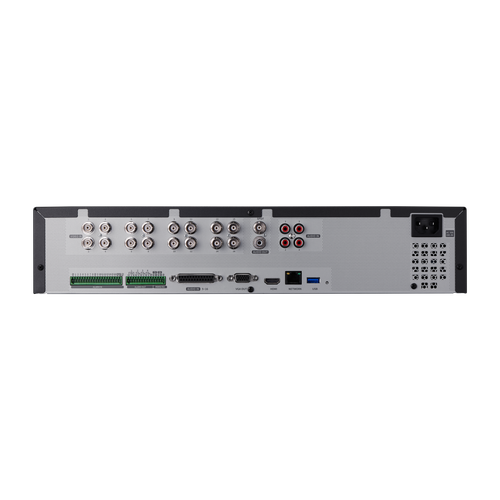
The HRX-1634 accepts AHD, HDTVI, HDCVI, and CVBS on its 16 BNC inputs via coaxial cable, plus up to 18 IP cameras over the network. Coaxial PTZ control supports CVBS (Pelco-C), AHD, CVI, and TVI. There is no built-in PoE; IP cameras require a separate PoE switch. Audio is handled via 4 RCA line inputs and 1 RCA line output. Power draw is rated at max 40 W (with two 6 TB HDDs installed). Operating temperature range is 0 °C to +40 °C.
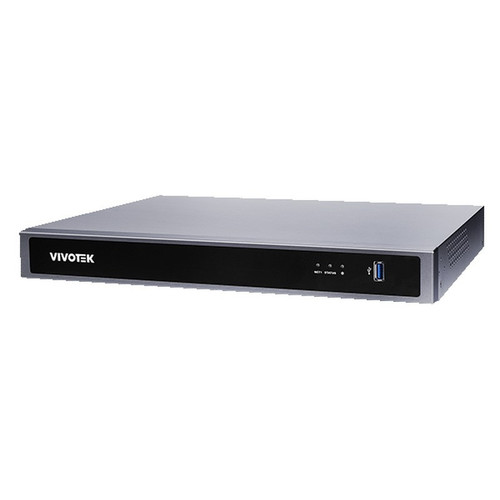
The ND9426P has no analog inputs; all 16 channels are IP-only and each port delivers PoE+ (802.3at), eliminating the need for a separate PoE switch. Total system power draw is up to 270 W—substantially higher, largely because it is powering up to 16 cameras directly. It provides dual RJ-45 Gigabit Ethernet ports for network redundancy or load separation. Audio uses a 3.5 mm jack (1 in / 1 out). Operating temperature range is wider: -10 °C to +55 °C.
The HRX-1634 is the only unit that supports analog cameras, making it the clear choice for mixed or legacy-analog sites. The ND9426P's integrated PoE+ simplifies full-IP deployments by removing a network switch from the BOM, but its 270 W maximum draw requires appropriate power provisioning. The ND9426P also operates in a broader temperature envelope (-10 °C to +55 °C vs. 0 °C to +40 °C), which matters in unconditioned spaces.
How do software integration, cybersecurity features, and remote management capabilities compare?
The HRX-1634 integrates with Hanwha's Wisenet ecosystem: SUNAPI (Wisenet), ONVIF Profile S, SSM VMS, SmartViewer, Wisenet Mobile, and Wisenet Viewer. Remote access supports up to 10 simultaneous live unicast users plus 20 multicast, with 3 concurrent search users. Security features include IP address filtering, user access logging, 802.1x authentication, and encryption covering ID/PW, recording, transmission, and backup, backed by a Hanwha Techwin Root CA device certificate. P2P setup via QR code and a Setup Wizard simplify initial configuration. ARB (Automatic Recovery Backup) is supported.
The ND9426P integrates with Vivotek's ecosystem via VAST Security Station (VSS), Shepherd, iViewer, VIVOCloud, and VORTEX mobile apps (Android and iOS). ONVIF Profile S is supported. Cybersecurity is explicitly called out as a managed feature, and the unit includes Trend Micro IoT Security integration. Advanced VCA capabilities are built in: object search (people, vehicles), scene search (line crossing, intrusion, loitering), attribute search (gender, age, clothing color, vehicle type/color), VCA counting, and Smart Search II. The HRX-1634 spec does not list equivalent on-device VCA analytics.
Both recorders support ONVIF Profile S and offer mobile apps, but their ecosystems are proprietary and non-interchangeable. The ND9426P provides substantially deeper on-device VCA and explicit cybersecurity management (Trend Micro integration), while the HRX-1634 provides a larger concurrent remote-user pool (10 unicast + 20 multicast vs. no explicit count stated for the ND9426P) and ARB redundancy.
Which should you choose: the HRX-1634 or the ND9426P?
Our take: The ND9426P is the stronger choice when deploying a new all-IP system where cameras need to be powered directly from the recorder, advanced on-device analytics are required, and a wider operating temperature range matters. It delivers 192 Mbps recording throughput (vs. 128 Mbps), integrated PoE+ across all 16 channels eliminating a separate switch, and built-in Trend Micro IoT Security plus VCA attribute search—none of which the HRX-1634 provides. Conversely, the HRX-1634 is the correct choice for any site retaining analog cameras on coax: it is the only unit here that accepts AHD, HDTVI, HDCVI, or CVBS inputs, supports 18-channel simultaneous playback (vs. 4 on the ND9426P), and draws only 40 W (vs. 270 W), making it far more practical in existing analog infrastructure or power-constrained rack environments. Platform lock-in is a real consideration: Hanwha sites benefit from SUNAPI/SSM, while Vivotek sites lean on VAST Security Station.
Side-by-Side Comparison
Spec-for-spec, from manufacturer data.
| Specification | Hanwha HRX-1634 | Vivotek ND9426P |
|---|---|---|
| Product Type | Pentabrid DVR (Analog + IP) | IP NVR (PoE+, IP only) |
| Total Channels | 16 analog + up to 18 IP | 16 IP |
| Analog Inputs | 16× BNC (AHD/TVI/CVI/CVBS) | — |
| Built-in PoE+ | — | Yes, 16× PoE+ ports |
| Recording Throughput | 128 Mbps max | 192 Mbps |
| Max Recording Resolution | 8 MP | 8 MP |
| Video Compression | H.265, H.264, MJPEG | H.265, H.264, MJPEG |
| Hardware Decoding | Not specified | Yes (H.265/H.264 4K @ 120 fps) |
| HDD Bays | 2× SATA (max 12 TB) | 2× 3.5" internal (RAID 0/1) |
| Simultaneous Playback Channels | 18 local / 18 CMS / 4 mobile | 4 channels |
| Video Outputs | 1× HDMI, 1× VGA (up to 4K) | 1× HDMI (4K), 1× VGA |
| Alarm Inputs / Outputs | 16 in / 4 out | 4 in / 1 out |
| Audio I/O | 4× RCA line in / 1× RCA line out | 1× 3.5 mm in / 1× 3.5 mm out |
| Operating Temperature | 0 °C to +40 °C | -10 °C to +55 °C |
| Max Power Draw | 40 W (dual 6 TB HDDs) | 270 W |
| Certifications | UL, CE, FCC, KC, UKCA | CE, FCC, VCCI, C-Tick, UL, CB, BSMI, BIS |
| ONVIF | Profile S | Profile S |
| Cybersecurity Features | 802.1x, encryption, device certificate | Trend Micro IoT Security, cybersecurity management |
| On-device VCA Analytics | Motion detection, tampering | People/vehicle search, line crossing, intrusion, loitering, attribute search |
| Weight | 4.5 kg (9.9 lb) | 2.78 kg |
| Dimensions (W×H×D) | 370 × 44 × 320 mm | 365 × 44 × 315 mm |
Frequently Asked Questions
Which should you choose: the HRX-1634 or the ND9426P?
The ND9426P is the stronger choice when deploying a new all-IP system where cameras need to be powered directly from the recorder, advanced on-device analytics are required, and a wider operating temperature range matters. It delivers 192 Mbps recording throughput (vs. 128 Mbps), integrated PoE+ across all 16 channels eliminating a separate switch, and built-in Trend Micro IoT Security plus VCA attribute search—none of which the HRX-1634 provides. Conversely, the HRX-1634 is the correct choice for any site retaining analog cameras on coax: it is the only unit here that accepts AHD, HDTVI, HDCVI, or CVBS inputs, supports 18-channel simultaneous playback (vs. 4 on the ND9426P), and draws only 40 W (vs. 270 W), making it far more practical in existing analog infrastructure or power-constrained rack environments. Platform lock-in is a real consideration: Hanwha sites benefit from SUNAPI/SSM, while Vivotek sites lean on VAST Security Station.
Can the HRX-1634 or ND9426P keep my existing analog cameras?
Only the HRX-1634 supports analog cameras. Its 16 BNC inputs accept AHD, HDTVI, HDCVI, and CVBS signals, so existing coax-wired cameras can be retained while IP channels are added. The ND9426P is IP-only and cannot connect to any analog camera directly.
Which unit handles higher-resolution or higher-throughput IP camera streams?
The ND9426P has a higher recording throughput ceiling: 192 Mbps versus the HRX-1634's 128 Mbps. Its hardware decoder also supports aggregate 4K (3840×2160) at 120 fps and a decoding resolution up to 7680×2560. For dense high-resolution IP-only deployments the ND9426P has the specification advantage on throughput.
Which recorder is better suited for a remote or unconditioned equipment room?
The ND9426P operates from -10 °C to +55 °C, versus the HRX-1634's 0 °C to +40 °C range. If the installation environment experiences low temperatures or elevated heat (e.g., an outdoor cabinet or non-climate-controlled closet), the ND9426P's broader thermal envelope is the specified advantage. Note that the ND9426P draws up to 270 W, which must be accounted for in thermal and power planning.
Get a Second Opinion on Your Camera Choice
Share your site layout, coverage goals, and budget. Our team will validate the camera selection, flag anything we would change, and recommend products that match the use case.