
Hanwha HRX-1634 vs Hanwha XRN-1620B2: Specification Comparison
Both the Hanwha HRX-1634 and XRN-1620B2 are 16-channel Hanwha security recorders sharing H.265/H.264/MJPEG compression, ONVIF/SUNAPI compatibility, and a common operating temperature range. The critical architectural difference: the HRX-1634 is a pentabrid DVR accepting analog coaxial inputs (AHD, HDTVI, HDCVI, CVBS) plus up to 18 IP channels, while the XRN-1620B2 is a pure IP NVR accepting only network cameras up to 32MP. This comparison covers recording capacity and throughput, storage and redundancy, and integration depth.
In This Guide
- Which recorder handles higher resolution and greater recording throughput?
- Which unit offers more storage capacity and better data protection?
- Which recorder integrates better with existing infrastructure and third-party platforms?
- Which should you choose: the HRX-1634 or the XRN-1620B2?
- Side-by-Side Specs
- FAQ
Which recorder handles higher resolution and greater recording throughput?
The XRN-1620B2 supports network camera inputs up to 32MP versus the HRX-1634's maximum of 8MP across both its analog and IP channels. On aggregate recording bandwidth, the XRN-1620B2 reaches 140Mbps while the HRX-1634 peaks at 128Mbps—a 9% higher ceiling on the NVR side.
For display output, the XRN-1620B2 drives its HDMI port at 3840×2160 (30Hz 4K) while the HRX-1634's HDMI is rated 'up to 4K' without a confirmed refresh rate in the provided specs. The VGA port on the XRN-1620B2 is specified at 1920×1080 60Hz; the HRX-1634 lists VGA without a resolution ceiling in the spec data.
Simultaneous playback differs meaningfully: the XRN-1620B2 supports up to 64 channels concurrently (16 local, up to 16 per remote user across 3 remote users), while the HRX-1634 supports 18 channels local, 18 via CMS, 4 mobile, and 1 web viewer simultaneously.
Which unit offers more storage capacity and better data protection?
The XRN-1620B2 provides 8 SATA bays accepting drives up to 10TB each for a maximum of 80TB raw capacity. The HRX-1634 offers only 2 SATA bays with a maximum of 6TB per drive, capping total raw storage at 12TB. For deployments requiring extended retention at high resolution, the XRN-1620B2's storage ceiling is more than six times larger.
On redundancy, the XRN-1620B2 supports both N+1 failover and Automatic Redundancy Backup (ARB). The HRX-1634 lists ARB support but does not specify N+1 failover in the provided specifications. The XRN-1620B2 also includes signed firmware validation as a security layer not listed for the HRX-1634.
Power consumption reflects the hardware difference: the XRN-1620B2 draws up to 130W and accepts 100–240VAC universally. The HRX-1634 draws up to 40W (with dual 6TB HDDs) but its primary input is listed as AC 100V, with DC 12V also noted—buyers should verify their supply voltage against the installation environment.
Which recorder integrates better with existing infrastructure and third-party platforms?
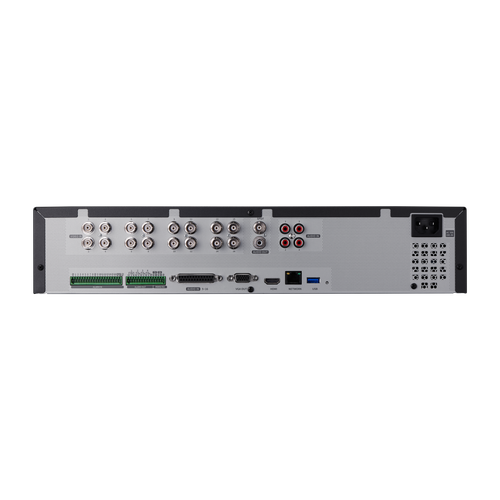
The HRX-1634's pentabrid design is its defining integration advantage: it accepts AHD, HDTVI, HDCVI, CVBS/NTSC/PAL analog cameras via 16 BNC inputs alongside up to 18 IP channels, and supports coaxial PTZ control (CVBS Pelco-C / AHD / CVI / TVI) plus RS-485 (Pelco-D/P, Samsung-T). This makes it the only option of the two for sites retaining any coaxial analog infrastructure.
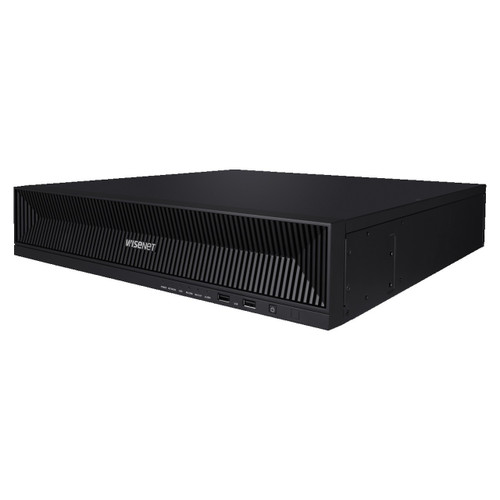
The XRN-1620B2 is IP-only but adds depth in other areas: its dual Ethernet ports (LAN/WAN, 1Gbps each) enable network segmentation not possible on the HRX-1634's single RJ-45 port. The NVR also supports IPv6 alongside IPv4; the HRX-1634's protocol list does not mention IPv6. PTZ presets are listed at 300 on the XRN-1620B2; the HRX-1634 does not specify a preset count.
Software ecosystem is broadly shared: both support SSM, Webviewer, Smart Viewer, and Wisenet Mobile. The XRN-1620B2 additionally lists WAVE VMS and explicitly notes CGI/SUNAPI for third-party VMS integration. The HRX-1634 includes SmartViewer and Wisenet Viewer. Both platforms support 802.1x authentication, IP filtering, and Hanwha Techwin Root CA device certificates. The XRN-1620B2 logs up to 100,000 entries each for system and event logs; no equivalent log-size figure is stated for the HRX-1634. Web viewer OS support is specified only for the XRN-1620B2 (Windows 10, macOS 10.13; Chrome, Edge, Safari).
Which should you choose: the HRX-1634 or the XRN-1620B2?
Our take: The HRX-1634 is the stronger choice when a site must support existing coaxial analog cameras alongside IP channels on a single recorder. Its pentabrid inputs accept AHD, HDTVI, HDCVI, and CVBS signals across 16 BNC ports—capability the XRN-1620B2 entirely lacks as a pure IP NVR. For greenfield or fully IP deployments, however, the XRN-1620B2 outperforms on every capacity and redundancy metric: 32MP maximum input versus 8MP, 80TB maximum storage across 8 SATA bays versus 12TB across 2, 140Mbps recording bandwidth versus 128Mbps, and N+1 failover redundancy not confirmed on the HRX-1634. The XRN-1620B2 also adds dual Ethernet ports for network segmentation and IPv6 support. Choose the HRX-1634 for hybrid analog-plus-IP migration sites; choose the XRN-1620B2 for IP-native installations requiring higher resolution, larger retention, or failover resilience.
Side-by-Side Comparison
Spec-for-spec, from manufacturer data.
| Specification | Hanwha HRX-1634 | Hanwha XRN-1620B2 |
|---|---|---|
| Device Type | Pentabrid DVR (Analog + IP) | Pure IP NVR |
| Max Analog Channels | 16 (BNC, coaxial) | — |
| Analog Signal Support | AHD, HDTVI, HDCVI, CVBS/NTSC/PAL | — |
| Max IP Channels | Up to 18CH (configurable) | Max. 16CH |
| Max Input Resolution | 8MP | 32MP |
| Recording Bandwidth | Max. 128Mbps | Max. 140Mbps |
| Transmission Bandwidth | Max. 100Mbps | Max. 140Mbps |
| HDD Bays | 2x SATA | 8x SATA |
| Max Storage Capacity | 12TB (6TB per drive) | 80TB (10TB per drive) |
| Simultaneous Playback | 18CH local / 18CH CMS / 4CH mobile / 1CH web | 64CH total (16CH local, 16CH per remote user) |
| HDMI Output | 1x (up to 4K) | 1x (3840×2160 @ 30Hz) |
| VGA Output | 1x | 1x (1920×1080 @ 60Hz) |
| Ethernet Ports | 1x RJ-45 (1Gbps) | 2x RJ-45 LAN/WAN (1Gbps each) |
| IPv6 Support | Not specified | Yes |
| N+1 Failover | Not specified | Yes |
| ARB Support | Yes | Yes |
| Alarm Inputs / Outputs | 16 inputs / 4 outputs | 4 inputs / 2 outputs |
| Audio Inputs | 4x Line In (local) | 16CH (network) |
| RS-485 / Coaxial PTZ | Yes (RS-485 + coaxial CVBS/AHD/CVI/TVI) | — |
| PTZ Presets | Not specified | 300 |
| Max Power Consumption | 40W (dual 6TB HDDs) | 130W |
| Input Voltage | AC 100V / DC 12V | 100–240VAC ±10%, 50/60Hz |
| Operating Temperature | 0°C to +40°C | 0°C to +40°C |
| Dimensions (WxHxD) | 370 x 44 x 320 mm (14.57" x 1.73" x 12.6") | 440 x 89.8 x 428.4 mm (17.32" x 3.54" x 16.87") |
| Weight | 4.5 kg (9.9 lb) | 5.71 kg (12.59 lb) |
| Certifications | UL, CE, FCC, KC, UKCA | Not specified in provided specs |
| Embedded OS | Not specified | Linux |
Frequently Asked Questions
Which should you choose: the HRX-1634 or the XRN-1620B2?
The HRX-1634 is the stronger choice when a site must support existing coaxial analog cameras alongside IP channels on a single recorder. Its pentabrid inputs accept AHD, HDTVI, HDCVI, and CVBS signals across 16 BNC ports—capability the XRN-1620B2 entirely lacks as a pure IP NVR. For greenfield or fully IP deployments, however, the XRN-1620B2 outperforms on every capacity and redundancy metric: 32MP maximum input versus 8MP, 80TB maximum storage across 8 SATA bays versus 12TB across 2, 140Mbps recording bandwidth versus 128Mbps, and N+1 failover redundancy not confirmed on the HRX-1634. The XRN-1620B2 also adds dual Ethernet ports for network segmentation and IPv6 support. Choose the HRX-1634 for hybrid analog-plus-IP migration sites; choose the XRN-1620B2 for IP-native installations requiring higher resolution, larger retention, or failover resilience.
Can the HRX-1634 or XRN-1620B2 work with my existing analog cameras?
Only the HRX-1634 supports analog cameras. It accepts AHD, HDTVI, HDCVI, and CVBS/NTSC/PAL signals across 16 BNC inputs and also handles coaxial PTZ control. The XRN-1620B2 is a pure IP NVR with no analog or BNC inputs; it requires network cameras exclusively.
Is the HRX-1634 or XRN-1620B2 better for larger deployments needing long video retention?
The XRN-1620B2 is significantly better suited for large retention requirements. Its 8 SATA bays support up to 80TB of raw storage (10TB per drive) versus the HRX-1634's 2 SATA bays capped at 12TB. The XRN-1620B2 also records at up to 32MP versus the HRX-1634's 8MP ceiling, and its 140Mbps recording bandwidth exceeds the HRX-1634's 128Mbps.
Which unit offers better redundancy and failover protection?
The XRN-1620B2 specifies both N+1 failover and Automatic Redundancy Backup (ARB). The HRX-1634 lists ARB support but does not include N+1 failover in its provided specifications. The XRN-1620B2 additionally includes signed firmware as a security integrity measure not listed for the HRX-1634.
Get a Second Opinion on Your Camera Choice
Share your site layout, coverage goals, and budget. Our team will validate the camera selection, flag anything we would change, and recommend products that match the use case.