
Hanwha C9022RV vs Pelco SRXF3-8360-ERS: Specification Comparison
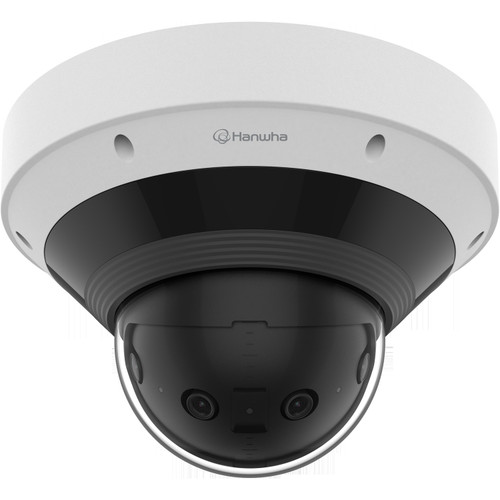
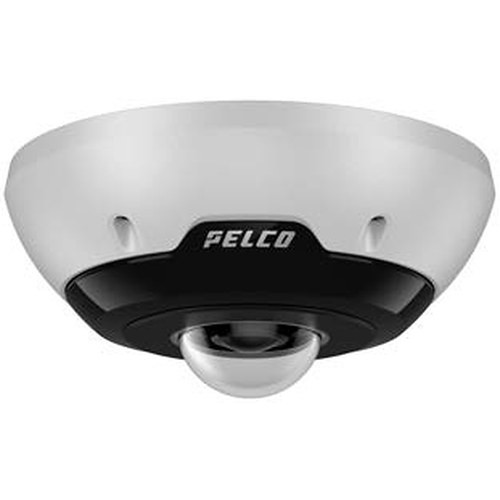
Both the Hanwha PNM-C9022RV and the Pelco SRXF3-8360-ERS are 8MP outdoor-rated fixed IP cameras designed to cover wide areas from a single installation point, making them genuine cross-shop candidates for perimeter and open-area surveillance. The Hanwha uses a quad-sensor stitched panoramic architecture delivering a 209° horizontal view, while the Pelco employs a single fisheye lens for a full 360° field of view. This comparison evaluates imaging performance, installation requirements, and VMS/analytics integration using only published specifications.
In This Guide
How do the imaging specs compare?
The Hanwha PNM-C9022RV uses four 1/2.8" CMOS sensors, each at 2.8mm fixed focal length and F2.0 aperture, stitched together to produce a maximum resolution of 5120×1568 pixels across a 209° horizontal by 60° vertical field of view at up to 20fps. Minimum illumination is rated at 0.1 lux color and 0 lux with IR active, with WiseIR illumination reaching 20m (65.6ft). WDR is specified at 120dB. The Pelco SRXF3-8360-ERS uses a single 2.7mm f/2.5 fisheye lens to produce 3264×2448 pixels across a full 360° field of view at 12.5fps full resolution. Its WDR is listed only as "WDR" with a noted ceiling of 83dB in the supplemental data; no minimum illumination lux figure is published in the provided specifications.
On quantifiable imaging metrics, the Hanwha holds a measurable edge: 120dB WDR versus the Pelco's up-to-83dB, a published 0-lux IR floor versus no stated lux figure for the Pelco, a 20fps frame rate versus 12.5fps, and explicit DORI distances (Detect 52.2m / Identify 5.2m) versus no published DORI data for the Pelco. The Pelco's 3264×2448 native resolution carries a higher pixel-per-degree density within its circular fisheye image than the Hanwha's stitched panoramic output, which may benefit de-warped regional views, but a direct pixel-density comparison cannot be made without the Pelco's published effective resolution after de-warp.
What about installation and environment?
Both cameras carry IP66 and IK10 ratings, confirming equivalence on dust/water ingress and impact resistance for outdoor dome installation. The Pelco additionally lists NEMA 4X, which the Hanwha matches via its own NEMA 250 Type 4X certification—functionally equivalent. Operating temperature ranges differ: the Hanwha is rated -40°C to +55°C, while the Pelco extends to -40°C to +60°C, a 5°C advantage at the upper end that may be relevant in high-heat environments such as rooftop or desert deployments.
Power requirements diverge on PoE class: the Hanwha draws up to 24.5W and requires PoE+ Class 4 (IEEE 802.3at), while the Pelco is rated PoE+ Class 3, implying lower maximum draw. The Hanwha also accepts 12VDC as an alternative power input; no DC input is listed for the Pelco. The Hanwha's physical footprint is Ø253×170mm at 2,900g; the Pelco is listed at 6"×6"×2.81" with a weight of approximately 1.0kg (2.21lb) with wall mount, making it substantially lighter and more compact for surface-mount or in-ceiling applications. The Hanwha supports a 3/4" (M25) conduit entry and named accessory hanging mounts; the Pelco's spec lists wall, ceiling, pole, pendant, and corner mount types but no specific conduit size.
Which fits your VMS and analytics better?
The Hanwha PNM-C9022RV supports ONVIF Profile S, G, T, and M, plus Hanwha's native SUNAPI and Wisenet SDK, providing broad VMS compatibility and native integration with Wisenet Wave/WiSeNet WAVE VMSs. Its AI analytics engine supports person and vehicle classification, virtual line crossing with direction detection, virtual area loitering/intrusion/enter/exit, and defocus detection—all edge-processed. It also includes 2 configurable alarm I/O ports, audio input (mic/line selectable) and audio output (line out, 1Vrms max), and dual Micro SD slots supporting up to 1TB (512GB×2) edge storage. Security features include 802.1X (EAP-TLS, EAP-LEAP, EAP-PEAP), device certificate pre-installed, IP filtering, and HTTPS/Digest authentication.
The Pelco SRXF3-8360-ERS supports ONVIF Profile S and Profile T—providing standard VMS compatibility but not the broader Profile G (recording) or Profile M (metadata/analytics) coverage of the Hanwha. Analytics are described as "Pelco Smart Analytics; 8 behaviors" with no published behavior names in the provided specifications. The Pelco lists microphone support for audio and microSD edge storage, but no audio output or alarm I/O is specified. Its memory is listed as 4GB RAM / 4GB Flash versus the Hanwha's 4GB RAM / 512MB Flash plus the dual SD card slots—notable that the Pelco lists more onboard Flash but no dual-card redundancy. Buyers using Pelco VideoXpert or Endura VMS will benefit from native Pelco ecosystem integration not present in the Hanwha.
Which should you choose: the C9022RV or the SRXF3-8360-ERS?
Our take: The PNM-C9022RV is the stronger choice when quantifiable imaging performance, deep analytics, and broad VMS compatibility are the primary evaluation criteria. It delivers a specified 120dB WDR versus the Pelco's documented up-to-83dB ceiling, a confirmed 0-lux IR floor at 20m versus no published lux figure for the Pelco, and a 20fps capture rate versus the Pelco's 12.5fps—meaningful for fast-moving subjects. It also adds dual SD card redundancy (up to 1TB), alarm I/O ports, and ONVIF Profile G/M support the Pelco lacks. The SRXF3-8360-ERS becomes the more appropriate choice when a true 360° blind-spot-free field of view is mandatory (versus the Hanwha's 209°), when the deployment site runs above +55°C (Pelco is rated to +60°C), when a lighter and more compact form factor is required, or when the installed VMS is Pelco-native. Neither camera's published spec data is complete enough to declare a low-light winner without the Pelco's missing lux figure.
Side-by-Side Comparison
Spec-for-spec, from manufacturer data.
| Specification | Hanwha C9022RV | Pelco SRXF3-8360-ERS |
|---|---|---|
| Camera Type | Panoramic Dome (quad-sensor) | Fisheye Dome |
| Max Resolution | 5120×1568 (stitched panoramic) | 3264×2448 |
| Field of View | H: 209°, V: 60° | 360° / 180° |
| Image Sensor | 1/2.8" CMOS ×4 | Not specified |
| Lens / Focal Length | 2.8mm fixed ×4, F2.0 | 2.7mm, F2.5 |
| Min. Illumination | 0.1 lux color / 0 lux IR | Not specified |
| IR Range | 20m (65.6ft) WiseIR | 360° integrated IR (range not specified) |
| Wide Dynamic Range | 120dB | Up to 83dB |
| Max Frame Rate | 20fps | 12.5fps (full resolution) |
| Video Compression | H.265, H.264, MJPEG | H.264 (H.265 listed in supplemental) |
| IP Rating | IP66, NEMA 250 Type 4X | IP66, NEMA 4X |
| IK / Impact Rating | IK10 | IK10 |
| Operating Temperature | -40°C to +55°C | -40°C to +60°C |
| Power Input / PoE Class | PoE+ Class 4 (IEEE 802.3at) / 12VDC; 24.5W max | PoE+ Class 3 |
| ONVIF Profiles | S, G, T, M | S, T |
| Edge Storage | Dual Micro SD/SDHC/SDXC, up to 1TB (512GB×2) | microSD (capacity not specified) |
| Alarm I/O | 2 configurable I/O ports | Not specified |
| Audio | Mic/line in selectable; line out 1Vrms | Microphone supported; no output specified |
| Dimensions | Ø253×170mm (9.96"×6.69") | 6"×6"×2.81" |
| Weight | 2,900g (6.39lb) | ~1,001g (2.21lb) with wall mount |
| Warranty | 3-year | 5-year |
Frequently Asked Questions
Which should you choose: the C9022RV or the SRXF3-8360-ERS?
The PNM-C9022RV is the stronger choice when quantifiable imaging performance, deep analytics, and broad VMS compatibility are the primary evaluation criteria. It delivers a specified 120dB WDR versus the Pelco's documented up-to-83dB ceiling, a confirmed 0-lux IR floor at 20m versus no published lux figure for the Pelco, and a 20fps capture rate versus the Pelco's 12.5fps—meaningful for fast-moving subjects. It also adds dual SD card redundancy (up to 1TB), alarm I/O ports, and ONVIF Profile G/M support the Pelco lacks. The SRXF3-8360-ERS becomes the more appropriate choice when a true 360° blind-spot-free field of view is mandatory (versus the Hanwha's 209°), when the deployment site runs above +55°C (Pelco is rated to +60°C), when a lighter and more compact form factor is required, or when the installed VMS is Pelco-native. Neither camera's published spec data is complete enough to declare a low-light winner without the Pelco's missing lux figure.
Is the PNM-C9022RV or SRXF3-8360-ERS better for low-light performance?
Based on published specifications, the Hanwha PNM-C9022RV has a stated minimum illumination of 0.1 lux color and 0 lux with IR active, with IR range reaching 20m (65.6ft). The Pelco SRXF3-8360-ERS does not publish a minimum lux figure in the provided specifications, so a direct low-light comparison cannot be made from spec data alone. The Pelco lists 360° integrated IR illumination, but without a lux or IR distance number, buyers should request that figure from Pelco before specifying for low-light-critical applications.
Which camera gives better coverage area—the 209° Hanwha or the 360° Pelco fisheye?
The Pelco SRXF3-8360-ERS covers a full 360° field of view with no blind spots, making it preferable for open-area or ceiling-center mounting where all-direction coverage from one point is required. The Hanwha PNM-C9022RV covers 209° horizontal by 60° vertical, which leaves a roughly 151° rear blind zone but delivers a higher effective frame rate (20fps vs 12.5fps) and a wider published WDR range (120dB vs up to 83dB) across its covered arc. The right choice depends on whether the mounting position can be oriented to eliminate the blind zone with the Hanwha, or whether true 360° coverage is operationally required.
Can both cameras integrate with third-party VMS platforms via ONVIF?
Yes, both cameras support ONVIF, but at different profile depths. The Hanwha PNM-C9022RV supports ONVIF Profile S, G, T, and M, covering streaming, recording, PTZ control, and metadata/analytics interoperability. The Pelco SRXF3-8360-ERS supports ONVIF Profile S and Profile T. For VMS platforms that leverage Profile G for on-board recording management or Profile M for edge analytics metadata passthrough, the Hanwha offers broader native ONVIF support. For Pelco-ecosystem VMS deployments (VideoXpert, Endura), the Pelco camera will provide tighter native integration not available with the Hanwha.
Get a Second Opinion on Your Camera Choice
Share your site layout, coverage goals, and budget. Our team will validate the camera selection, flag anything we would change, and recommend products that match the use case.